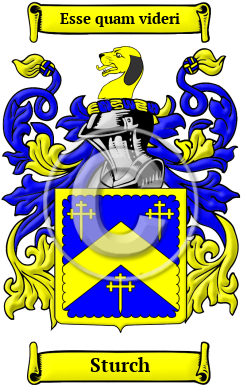
| ![Show Contents]() Sturch History, Family Crest & Coats of Arms Sturch History, Family Crest & Coats of Arms
- Origins Available:
England
Etymology of SturchWhat does the name Sturch mean? The Sturch name is said to be derived from the old Anglo-Saxon name "Styrgar" which appeared in Mercia in ancient times. "Styrgar" denoted a battle spear. Another source claims the name was derived from "the name of an ancestor, 'the son of Thurgis or Turgis,' with prefixed 's'." 1 And another claims the name is from the Old Swedish "Thorgisl," meaning "Thor's hostage." 2 Early Origins of the Sturch familyThe surname Sturch was first found in Northamptonshire where they held a family seat. This Anglo-Saxon family name appears to have been undisturbed by the Norman invasion of 1066 A.D., retaining their estates in Northamptonshire. Clipston, their family seat, was not granted to one of the Norman nobles after the victory at Hastings, and remained the 'King's Land' according to the Domesday Book, 3 a survey taken by Duke William of Normandy in 1086 A.D. However, the aforementioned Domesday Book does list Hugo filius Turgisi as holding lands in Shropshire. 3 Other early entries include: Turgis Hy in Lincolnshire; Thurgis filius Owani in the Assize Rolls for Warwickshire in 1221; Henry Turgis in the Pipe Rolls for Wiltshire in 1210; Adam Thurgis in the Hundredorum Rolls for Bedfordshire in 1279; John Sturgys in the Feet of Fines for Cambridgeshire in 1353; Joan Sturge at Colchester in 1379; and Richard Sturges in London in 1481. 2 As noted, early rolls had a mix of the "T" and "S" prefix. The History of Norfolk includes: Thurgis le Caldccote, Norfolk, temp. King John; Thurgis (without surname), Lincolnshire; Turgeus de Gorton, Suffolk; Turgisius de Heredefeld, Kent; William Thurgys, Wiltshire; Adam Thurgis, Bedfordshire; and Richard Turgis, Wiltshire. 4 A century later the "S" had moved to the front of the name as seen in the Yorkshire Poll Tax Rolls of 1379: Johannes Sturgys; Johannes Sturgys, junior. 1 Early History of the Sturch familyThis web page shows only a small excerpt of our Sturch research. Another 116 words (8 lines of text) covering the years 1629, 1634, 1646, 1666 and 1785 are included under the topic Early Sturch History in all our PDF Extended History products and printed products wherever possible. Sturch Spelling VariationsSpelling variations of this family name include: Sturgis, Sturges, Sturgiss, Sturgess, Sturge, Sturch, Sturk and many more. Early Notables of the Sturch familyMore information is included under the topic Early Sturch Notables in all our PDF Extended History products and printed products wherever possible.
| Sturch migration to New Zealand | + |
Emigration to New Zealand followed in the footsteps of the European explorers, such as Captain Cook (1769-70): first came sealers, whalers, missionaries, and traders. By 1838, the British New Zealand Company had begun buying land from the Maori tribes, and selling it to settlers, and, after the Treaty of Waitangi in 1840, many British families set out on the arduous six month journey from Britain to Aotearoa to start a new life. Early immigrants include: Sturch Settlers in New Zealand in the 19th Century- Mrs. Mary Sturch (Starch), British settler travelling from Gravesend aboard the ship "Evening Star" arriving in Auckland, New Zealand in 1858 5
- Mr. Thomas Sturch (Starch), British settler travelling from Gravesend aboard the ship "Evening Star" arriving in Auckland, New Zealand in 1858 5
- Mr. John Sturch (Starch), British settler travelling from Gravesend aboard the ship "Evening Star" arriving in Auckland, New Zealand in 1858 5
| Contemporary Notables of the name Sturch (post 1700) | + |
- William Sturch (1753-1838), English theological writer, born at Newport, Isle of Wight, great-grandson of William Sturch (d. 1728), a general Baptist minister in London
The motto was originally a war cry or slogan. Mottoes first began to be shown with arms in the 14th and 15th centuries, but were not in general use until the 17th century. Thus the oldest coats of arms generally do not include a motto. Mottoes seldom form part of the grant of arms: Under most heraldic authorities, a motto is an optional component of the coat of arms, and can be added to or changed at will; many families have chosen not to display a motto.
Motto: Esse quam videri
Motto Translation: To be, rather than to seem.
- Bardsley, C.W, A Dictionary of English and Welsh Surnames: With Special American Instances. Wiltshire: Heraldry Today, 1901. Print. (ISBN 0-900455-44-6)
- Reaney, P.H and R.M. Wilson, A Dictionary of English Surnames. London: Routledge, 1991. Print. (ISBN 0-415-05737-X)
- Williams, Dr Ann. And G.H. Martin, Eds., Domesday Book A Complete Translation. London: Penguin, 1992. Print. (ISBN 0-141-00523-8)
- Rye, Walter, A History of Norfolk. London: Elliot Stock, 62, Paternoster Row, 1885. Print
- New Zealand Yesteryears Passenger Lists 1800 to 1900 (Retrieved 17th October 2018). Retrieved from http://www.yesteryears.co.nz/shipping/passlist.html
 |