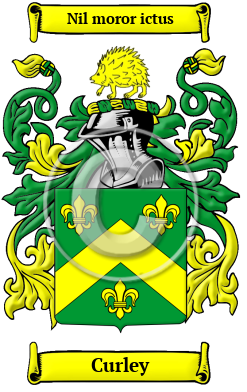
| ![Show Contents]() Curley History, Family Crest & Coats of Arms Curley History, Family Crest & Coats of Arms
Etymology of CurleyWhat does the name Curley mean? Curley is a name of ancient Norman origin. It arrived in England with the Norman Conquest of 1066. The Curley family lived at Kirkley, a township in the parish of Poneteland in the county of Northumberland. The family name Curley became popular in England after the Norman Conquest, when William the Conqueror gave his friends and relatives most of the land formerly owned by Anglo-Saxon aristocrats. An early roll lists John de Curli of England, 1199 and this source presumes the name is from Thomas de Curleio in Normandy, 1198. 1 Another source postulates the name means "dweller near Curley (bend or turn in the road), in Scotland; one who came from Curley, in France; one who had curly hair." 2 Early Origins of the Curley familyThe surname Curley was first found in Sussex where they held a family seat as Lords of the Manor of Ashburnham, anciently Esseborne. These estates, including three salt houses, were granted to Robert de Criel, a Norman Knight, by William, Duke of Normandy for his assistance at the Battle of Hastings in 1066 A.D., and is so noted in the Domesday Book, 3 a survey taken of landholders in England in 1086. Robert de Criel was from the Castle of Criel near Criel-sur-Mer in the arrondisement of Dieppe. Part of the walls of this huge castle are still standing, and there are also traces of a moat. Robert's chief tenant was the Count of Eu. 1 Early English rolls showed a wide variety of spellings in Latin and early English: Rannulf de Curleio was listed at Hinton, Hampshire c. 1110; Robert de Curli was found in the Pipe Rolls for Oxfordshire in 1190; William de Curly in the Feet of Fines for Warwickshire 1227-1228; Benedict le Curly in Staffordshire in 1271; and Thomas Curly in the Subsidy Rolls for Warwickshire in 1332. 4 Early History of the Curley familyThis web page shows only a small excerpt of our Curley research. Another 257 words (18 lines of text) covering the years 1086, 1295, 1339, 1489, 1575, 1628, 1629, 1632, 1637, 1647, 1678, 1679, 1724 and 1890 are included under the topic Early Curley History in all our PDF Extended History products and printed products wherever possible. Curley Spelling VariationsEndless spelling variations are a prevailing characteristic of Norman surnames. Old and Middle English lacked any definite spelling rules, and the introduction of Norman French added an unfamiliar ingredient to the English linguistic stew. French and Latin, the languages of the court, also influenced spellings. Finally, Medieval scribes generally spelled words according to how they sounded, so one person was often referred to by different spellings in different documents. The name has been spelled Crull, Crul, Cruel, Criel, Cryle, Kriel, Krile, Crile, Kirle, Kyrle, Cyrle, Kreel, Creel, Crulle, Crule, Curl, Curle, Girl, Cryll and many more. Early Notables of the Curley familyWalter Curle (Curll) (1575-1647), an English bishop, a close supporter of William Laud, Bishop of Rochester in 1628, Bishop of Bath and Wells from 1629 to 1632; John Kirle, High Sheriff of Herefordshire...
Another 32 words (2 lines of text) are included under the topic Early Curley Notables in all our PDF Extended History products and printed products wherever possible. Curley RankingIn the United States, the name Curley is the 2,518th most popular surname with an estimated 12,435 people with that name. 5 Migration of the Curley family to IrelandSome of the Curley family moved to Ireland, but this topic is not covered in this excerpt.
Another 59 words (4 lines of text) about their life in Ireland is included in all our PDF Extended History products and printed products wherever possible.
| Curley migration to the United States | + |
To escape the political and religious persecution within England at the time, many English families left for the various British colonies abroad. The voyage was extremely difficult, though, and the cramped, dank ships caused many to arrive in the New World diseased and starving. But for those who made it, the trip was most often worth it. Many of the families who arrived went on to make valuable contributions to the emerging nations of Canada and the United States. An inquiry into the early roots of North American families reveals a number of immigrants bearing the name Curley or a variant listed above:
Curley Settlers in United States in the 17th Century- Alice Curley, who arrived in Virginia in 1636 6
- Charles Curley who settled in America in 1654
Curley Settlers in United States in the 19th Century- James Curley, who landed in Maryland in 1822 6
- Margaret Curley, aged 30, who landed in New York, NY in 1849 6
- Israel Curley, who landed in San Francisco, California in 1850 6
- William M Curley, who arrived in San Francisco, California in 1850 6
- P Curley, who arrived in San Francisco, California in 1851 6
- ... (More are available in all our PDF Extended History products and printed products wherever possible.)
| Curley migration to Canada | + |
Curley Settlers in Canada in the 19th Century- Owen Curley, aged 24, a labourer, who arrived in Saint John, New Brunswick in 1834 aboard the ship "Edwin" from Dublin, Ireland
- Rose Curley, aged 21, who arrived in Saint John, New Brunswick in 1834 aboard the ship "Edwin" from Dublin, Ireland
- Patrick Curley, aged 23, a labourer, who arrived in Saint John, New Brunswick in 1834 aboard the brig "Trafalgar" from Galway, Ireland
- Miss. Ellen Curley, aged 1 who was emigrating through Grosse Isle Quarantine Station, Quebec aboard the ship "Yorkshire" departing 9th June 1847 from Liverpool, England; the ship arrived on 10th August 1847 but she died on board 7
- Mr. James Curley who was emigrating through Grosse Isle Quarantine Station, Quebec aboard the ship "Junior" departing 10th May 1847 from Liverpool, England; the ship arrived on 3rd July 1847 but he died on board 7
- ... (More are available in all our PDF Extended History products and printed products wherever possible.)
| Curley migration to Australia | + |
Curley Settlers in Australia in the 19th Century- Miss Mary Curley, (b. 1793), aged 20, Irish convict who was convicted in Dublin, Ireland for 7 years, transported aboard the "Catherine" on 8th December 1813, arriving in New South Wales, Australia 8
- Mr. James Curley, (b. 1778), aged 37, British labourer, born in Hampshire, England who was convicted in St Johns, Newfoundland, Canada for life, transported aboard the "Baring" in April 1815, arriving in New South Wales, Australia 9
- Miss Margaret Curley, (b. 1810), aged 20, Irish nurse girl who was convicted in Westmeath, Ireland for 7 years for stealing, transported aboard the "Forth II" on 3rd June 1830, arriving in New South Wales, Australia 10
- Mr. John Curley, (Carley), (b. 1814), aged 24, Irish labourer who was convicted in County Offaly (King's County), Ireland for 7 years for stealing, transported aboard the "Clyde" on 11th May 1838, arriving in New South Wales, Australia 11
- Mr. William Curley, British Convict who was convicted in London, England for 10 years, transported aboard the "Asiatic" on 26th May 1843, arriving in Tasmania (Van Diemen's Land) 12
- ... (More are available in all our PDF Extended History products and printed products wherever possible.)
| Curley migration to New Zealand | + |
Emigration to New Zealand followed in the footsteps of the European explorers, such as Captain Cook (1769-70): first came sealers, whalers, missionaries, and traders. By 1838, the British New Zealand Company had begun buying land from the Maori tribes, and selling it to settlers, and, after the Treaty of Waitangi in 1840, many British families set out on the arduous six month journey from Britain to Aotearoa to start a new life. Early immigrants include: Curley Settlers in New Zealand in the 19th Century- Mr. Michael Curley, British settler, as the 2nd Detachment of New Zealand Corps of Royal New Zealand Fencibles travelling from Gravesend aboard the ship "Minerva" arriving in Auckland, New Zealand on 8th October 1847 13
- Daniel Curley, aged 20, who arrived in Wellington, New Zealand aboard the ship "Strathnaver" in 1874
- Mary Curley, aged 16, a housekeeper, who arrived in Wellington, New Zealand aboard the ship "Arawa" in 1884
| Contemporary Notables of the name Curley (post 1700) | + |
- Thomas "Tom" Curley (b. 1948), American journalist appointed President of the Associated Press, the world's largest news organization in 2003
- Carlo Curley (b. 1952), American classical concert organist
- Walter Joseph Patrick Curley (b. 1922), United States Ambassador to France from 1989 to 1993 and the United States Ambassador to Ireland from 1975 to 1977
- James Michael Curley (1874-1958), American political leader, mayor of Boston, Governor of Massachusetts
- Michael Joseph Curley (1879-1947), American who was the 10th Archbishop of Baltimore and first Archbishop of Washington
- Gerald M. Curley, American Democratic Party politician, Candidate in primary for Michigan State Senate 5th District, 1966 14
- George F. Curley, American Democratic Party politician, Alternate Delegate to Democratic National Convention from New York, 1952 15
- Edward Walter Curley (1873-1940), American Democratic Party politician, U.S. Representative from New York 22nd District, 1935-40 15
- Charles F. Curley, American Democratic Party politician, U.S. Attorney for Delaware, 1916-20; Delegate to Democratic National Convention from Delaware, 1928 15
- ... (Another 22 notables are available in all our PDF Extended History products and printed products wherever possible.)
| Historic Events for the Curley family | + |
- Miss Alice Curley, American 3rd Class passenger from New York, New York, USA, who sailed aboard the RMS Lusitania (1915) and died in the sinking 15
The motto was originally a war cry or slogan. Mottoes first began to be shown with arms in the 14th and 15th centuries, but were not in general use until the 17th century. Thus the oldest coats of arms generally do not include a motto. Mottoes seldom form part of the grant of arms: Under most heraldic authorities, a motto is an optional component of the coat of arms, and can be added to or changed at will; many families have chosen not to display a motto.
Motto: Nil moror ictus
Motto Translation: I do not care for blows.
- The Norman People and Their Existing Descendants in the British Dominions and the United States Of America. Baltimore: Genealogical Publishing, 1975. Print. (ISBN 0-8063-0636-X)
- Smith, Eldson Coles, New Dictionary of American Family Names New York: Harper & Row, 1956. Print
- Williams, Dr Ann. And G.H. Martin, Eds., Domesday Book A Complete Translation. London: Penguin, 1992. Print. (ISBN 0-141-00523-8)
- Reaney, P.H and R.M. Wilson, A Dictionary of English Surnames. London: Routledge, 1991. Print. (ISBN 0-415-05737-X)
- "What are the 5,000 Most Common Last Names in the U.S.?". NameCensus.com, https://namecensus.com/last-names/
- Filby, P. William, Meyer, Mary K., Passenger and immigration lists index : a guide to published arrival records of about 500,000 passengers who came to the United States and Canada in the seventeenth, eighteenth, and nineteenth centuries. 1982-1985 Cumulated Supplements in Four Volumes Detroit, Mich. : Gale Research Co., 1985, Print (ISBN 0-8103-1795-8)
- Charbonneau, André, and Doris Drolet-Dubé. A Register of Deceased Persons at Sea and on Grosse Île in 1847. The Minister of Canadian Heritage, 1997. ISBN: 0-660-198/1-1997E (p. 72)
- Convict Records of Australia (Retreived 2nd January 2021, retreived from https://convictrecords.com.au/ships/catherine
- Convict Records Voyages to Australia (Retrieved 16th September 2020). Retrieved from https://convictrecords.com.au/ships/baring
- Convict Records Voyages to Australia (Retrieved 24th October 2022). https://convictrecords.com.au
- Convict Records Voyages to Australia (Retrieved 24th February 2021). Retrieved from https://convictrecords.com.au/ships/clyde
- Convict Records Voyages to Australia (Retrieved 14th July 2020). Retrieved from https://convictrecords.com.au/ships/asiatic
- New Zealand Yesteryears Passenger Lists 1800 to 1900 (Retrieved 17th October 2018). Retrieved from http://www.yesteryears.co.nz/shipping/passlist.html
- The Political Graveyard: Alphabetical Name Index. (Retrieved 2015, October 28) . Retrieved from http://politicalgraveyard.com/alpha/index.html
- Lusitania Passenger List - The Lusitania Resource. (Retrieved 2014, March 7) . Retrieved from http://www.rmslusitania.info/lusitania-passenger-list/
 |