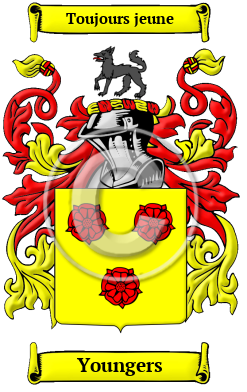
| ![Show Contents]() Youngers History, Family Crest & Coats of Arms Youngers History, Family Crest & Coats of Arms
Etymology of YoungersWhat does the name Youngers mean? The name Youngers comes from a name for a person who was very young, from the Old English word yong and yung and was first bestowed on the younger of two bearers of the same personal name, usually a son who was named for his father. Early Origins of the Youngers familyThe surname Youngers was first found in Essex, where the first record of the name appears in the Anglo-Saxon Chronicle as Wilfer seo lunga in 744. Many years later Walter Yonge was listed in the Subsidy Rolls for Sussex in 1296. 1 Another reference lists Hugh le Yunge in the Hundredorum Rolls of 1273 as residing in Oxfordshire. The same rolls list Ralph le Younge in Staffordshire and later William le Yunge in Northumberland during the reign of Edward I. 2 Down in Devon, Honiton was "for a long period it was very much of a family borough. Members of the Yonge family sat almost continuously from 1640 to 1796." 3 Early History of the Youngers familyThis web page shows only a small excerpt of our Youngers research. Another 117 words (8 lines of text) covering the years 1271, 1400, 1405, 1407, 1411, 1413, 1414, 1423, 1425, 1426, 1437, 1455, 1463, 1466, 1467, 1476, 1500, 1516, 1526, 1579, 1603, 1642, 1646, 1649, 1660, 1663, 1721, 1860, 1868 and 1890 are included under the topic Early Youngers History in all our PDF Extended History products and printed products wherever possible. Youngers Spelling VariationsUntil quite recently, the English language has lacked a definite system of spelling rules. Consequently, Anglo-Saxon surnames are characterized by a multitude of spelling variations. Changes in Anglo-Saxon names were influenced by the evolution of the English language, as it incorporated elements of French, Latin, and other languages. Although Medieval scribes and church officials recorded names as they sounded, so it is common to find one person referred to by several different spellings of his surname, even the most literate people varied the spelling of their own names. Variations of the name Youngers include Young, Younge, Yonge, Youngson and others. Early Notables of the Youngers familyJames Yonge (fl. 1423), English translator who belonged to an English family settled in the Irish pale. William Yonge, Archdeacon of Meath from 1407 to 1437, was possibly his brother. "James Yonge was in prison in Trim Castle from January to October 1423, being removed in the latter month to Dublin Castle, and being pardoned on 10 May 1425. A John Yonge was serjeant of the county of Limerick in the reign of Richard II, held a lease of various lands, and was convicted of unspecified felonies. " 4
Thomas Yonge (1405?-1476), was an English judge, born about 1405, the elder son...
Another 135 words (10 lines of text) are included under the topic Early Youngers Notables in all our PDF Extended History products and printed products wherever possible. Migration of the Youngers family to IrelandSome of the Youngers family moved to Ireland, but this topic is not covered in this excerpt.
Another 121 words (9 lines of text) about their life in Ireland is included in all our PDF Extended History products and printed products wherever possible. Migration of the Youngers familySearching for a better life, many English families migrated to British colonies. Unfortunately, the majority of them traveled under extremely harsh conditions: overcrowding on the ships caused the majority of the immigrants to arrive diseased, famished, and destitute from the long journey across the ocean. For those families that arrived safely, modest prosperity was attainable, and many went on to make invaluable contributions to the development of the cultures of the new colonies. Research into the origins of individual families in North America revealed records of the immigration of a number of people bearing the name Youngers or a variant listed above: Richard Young and his wife, who settled in Virginia in 1623; as did Edward and Jane Young in 1636; Joseph and Margaret Young, who immigrated to New England with their two sons in 1635.
The motto was originally a war cry or slogan. Mottoes first began to be shown with arms in the 14th and 15th centuries, but were not in general use until the 17th century. Thus the oldest coats of arms generally do not include a motto. Mottoes seldom form part of the grant of arms: Under most heraldic authorities, a motto is an optional component of the coat of arms, and can be added to or changed at will; many families have chosen not to display a motto.
Motto: Toujours jeune
Motto Translation: Always young.
- Reaney, P.H and R.M. Wilson, A Dictionary of English Surnames. London: Routledge, 1991. Print. (ISBN 0-415-05737-X)
- Bardsley, C.W, A Dictionary of English and Welsh Surnames: With Special American Instances. Wiltshire: Heraldry Today, 1901. Print. (ISBN 0-900455-44-6)
- Worth, R.N., A History of Devonshire London: Elliot Stock, 62, Paternoster Row, E.G., 1895. Digital
- Smith, George (ed), Dictionary of National Biography. London: Smith, Elder & Co., 1885-1900. Print
 |