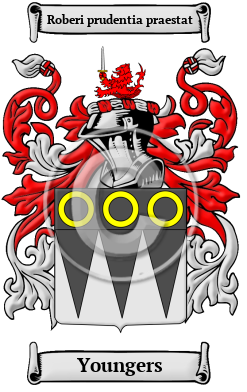
| ![Show Contents]() Youngers History, Family Crest & Coats of Arms Youngers History, Family Crest & Coats of Arms
Etymology of YoungersWhat does the name Youngers mean? The history of the name Youngers begins in the Scottish/English Borderlands with a family of Strathclyde-Briton ancestry. It is a name for a person who was very young, from the Old English word yong and yung. Alternatively, it could be "a personal name the same in meaning with Gaelic Og, 'young.' " 1 Early Origins of the Youngers familyThe surname Youngers was first found in the Borderlands between Scotland and England. The name was first borne in this region by a Strathclyde-Briton family, as revealed in records dating back to the 13th century. "Its centre in the north is in Northumberland and Durham. Over a large part of Scotland, but especially south of the Forth and the Clyde, Young is numerously to be found." 2 One of the earliest records of the family was in the Latin form of the name (typical of the time): "Malmor dictus Juvenis and Ade dictus Juvenis were assizers at Dumbarton in 1271." 1 Years later, John Yong de Dyngvale witnessed a charter by the earl of Ross to Reginald, son of Roderick of the Isles, in 1342 and one year later, Symone Yong was burgess of Elgin in 1343. Early History of the Youngers familyThis web page shows only a small excerpt of our Youngers research. Another 173 words (12 lines of text) covering the years 1342, 1343, 1376, 1413, 1428, 1439, 1446, 1449, 1462, 1587, 1655, 1671, 1679, 1683, 1684, 1699, 1762, 1765, 1860, 1868 and 1890 are included under the topic Early Youngers History in all our PDF Extended History products and printed products wherever possible. Youngers Spelling VariationsMedieval Scottish names are rife with spelling variations. This is due to the fact that scribes in that era spelled according to the sound of words, rather than any set of rules. Youngers has been spelled Young, Younge, Yonge, Yong, Yung, Youngson and others. Early Notables of the Youngers familyThomas Young (1587-1655), Scottish theologian; Alexander Young (died 1684), a Scottish prelate, Bishop of Edinburgh (1671-1679), and Bishop of Ross (1679-1684); and Edward Young (1683-1765), English poet.
Elizabeth Younger (1699?-1762), was a Scottish actress, called indifferently on the stage at the outset Miss and Mrs. Younger, was the daughter of James...
Another 50 words (4 lines of text) are included under the topic Early Youngers Notables in all our PDF Extended History products and printed products wherever possible. Migration of the Youngers family to IrelandSome of the Youngers family moved to Ireland, but this topic is not covered in this excerpt.
Another 119 words (8 lines of text) about their life in Ireland is included in all our PDF Extended History products and printed products wherever possible. Migration of the Youngers familyMany Scots were left with few options other than to leave their homeland for the colonies across the Atlantic. Some of these families fought to defend their newfound freedom in the American War of Independence. Others went north to Canada as United Empire Loyalists. The ancestors of all of these families have recently been able to rediscover their roots through Clan societies and other Scottish organizations. Among them: Richard Young and his wife, who settled in Virginia in 1623; as did Edward and Jane Young in 1636; Joseph and Margaret Young, who immigrated to New England with their two sons in 1635.
The motto was originally a war cry or slogan. Mottoes first began to be shown with arms in the 14th and 15th centuries, but were not in general use until the 17th century. Thus the oldest coats of arms generally do not include a motto. Mottoes seldom form part of the grant of arms: Under most heraldic authorities, a motto is an optional component of the coat of arms, and can be added to or changed at will; many families have chosen not to display a motto.
Motto: Roberi prudentia praestat
Motto Translation: Prudence excels strength.
- Black, George F., The Surnames of Scotland Their Origin, Meaning and History. New York: New York Public Library, 1946. Print. (ISBN 0-87104-172-3)
- Guppy, Henry Brougham, Homes of Family Names in Great Britain. 1890. Print.
 |