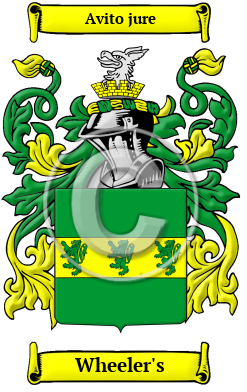
| ![Show Contents]() Wheeler's History, Family Crest & Coats of Arms Wheeler's History, Family Crest & Coats of Arms
Etymology of Wheeler'sWhat does the name Wheeler's mean? The many generations and branches of the Wheeler's family can all place the origins of their surname with the ancient Anglo-Saxon culture. Their name reveals that an early member worked as a wheelwright. In medieval times wheels were wooden and quite fragile and high maintenance. Thus there was a high demand for both wheels and skilled people to make and repair them. 1 "The name of Houelleur which means 'charron' [cartwright] in English, is as common, at least in the Cotentin, as that of Carron or Charron. I imagine that it was introduced into Normandy during the thirty-two years' occupation of this country by the English. " 2 Accordingly, the Magni Rotuli Scaccarii Normanniae lists Osmondus Huielor, Normandy 1198; William and Roger Huelier, 1180-95. 3 Early Origins of the Wheeler's familyThe surname Wheeler's was first found in Worcestershire where they held a family seat from ancient times, before and after the Norman Conquest in 1066, at Martin Hussingtree. The Hundredorum Rolls of 1273 has only one listing for the family: Hugh le Welere, Cambridgeshire. 1 Kirby's Quest lists "William Wheler, Somerset, 1 Edward III. [during the first year's reign of King Edward III] " 4 Early History of the Wheeler's familyThis web page shows only a small excerpt of our Wheeler's research. Another 100 words (7 lines of text) covering the years 1591, 1601, 1603, 1604, 1608, 1615, 1620, 1642, 1647, 1648, 1650, 1656, 1664, 1683, 1686, 1691, 1694, 1723 and 1727 are included under the topic Early Wheeler's History in all our PDF Extended History products and printed products wherever possible. Wheeler's Spelling VariationsBefore the last few hundred years, the English language had no fast system of spelling rules. For that reason, spelling variations are commonly found in early Anglo-Saxon surnames. Over the years, many variations of the name Wheeler's were recorded, including Wheeler, Wheler, Wheller and others. Early Notables of the Wheeler's familyJohn Wheeler (fl. 1601-1608), secretary of the Merchant Adventurers' Company, was probably born at Great Yarmouth. "He may be identical with the John Wheeler who in 1615 was admitted to the East India Company. " 5 Thomas Wheeler (c.1620-1686), was an English-born, American settler in 1642 and colonial soldier of the Massachusetts Bay Colony. Maurice Wheeler (1648?-1727), was an English divine and almanac-maker, born in 1647 or 1648, the son of Maurice Wheeler 'plebeius,'...
Another 73 words (5 lines of text) are included under the topic Early Wheeler's Notables in all our PDF Extended History products and printed products wherever possible. Migration of the Wheeler's family to IrelandSome of the Wheeler's family moved to Ireland, but this topic is not covered in this excerpt.
Another 41 words (3 lines of text) about their life in Ireland is included in all our PDF Extended History products and printed products wherever possible. Migration of the Wheeler's familyTo escape oppression and starvation at that time, many English families left for the "open frontiers" of the New World with all its perceived opportunities. In droves people migrated to the many British colonies, those in North America in particular, paying high rates for passages in cramped, unsafe ships. Although many of the settlers did not make the long passage alive, those who did see the shores of North America perceived great opportunities before them. Many of the families that came from England went on to make essential contributions to the emerging nations of Canada and the United States. Research into various historical records revealed some of first members of the Wheeler's family emigrate to North America: Joseph Wheeler who settled in New England in 1630; Mercy Wheeler, who settled in Massachusetts in 1633; Henry Wheeler, who settled in Virginia in 1623.
The motto was originally a war cry or slogan. Mottoes first began to be shown with arms in the 14th and 15th centuries, but were not in general use until the 17th century. Thus the oldest coats of arms generally do not include a motto. Mottoes seldom form part of the grant of arms: Under most heraldic authorities, a motto is an optional component of the coat of arms, and can be added to or changed at will; many families have chosen not to display a motto.
Motto: Avito jure
Motto Translation: By ancestral right.
- Bardsley, C.W, A Dictionary of English and Welsh Surnames: With Special American Instances. Wiltshire: Heraldry Today, 1901. Print. (ISBN 0-900455-44-6)
- Lower, Mark Anthony, Patronymica Britannica, A Dictionary of Family Names of the United Kingdom. London: John Russel Smith, 1860. Print.
- The Norman People and Their Existing Descendants in the British Dominions and the United States Of America. Baltimore: Genealogical Publishing, 1975. Print. (ISBN 0-8063-0636-X)
- Dickinson, F.H., Kirby's Quest for Somerset of 16th of Edward the 3rd London: Harrison and Sons, Printers in Ordinary to Her Majesty, St, Martin's Lane, 1889. Print.
- Smith, George (ed), Dictionary of National Biography. London: Smith, Elder & Co., 1885-1900. Print
 |