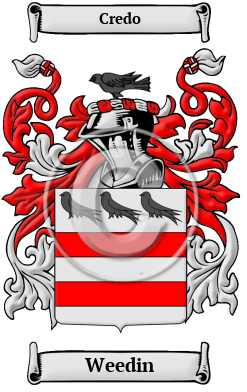
| ![Show Contents]() Weedin History, Family Crest & Coats of Arms Weedin History, Family Crest & Coats of Arms
- Origins Available:
England
Etymology of WeedinWhat does the name Weedin mean? The history of the Weedin family name begins after the Norman Conquest of 1066. They lived in Buckinghamshire, on Whielden Lane, Amersham. Today Weedon is a village and also a civil parish within Aylesbury Vale district to the north of Aylesbury and south of Hardwick in Buckinghamshire. Early Origins of the Weedin familyThe surname Weedin was first found in Northamptonshire where they held a family seat at two villages called Weedon Beck and Weedon Lois. They held these lands from the Count of Mortain, and were conjecturally descended from Hugh of Grand Mesnil in Normandy. The poet, Dame Edith Sitwell, is buried in the village. Early rolls give a glimpse of the many spellings in use at the time. Robert de Wedonia was listed in Northamptonshire c. 1160. In Berkshire Ralph de Wedon was listed there in 1207 and the Feet of Fines for Warwickshire included an entry for William Wedon 1396-1397. 1 The root name was found in the Hundredorum Rolls for Dorset in 1273 as William Wede. William le Weed was found in the Subsidy Rolls for Sussex in 1296. 1 Another source notes the Hundredorum Rolls include: John de Wedon, Buckinghamshire; and Ralph de Wedone, Bedfordshire. 2 The Testa de Nevill, sive Liber Feodorum, temp. Henry III-Edward I. includes an entry for Nicholas de Wedon, Nottinghamshire, Henry III-Edward I. 3 Early History of the Weedin familyThis web page shows only a small excerpt of our Weedin research. Another 109 words (8 lines of text) covering the years 1582, 1606, 1608, 1611, 1612, 1734, 1777 and 1793 are included under the topic Early Weedin History in all our PDF Extended History products and printed products wherever possible. Weedin Spelling VariationsAnglo-Norman names are characterized by a multitude of spelling variations. When the Normans became the ruling people of England in the 11th century, they introduced a new language into a society where the main languages of Old and later Middle English had no definite spelling rules. These languages were more often spoken than written, so they blended freely with one another. Contributing to this mixing of tongues was the fact that medieval scribes spelled words according to sound, ensuring that a person's name would appear differently in nearly every document in which it was recorded. The name has been spelled Weedon, Weeden, Weeton, Weton, Wedon and others. Early Notables of the Weedin familyGeorge Weedon (1734-1793), American soldier during the Revolutionary War from Fredericksburg, Colony of Virginia. He served as a lieutenant under George Washington in the French and Indian War...
Another 27 words (2 lines of text) are included under the topic Early Weedin Notables in all our PDF Extended History products and printed products wherever possible. Migration of the Weedin familyFor many English families, the political and religious disarray that plagued their homeland made the frontiers of the New World an attractive prospect. Thousands migrated, aboard cramped disease-ridden ships. They arrived sick, poor, and hungry, but were welcomed in many cases with far greater opportunity than at home in England. Many of these hardy settlers went on to make important contributions to the emerging nations in which they landed. Among early immigrants bearing the name Weedin or a variant listed above were: James Weedon settled in Newport, R.I. in 1630; along with William; Isaac Weedon settled in Virginia in 1720; Jane Weedon settled in Maryland in 1720; James Weedon settled in New England in 1755..
The motto was originally a war cry or slogan. Mottoes first began to be shown with arms in the 14th and 15th centuries, but were not in general use until the 17th century. Thus the oldest coats of arms generally do not include a motto. Mottoes seldom form part of the grant of arms: Under most heraldic authorities, a motto is an optional component of the coat of arms, and can be added to or changed at will; many families have chosen not to display a motto.
Motto: Credo
Motto Translation: I Believe.
- Reaney, P.H and R.M. Wilson, A Dictionary of English Surnames. London: Routledge, 1991. Print. (ISBN 0-415-05737-X)
- Bardsley, C.W, A Dictionary of English and Welsh Surnames: With Special American Instances. Wiltshire: Heraldry Today, 1901. Print. (ISBN 0-900455-44-6)
- Testa de Nevill or "Liber Feodorum" or "Book of Fees," thought to have been written by Ralph de Nevill, for King John (1199–1216)
 |