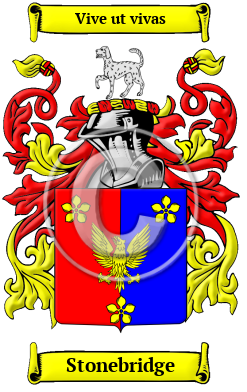
| ![Show Contents]() Stonebridge History, Family Crest & Coats of Arms Stonebridge History, Family Crest & Coats of Arms
Etymology of StonebridgeWhat does the name Stonebridge mean? The illustrious surname Stonebridge finds its origin in the rocky, sea swept coastal area of southwestern England known as Cornwall. Although surnames were fairly widespread in medieval England, people were originally known only by a single name. The process by which hereditary surnames were adopted is extremely interesting. As populations grew, people began to assume an extra name to avoid confusion and to further identify themselves. Under the Feudal System of government, surnames evolved and they often reflected life on the manor and in the field. Lords and their tenants often became known by the name of the feudal territory they owned or lived on. Unlike most Celtic peoples, who favored patronymic names, the Cornish predominantly used local surnames. This was due to the heavy political and cultural influence of the English upon the Cornish People at the time that surnames first came into use. Local surnames were derived from where a person lived, held land, or was born. While many Cornish surnames of this sort appear to be topographic surnames, which were given to people who resided near physical features such as hills, streams, churches, or types of trees, many are actually habitation surnames derived from lost or unrecorded place names. The name Stonebridge is a local type of surname and the Stonebridge family lived in Cornwall. Their name, however, is derived from the Old English word stan, meaning stone, and indicates that the original bearer lived near a prominent stone. 1 2 Early Origins of the Stonebridge familyThe surname Stonebridge was first found in the Hundredorum Rolls of 1273 which include the following early entries for the family: Warin de la Stane, Devon; Reginald ad Stone, Bedfordshire; and John de la Stone, Sussex, while the Yorkshire Poll Tax Rolls of 1379 included: Johannes del Stone; Robertus del Stones; and Elena de Stons. 3 Other early rolls point to the diverse spellings and the many places the family held: Robert Ston was found in the Curia Regis Rolls for Oxfordshire in 1212; Roger del ston found at Ely, Suffolk in 1277; Robert atte Stone in the Subsidy Rolls for Sussex in 1296; Elias atte Stonis in the Subsidy Rolls for Suffolk in 1327; John in le Stones in the Subsidy Rolls for Staffordshire in 1332; William del stones in 1348; and Richard de Stone in the Subsidy Rolls for Worcestershire in 1275. 4 "Excepting its establishment in Derbyshire, this name is mostly restricted to the south of England and is especially at home in Berks and Bucks, and in the south - western counties of Somerset, Dorset, and Devon. It has probably in most cases a local origin, as in Somerset, Bucks, Kent, etc., where there are parishes and villages thus called." 5 Some of the family ventured into Scotland where the name was "probably of English origin. Thomas de Stone of Roxburghshire rendered homage [to King Edward I of England] in 1296. Thomas de Stone was common councillor of Aberdeen, 1435." 6 Early History of the Stonebridge familyThis web page shows only a small excerpt of our Stonebridge research. Another 112 words (8 lines of text) covering the years 1296, 1417, 1586, 1602, 1603, 1630, 1633, 1639, 1642, 1647, 1648, 1651, 1661, 1663, 1743 and 1787 are included under the topic Early Stonebridge History in all our PDF Extended History products and printed products wherever possible. Stonebridge Spelling VariationsCornish surnames are characterized by a multitude of spelling variations. The frequent changes in surnames are due to the fact that the Old and Middle English languages lacked definite spelling rules. The official court languages, which were Latin and French, were also influential on the spelling of a surname. Since the spelling of surnames was rarely consistent in medieval times, and scribes and church officials recorded names as they sounded rather than adhering to any specific spelling rules, it was common to find the same individual referred to with different spellings of their surname in the ancient chronicles. Moreover, a large number of foreign names were brought into England, which accelerated and accentuated the alterations to the spelling of various surnames. Lastly, spelling variations often resulted from the linguistic differences between the people of Cornwall and the rest of England. The Cornish spoke a unique Brythonic Celtic language which was first recorded in written documents during the 10th century. However, they became increasingly Anglicized, and Cornish became extinct as a spoken language in 1777, although it has been revived by Cornish patriots in the modern era. The name has been spelled Stone, Stoan and others. Early Notables of the Stonebridge familyGilbert Stone (d. 1417?), English medieval letter-writer, born at Stone in Staffordshire, whence he took his name.
Nicholas Stone (1586-1647), was an English mason, statuary, and architect, born at Woodbury, near Exeter, in 1586, the son of a quarryman.
Benjamin Stone (fl. 1630-1642), was an English sword-maker and enterprising cutler of London who about 1630 established on Hounslow Heath, on the site now occupied by Bedfont powder-mills, the earliest English sword factory of which anything is known. 7
Samuel Stone (1602-1663), was an English Puritan...
Another 81 words (6 lines of text) are included under the topic Early Stonebridge Notables in all our PDF Extended History products and printed products wherever possible. Migration of the Stonebridge family to IrelandSome of the Stonebridge family moved to Ireland, but this topic is not covered in this excerpt. More information about their life in Ireland is included in all our PDF Extended History products and printed products wherever possible.
| Stonebridge migration to New Zealand | + |
Emigration to New Zealand followed in the footsteps of the European explorers, such as Captain Cook (1769-70): first came sealers, whalers, missionaries, and traders. By 1838, the British New Zealand Company had begun buying land from the Maori tribes, and selling it to settlers, and, after the Treaty of Waitangi in 1840, many British families set out on the arduous six month journey from Britain to Aotearoa to start a new life. Early immigrants include: Stonebridge Settlers in New Zealand in the 19th Century- Miss Amelia Stonebridge, (b. 1826), aged 38, British housekeeper travelling from Gravesend, UK aboard the ship "British Empire" arriving in Lyttelton, South Island, New Zealand on 6th September 1864 8
| Contemporary Notables of the name Stonebridge (post 1700) | + |
- Brian Stonebridge (1928-1959), leading English motorcycle racer of the 1950s
- Ian Robert Stonebridge (b. 1981), English former professional footballer, member of the 1999 England U18 National Team
- Lyndsey Stonebridge FEA (b. 1965), British scholar and professor of Humanities and Human Rights at the University of Birmingham
| Historic Events for the Stonebridge family | + |
HMS Vanguard - Mr. Herbert Stonebridge (1889-1917), British from Lancashire, who was aboard the ship "HMS Vanguard" when she exploded in the Scapa Flow off the Orkney Islands, Scotland on 9th July 1917
The motto was originally a war cry or slogan. Mottoes first began to be shown with arms in the 14th and 15th centuries, but were not in general use until the 17th century. Thus the oldest coats of arms generally do not include a motto. Mottoes seldom form part of the grant of arms: Under most heraldic authorities, a motto is an optional component of the coat of arms, and can be added to or changed at will; many families have chosen not to display a motto.
Motto: Vive ut vivas
Motto Translation: Live that you may live for ever
- Harrison, Henry, Surnames of the United Kingdom: A Concise Etymological Dictionary Baltimore: Geneological Publishing Company, 2013. Print
- Smith, Eldson Coles, New Dictionary of American Family Names New York: Harper & Row, 1956. Print
- Bardsley, C.W, A Dictionary of English and Welsh Surnames: With Special American Instances. Wiltshire: Heraldry Today, 1901. Print. (ISBN 0-900455-44-6)
- Reaney, P.H and R.M. Wilson, A Dictionary of English Surnames. London: Routledge, 1991. Print. (ISBN 0-415-05737-X)
- Guppy, Henry Brougham, Homes of Family Names in Great Britain. 1890. Print.
- Black, George F., The Surnames of Scotland Their Origin, Meaning and History. New York: New York Public Library, 1946. Print. (ISBN 0-87104-172-3)
- Smith, George (ed), Dictionary of National Biography. London: Smith, Elder & Co., 1885-1900. Print
- New Zealand Yesteryears Passenger Lists 1800 to 1900 (Retrieved 17th October 2018). Retrieved from http://www.yesteryears.co.nz/shipping/passlist.html
 |