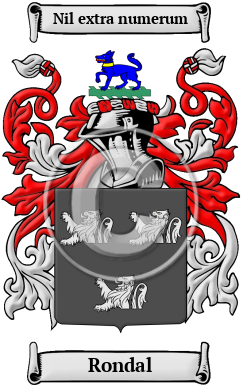
| ![Show Contents]() Rondal History, Family Crest & Coats of Arms Rondal History, Family Crest & Coats of Arms
Etymology of RondalWhat does the name Rondal mean? The Anglo-Saxon name Rondal comes from the baptismal name Randel. In this case the surname Rondal was a diminutive of the personal name Rand, a short form of various German names with the first element rand meaning shield or wolf. 1 Alternatively, the name was derived from the name of an ancestor as in 'the son of Randolph,' from the nickname Randle. As such, the earliest records of the family were as a forename as in Randle de Arclet, Cheshire, temp. 1290. 2 Early Origins of the Rondal familyThe surname Rondal was first found in the parish of Ladock in Cornwall. "Hay, which was formerly deemed a genteel residence, was successively a seat of the families of Randyll, Tregain, and Bone." 3 In Scotland, the name "occurs frequently in the Register of Cupar Abbey [near Coupar, Angus in central Scotland]. Amongst the tenants in Carse Grange are Ranalds, Ranaldsons, Randalsons and Randalls, or as it is sometimes given, Randal, Randale, Randell, Rendall. There were others about Perth in the days of the Reformation." 4 Early History of the Rondal familyThis web page shows only a small excerpt of our Rondal research. Another 159 words (11 lines of text) covering the years 1436, 1464, 1478, 1570, 1571, 1581, 1587, 1592, 1598, 1622, 1637, 1640, 1664, 1758, 1781, 1799, 1815, 1822 and 1856 are included under the topic Early Rondal History in all our PDF Extended History products and printed products wherever possible. Rondal Spelling VariationsOne relatively recent invention that did much to standardize English spelling was the printing press. However, before its invention even the most literate people recorded their names according to sound rather than spelling. The spelling variations under which the name Rondal has appeared include Randall, Rendle, Randal, Rendel, Rendell and others. Early Notables of the Rondal familyJohn Randall (1570-1622), English divine, born at Great Missenden, Buckinghamshire who was sent at the early age of eleven to St. Mary Hall, Oxford, where he matriculated on 27 Nov. 1581. He was elected a fellow of Lincoln College on 6 July 1587. "On the occasion of Queen Elizabeth's visit to Oxford, in August 1592, Randall was appointed to 'frame and oversee the stage for the academical performance given' in her honour." 5 William Randall (fl. 1598) was an English musician and is included by Meres in his list of England's 'excellente musitians.' John Rendle (1758-1815), divine, was born at Tiverton in...
Another 187 words (13 lines of text) are included under the topic Early Rondal Notables in all our PDF Extended History products and printed products wherever possible. Migration of the Rondal family to IrelandSome of the Rondal family moved to Ireland, but this topic is not covered in this excerpt.
Another 34 words (2 lines of text) about their life in Ireland is included in all our PDF Extended History products and printed products wherever possible. Migration of the Rondal familyAt this time, the shores of the New World beckoned many English families that felt that the social climate in England was oppressive and lacked opportunity for change. Thousands left England at great expense in ships that were overcrowded and full of disease. A great portion of these settlers never survived the journey and even a greater number arrived sick, starving, and without a penny. The survivors, however, were often greeted with greater opportunity than they could have experienced back home. These English settlers made significant contributions to those colonies that would eventually become the United States and Canada. An examination of early immigration records and passenger ship lists revealed that people bearing the name Rondal arrived in North America very early: Philip Randall, his wife and their three children, who arrived in Dorchester, MA in 1633; John Randall, who arrived in Virginia in 1635; Phillip and Robert Randall, who settled in Boston Massachusetts in 1639.
The motto was originally a war cry or slogan. Mottoes first began to be shown with arms in the 14th and 15th centuries, but were not in general use until the 17th century. Thus the oldest coats of arms generally do not include a motto. Mottoes seldom form part of the grant of arms: Under most heraldic authorities, a motto is an optional component of the coat of arms, and can be added to or changed at will; many families have chosen not to display a motto.
Motto: Nil extra numerum
Motto Translation: Nothing out of time.
- Smith, Eldson Coles, New Dictionary of American Family Names New York: Harper & Row, 1956. Print
- Bardsley, C.W, A Dictionary of English and Welsh Surnames: With Special American Instances. Wiltshire: Heraldry Today, 1901. Print. (ISBN 0-900455-44-6)
- Hutchins, Fortescue, The History of Cornwall, from the Earliest Records and Traditions to the Present Time. London: William Penaluna, 1824. Print
- Black, George F., The Surnames of Scotland Their Origin, Meaning and History. New York: New York Public Library, 1946. Print. (ISBN 0-87104-172-3)
- Smith, George (ed), Dictionary of National Biography. London: Smith, Elder & Co., 1885-1900. Print
 |