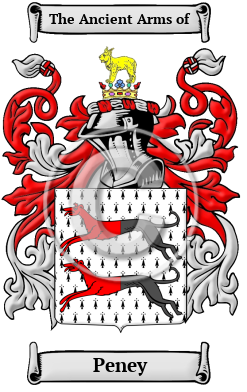
| ![Show Contents]() Peney History, Family Crest & Coats of Arms Peney History, Family Crest & Coats of Arms
Etymology of PeneyWhat does the name Peney mean? The origins of the Peney surname date back to the time of the Anglo-Saxon tribes of Britain. It comes from an early member of the family who was a someone as a personal name or literally derived from the coin. It was derived from the Old English "Penig," denoting a coin. The penny was the only unit of coinage in England until the early 14th century, and as such was a coin of considerable value. While the Saxon heritage is the generally accepted origin of this family, another source points to a possible Norman origin as the Magni Rotuli Scaccarii Normanniae lists Serlo Penné in Normandy in 1180-1195. 1 Early Origins of the Peney familyThe surname Peney was first found in Northampton where they held a family seat from very early times, and before the 12th century had become associated with London and had moved north into Scotland. Some of the first records of the family in Scotland include: Johannes Peny, a witness in Elgin in 1343; Mr. John Peny, a Scottish clerk, having a safe conduct in England in 1362; and a later John Peny who had a grant of the fulling mill of Ballernache in Perthshire in 1375. 2 Down in Lancashire, an ancient branch of the family was found. "The neat village of Penny-Bridge, so called perhaps from the British word Pen, 'the head,' was the seat of the family of Penny. The chapel, dedicated to the Blessed Virgin Mary, was built and endowed by William Penny, Esq., was consecrated in 1791." 3 The Hundredorum Rolls of 1273 included various early spellings in many counties: Hurtin Peni in Kent; Alexander Penny in Cambridgeshire; Agatha Peni in Oxfordshire; and Robert Peni in Kent. 4 Kirby's Quest listed Johanne Peny in Somerset, 1 Edward III (during the first year's reign of King Edward III.) 5 "In the reign of Anne, John Penny, Esq., lived at Charlton Musgrove, and at the same time a burgess of Glastonbury bore this name." 6 Early History of the Peney familyThis web page shows only a small excerpt of our Peney research. Another 150 words (11 lines of text) covering the years 1296, 1379, 1433, 1477, 1486, 1487, 1496, 1500, 1520, 1529, 1574, 1589, 1683 and 1890 are included under the topic Early Peney History in all our PDF Extended History products and printed products wherever possible. Peney Spelling VariationsThe first dictionaries that appeared in the last few hundred years did much to standardize the English language. Before that time, spelling variations in names were a common occurrence. The language was changing, incorporating pieces of other languages, and the spelling of names changed with it. Peney has been spelled many different ways, including Penny, Penney, Pennie, Penne and others. Early Notables of the Peney familyJohn Penny (d. 1520), English Bishop of Carlisle. He was educated at Lincoln College, Oxford, and at some unknown time became LL.D. of Cambridge. In 1477 he was a canon at the abbey of St. Mary de Pratis at...
Another 38 words (3 lines of text) are included under the topic Early Peney Notables in all our PDF Extended History products and printed products wherever possible. Migration of the Peney family to IrelandSome of the Peney family moved to Ireland, but this topic is not covered in this excerpt.
Another 70 words (5 lines of text) about their life in Ireland is included in all our PDF Extended History products and printed products wherever possible. Migration of the Peney familyThousands of English families in this era began to emigrate the New World in search of land and freedom from religious and political persecution. Although the passage was expensive and the ships were dark, crowded, and unsafe, those who made the voyage safely were rewarded with opportunities unavailable to them in their homeland. Research into passenger and immigration lists has revealed some of the very first Peneys to arrive in North America: George Penny who settled in Barbados in 1635; Charles Penny settled in Maryland in 1775; P. Penny settled in Boston Massachusetts in 1769; the family also settled in Pennsylvania in the 18th century. In Newfoundland, Benedict Penny inherited property in Carbonear which dated back to 1699.
- The Norman People and Their Existing Descendants in the British Dominions and the United States Of America. Baltimore: Genealogical Publishing, 1975. Print. (ISBN 0-8063-0636-X)
- Black, George F., The Surnames of Scotland Their Origin, Meaning and History. New York: New York Public Library, 1946. Print. (ISBN 0-87104-172-3)
- Lewis, Samuel, A Topographical Dictionary of England. Institute of Historical Research, 1848, Print.
- Bardsley, C.W, A Dictionary of English and Welsh Surnames: With Special American Instances. Wiltshire: Heraldry Today, 1901. Print. (ISBN 0-900455-44-6)
- Dickinson, F.H., Kirby's Quest for Somerset of 16th of Edward the 3rd London: Harrison and Sons, Printers in Ordinary to Her Majesty, St, Martin's Lane, 1889. Print.
- Guppy, Henry Brougham, Homes of Family Names in Great Britain. 1890. Print.
 |