| ![Show Contents]() Peacox History, Family Crest & Coats of Arms Peacox History, Family Crest & Coats of Arms
Etymology of PeacoxWhat does the name Peacox mean? Peacox is an ancient name dating from the times of the Anglo-Saxon tribes of Britain. It was a name for a person who was a peacock, a nickname used also as a personal name. 1 2 3 Or the name could denote a "dweller at the sign of the peacock; one with the qualities of a peacock." 4 While most sources agree on this etymology of the name, one source postulates the name could be from Peakirk, a parish, in the union and soke of Peterborough, N. division of the county of Northampton. 5 "St. Pega, in 714, settled here in a cell, afterwards converted by Edmund Atheling into a monastery, which, though twice destroyed by the Danes, existed till 1048: there are remains in the parish." 6 Early Origins of the Peacox familyThe surname Peacox was first found in Essex, where the name Pecoc was listed in the Domesday Book of 1086. 7 From this earliest record of the family, we move to Cornwall where Roger Paucoc was listed in the Pipe Rolls for 1194. Years later in Somerset, the Assize Rolls there listed Richard Pocock in 1225 and in Yorkshire, Simon Pacock was listed in the Subsidy Rolls for 1297. As a forename, Pecoc de Briminton was recorded in the Assize Rolls for Cheshire in 1285. Moving back to Essex, Robert Pecok (Paycock) was listed there in the Subsidy Rolls of 1327. 1 The Hundredorum Rolls of 1273 had three listings for the family: Geoffrey Pokoc, Cambridgeshire; Hugh Pokok, Oxfordshire; and Robert Pokoc, Lincolnshire. 8 In Somerset, Walter Pokok and Roger Pokok were listed there, 1 Edward III (during the first year of King Edward I's reign.) 9 The name was also found in Scotland where "a gift of six pennies annually was made from the toft of Roger Pacok in Annan in thirteenth century. Andreas Pacok was presbyter and notary public in the diocese of St. Andrews, 1311-1321, and the name appears frequently in the parish register of Dunfermline, 1561-1700, as Paycok (1564) and Paicok (1572). Thomas Pacok had grant of a third part of the land of Quhitfeilde in the barony of Lyntounrothrike in 1378, and another Thomas Pacok was presented to a chaplaincy in 1426. Andrew Pacock was notary public in Dunfermling, 1512, and George Pacok was witness in Linlithgow, 1536." 10 Early History of the Peacox familyThis web page shows only a small excerpt of our Peacox research. Another 229 words (16 lines of text) covering the years 1300, 1510, 1516, 1528, 1534, 1535, 1537, 1541, 1554, 1582, 1596, 1598, 1601, 1612, 1631, 1647, 1648, 1649, 1650, 1651, 1652, 1653, 1673, 1707, 1843 and 1890 are included under the topic Early Peacox History in all our PDF Extended History products and printed products wherever possible. Peacox Spelling VariationsUntil the dictionary, an invention of only the last few hundred years, the English language lacked any comprehensive system of spelling rules. Consequently, spelling variations in names are frequently found in early Anglo-Saxon and later Anglo-Norman documents. One person's name was often spelled several different ways over a lifetime. The recorded variations of Peacox include Peacock, Peacocke and others. Early Notables of the Peacox familyThomas Peacock (1516?-1582?), President of Queens' College, Cambridge, born at Cambridge, about 1516, was son of Thomas Peacock, burgess of Cambridge, whose will, dated 1528, was proved in the court of the archdeacon of Ely in 1541. He was admitted fellow of St. John's College, Cambridge, in 1534, and graduated B.A. 1534-1535, M.A. 1537, and B.D. 1554. " 11
James Peacock (d. 1653), was a Vice-Admiral who appears to have been a "merchant and sea captain, whose native place was Ipswich. He is first mentioned as captain of the Warwick frigate for the parliament, and commanding a squadron of ships-of-war in the...
Another 203 words (14 lines of text) are included under the topic Early Peacox Notables in all our PDF Extended History products and printed products wherever possible. Migration of the Peacox family to IrelandSome of the Peacox family moved to Ireland, but this topic is not covered in this excerpt.
Another 60 words (4 lines of text) about their life in Ireland is included in all our PDF Extended History products and printed products wherever possible. Migration of the Peacox familyThousands of English families boarded ships sailing to the New World in the hope of escaping the unrest found in England at this time. Although the search for opportunity and freedom from persecution abroad took the lives of many because of the cramped conditions and unsanitary nature of the vessels, the opportunity perceived in the growing colonies of North America beckoned. Many of the settlers who survived the journey went on to make important contributions to the transplanted cultures of their adopted countries. The Peacox were among these contributors, for they have been located in early North American records: Charles Peacock settled in Virginia in 1635; Mathew, Michael, Richard and Robert Peacock also settled in Virginia in the 17th century; Nathaniel Peacock settled in Virginia in 1606.
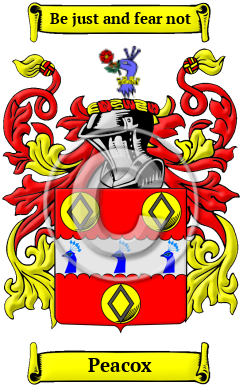
The motto was originally a war cry or slogan. Mottoes first began to be shown with arms in the 14th and 15th centuries, but were not in general use until the 17th century. Thus the oldest coats of arms generally do not include a motto. Mottoes seldom form part of the grant of arms: Under most heraldic authorities, a motto is an optional component of the coat of arms, and can be added to or changed at will; many families have chosen not to display a motto.
Motto: Be just and fear not
- Reaney, P.H and R.M. Wilson, A Dictionary of English Surnames. London: Routledge, 1991. Print. (ISBN 0-415-05737-X)
- Harrison, Henry, Surnames of the United Kingdom: A Concise Etymological Dictionary Baltimore: Geneological Publishing Company, 2013. Print
- Lower, Mark Anthony, Patronymica Britannica, A Dictionary of Family Names of the United Kingdom. London: John Russel Smith, 1860. Print.
- Smith, Eldson Coles, New Dictionary of American Family Names New York: Harper & Row, 1956. Print
- Barber, Henry, British Family Names London: Elliot Stock, 62 Paternoster Row, 1894. Print.
- Lewis, Samuel, A Topographical Dictionary of England. Institute of Historical Research, 1848, Print.
- Williams, Dr Ann. And G.H. Martin, Eds., Domesday Book A Complete Translation. London: Penguin, 1992. Print. (ISBN 0-141-00523-8)
- Bardsley, C.W, A Dictionary of English and Welsh Surnames: With Special American Instances. Wiltshire: Heraldry Today, 1901. Print. (ISBN 0-900455-44-6)
- Dickinson, F.H., Kirby's Quest for Somerset of 16th of Edward the 3rd London: Harrison and Sons, Printers in Ordinary to Her Majesty, St, Martin's Lane, 1889. Print.
- Black, George F., The Surnames of Scotland Their Origin, Meaning and History. New York: New York Public Library, 1946. Print. (ISBN 0-87104-172-3)
- Smith, George (ed), Dictionary of National Biography. London: Smith, Elder & Co., 1885-1900. Print
 |