| ![Show Contents]() Longs History, Family Crest & Coats of Arms Longs History, Family Crest & Coats of Arms
Etymology of LongsWhat does the name Longs mean? The ancient name Longs is a Norman name that would have been developed in England after the Norman Conquest of England in 1066. This name was a name given to a person who was tall, big, or lanky. 1 The English Longs family is descended from a Norman noble of Preux in Normandy. Also, known as Petrus de Longa, the family held estates in Normandy before and after the Conquest as in 1198 Emma de Longues was still listed in Normandy at that time. 2 The family name Longs became popular in England after the Norman Conquest, when William the Conqueror gave his friends and relatives most of the land formerly owned by Anglo-Saxon aristocrats. Early Origins of the Longs familyThe surname Longs was first found in Wiltshire and Gloucestershire. "It has evidently more than one home, the principal one being in Wilts [(Wiltshire)] and the neighbouring county of Gloucester; there is a second in Kent, and a third in Norfolk and Suffolk and their vicinity. According to Camden, the Wiltshire Longs are descended from a very tall attendant of Lord Treasurer Hungerford. However, we know that the Longs have been established in this part of England for many centuries, since we learn from the Hundredorum Rolls that the name was numerous in Oxfordshire, as well as in Cambridgeshire, in the reign of Edward I." 3 Another source explores the story further: "one of the family of Preux, an attendant on Lord Treasurer Hungerford, from his great height, acquired the sobriquet of Long Henry. On his marriage to a lady of quality he transposed this appellation to Henry Long, and became the founder of the Longs of Wiltshire." 4 As if to underscore Bardsley's comments above, Walter Hungerford, 1st Baron Hungerford (1378-1449) was made Lord High Treasurer in 1425, so the reader needs to take the rather romantic story of "Long Henry" as an oral tradition only. In the aforementioned Hundredorum Rolls of 1273, we found early spellings of the name in various shires: Henry le Longe in Buckinghamshire; John le Longe in Huntingdonshire; and Walter le Longe in Shropshire. The Yorkshire Poll Tax Rolls of 1379 listed Johanna Long as residing there at that time. 5 Much further to the north in Scotland, one of the first listing there was Johannes Longus who witnessed a grant to the Hospital of Soltre, c. 1180-1214. William Longus held land near Lyntonrothrik, c. 1200 and , Adam Long appears in Dumfriesshire, c. 1259. A few years later, Gregory le Long was a burgess of Dundee in 1268 and William Long witnessed confirmation of Snawdoun to Dryburgh c. 1350. 6 Early History of the Longs familyThis web page shows only a small excerpt of our Longs research. Another 115 words (8 lines of text) covering the years 1391, 1419, 1447, 1451, 1478, 1489, 1508, 1517, 1556, 1560, 1575, 1581, 1594, 1600, 1607, 1610, 1613, 1617, 1621, 1630, 1631, 1637, 1659, 1673, 1692, 1838 and 1890 are included under the topic Early Longs History in all our PDF Extended History products and printed products wherever possible. Longs Spelling VariationsBefore the last few hundred years the English language had no fixed system of spelling rules. For that reason, spelling variations occurred commonly in Anglo Norman surnames. Over the years, many variations of the name Longs were recorded, including Long, Longe and others. Early Notables of the Longs familyRobert Long of Draycot Cerne (c.1391-1447), an English politician; John Long of Draycot Cerne (c.1419-1478), an English politician; Sir Thomas Long of Draycot (c.1451-1508), an English politician; Sir Henry Long (ca. 1489-1556); Sir Robert Long (c. 1517-c.1581), High Sheriff of Wiltshire in 1575; Sir Walter Long (1560-1610), an English knight and landowner; Sir Walter Long (c. 1594-1637), an English landowner, Member...
Another 61 words (4 lines of text) are included under the topic Early Longs Notables in all our PDF Extended History products and printed products wherever possible. Migration of the Longs family to IrelandSome of the Longs family moved to Ireland, but this topic is not covered in this excerpt.
Another 137 words (10 lines of text) about their life in Ireland is included in all our PDF Extended History products and printed products wherever possible. Migration of the Longs familyThe unstable environment in England at this time caused numerous families to board ships and leave in search of opportunity and freedom from persecution abroad in places like Ireland, Australia, and particularly the New World. The voyage was extremely difficult, however, and only taken at great expense. The cramped conditions and unsanitary nature of the vessels caused many to arrive diseased and starving, not to mention destitute from the enormous cost. Still opportunity in the emerging nations of Canada and the United States was far greater than at home and many went on to make important contributions to the cultures of their adopted countries. An examination of many early immigration records reveals that people bearing the name Longs arrived in North America very early: John Long who arrived in Boston in 1635; Edward Long, who settled in Virginia in 1649; Henry Long, who settled in Virginia in 1774; James Long, who settled in Virginia in 1642.
| Contemporary Notables of the name Longs (post 1700) | + |
- Justice Longs Christopher (1981-2022), Nigerian professional footballer who played as a midfielder
The motto was originally a war cry or slogan. Mottoes first began to be shown with arms in the 14th and 15th centuries, but were not in general use until the 17th century. Thus the oldest coats of arms generally do not include a motto. Mottoes seldom form part of the grant of arms: Under most heraldic authorities, a motto is an optional component of the coat of arms, and can be added to or changed at will; many families have chosen not to display a motto.
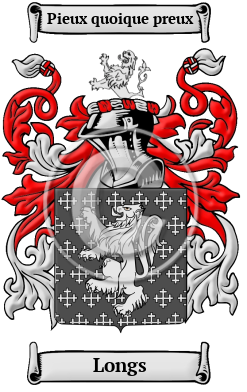
Motto: Pieux quoique preux
Motto Translation: Pious although chivalrous.
- Smith, Eldson Coles, New Dictionary of American Family Names New York: Harper & Row, 1956. Print
- The Norman People and Their Existing Descendants in the British Dominions and the United States Of America. Baltimore: Genealogical Publishing, 1975. Print. (ISBN 0-8063-0636-X)
- Guppy, Henry Brougham, Homes of Family Names in Great Britain. 1890. Print.
- Lower, Mark Anthony, Patronymica Britannica, A Dictionary of Family Names of the United Kingdom. London: John Russel Smith, 1860. Print.
- Bardsley, C.W, A Dictionary of English and Welsh Surnames: With Special American Instances. Wiltshire: Heraldry Today, 1901. Print. (ISBN 0-900455-44-6)
- Black, George F., The Surnames of Scotland Their Origin, Meaning and History. New York: New York Public Library, 1946. Print. (ISBN 0-87104-172-3)
 |