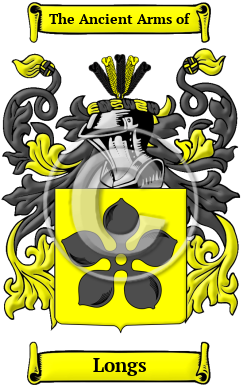
| ![Show Contents]() Longs History, Family Crest & Coats of Arms Longs History, Family Crest & Coats of Arms
Etymology of LongsWhat does the name Longs mean? The name Longs belongs to the early history of France, in that much fought over region of Normandy. It is a product of the family's residency at Longueuil, in Normandy. Early Origins of the Longs familyThe surname Longs was first found in Normandy (French: Normandie), the former Duchy of Normandy, where the family established itself in early times. One of the first records of the name was Guillaume Longue-Épée (c. 893-942), also known as William Longsword. He was the second ruler of Normandy, from 927 until his assassination in 942 when he was ambushed and killed by followers of Arnulf while at a peace conference to settle their differences. He was son of the Viking Rollo (c.846-930), the first ruler of Normandy. Early History of the Longs familyThis web page shows only a small excerpt of our Longs research. Another 70 words (5 lines of text) covering the years 1463, 1470, 1665, 1721 and 1880 are included under the topic Early Longs History in all our PDF Extended History products and printed products wherever possible. Longs Spelling VariationsThere were a great number of spelling variations in French surnames. One reason for this was the wide variety of cultural influences present in France during the early development of the French language. The many spelling variations of the name include Delong, DeLong, Delon, Long, Lelong, Longin, Longet, Longuet, Longuay, Longueuil, Longeau, Longueau, Longeaux, Longueaux, Longeaud, Longaud, Longeret, Longueret and many more. Early Notables of the Longs familyRichard Olivier de Longueuil, a French prelate, who was ordered by the pope to oversee the trial of Jeanne d'Arc, and who died in Rome in 1470; and Jacques...
Another 29 words (2 lines of text) are included under the topic Early Longs Notables in all our PDF Extended History products and printed products wherever possible. Migration of the Longs familyIn the 1700s, land incentives were finally given out by France to 2,000 migrants. Early marriage was encouraged in New France, and youths of 18 took fourteen-year-old girls for their wives. The fur trade was developed and attracted migrants, both noble and commoner from France. 15,000 explorers left Montreal in the late 17th and 18th centuries, leaving French names scattered across the continent. The search for the Northwest passage continued. Migration from France to New France or Quebec, as it was now more popularly called, continued until 1759. By 1675, there were 7000 French in Quebec. By the same year the Acadian presence in Nova Scotia, New Brunswick and Prince Edward Island had reached 500. In the treaty of Utrecht, Acadia were ceded by France to Britain in 1713. In 1755, 10,000 French Acadians refused to take an oath of allegiance to England and were deported. They found refuge in Louisiana. Meanwhile, in Quebec, the French race flourished, founding in Lower Canada, one of the two great solitudes which became Canada. Many of this distinguished family name Longs were prominent in social, cultural, religious and political affairs in France and New France. Amongst the settlers in North America with this distinguished name Longs were Jean Delon, who settled in Louisiana in 1720; M. de Longrais, who was living in Natchez, Louisiana in 1726; M. Delongrais, who settled in Louisiana in 1729.
| Contemporary Notables of the name Longs (post 1700) | + |
- Justice Longs Christopher (1981-2022), Nigerian professional footballer who played as a midfielder
 |