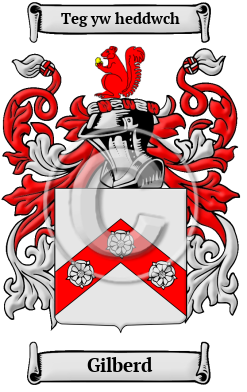
| ![Show Contents]() Gilberd History, Family Crest & Coats of Arms Gilberd History, Family Crest & Coats of Arms
Etymology of GilberdWhat does the name Gilberd mean? It was among those Anglo-Saxon tribes that once ruled over Britain that the name Gilberd was formed. The name was derived from the ancient Germanic personal name Gisilbert, meaning bright hostage or bright pledge. 1 2 3 Early Origins of the Gilberd familyThe surname Gilberd was first found in Devon where they were well established shortly after the Conquest with Gilbert of Sempringham (c. 1083-1190,) son of a wealthy Norman knight, a theologian, who became the first Englishman to found a convent; he was canonized in 1202. He was founder of the order that bears his name. 4 The Domesday Book of 1086 includes an entry for the family in Wiltshire: Gislebertus, the early Latin form of the name. 5 "Near Dartmouth is Greenway, the seat of the famous Gilberts. The family was settled here in the reign of Edward II. ; and here were born their father being Otho Gilbert and their mother Katherine Champernowne Humphry and Adrian Gilbert, the famous half-brothers of the still more famous Sir Walter Ralegh." 6 Gilbertus presbiter was listed in Lincolnshire c. 1150. Later, Willelmus Gilberti was found in the Curia Regis Rolls for Wiltshire in 1202 and later again, Robert Gylwbert was found in Norfolk in 1235. Robert Gilberd was listed in Cambridgeshire in 1240 as was William Gilbert in 1290. The Feet of Fines for Suffolk listed John Gilbard in Suffolk in 1204. 7 "The frequency of Gilberd suggests that this, with Gil(f)bard, may at times belong to Goldbard, though Gilbeard certainly occurs for Gilbert." 7 Gilbert the Universal (d. 1134?), was Bishop of London, "is described as 'natione Britannus' by Richard of Poitiers, who probably means a Breton rather than a Welshman." 8 Gilbert of Louth (d. 1153?), Abbot of Basingwerk, was sent by Gervase, founder and first abbot of Louth in Lincolnshire, about 1140 to an Irish king " in order to obtain a grant to build a monastery in Ireland. The grant was made, and on Gilbert complaining that he did not understand the language, the king gave him as an interpreter the knight Owen, who, according to the legend, had descended into purgatory." 8 "The Gilbertines were an English order with numerous convents at the time of the suppression." 9 The Hundredorum Rolls of 1273 listed the following: Isolda filius Gilberti; Robert Gilbertus; and Eustace filius Gilebert, while the Yorkshire Poll Tax Rolls of 1379 listed: Nicholas Gilberdson; and Johannes Gilberd. 9 "This name has its principal home in the midland counties of Leicester and Rutland, Northampton, Warwick, and Worcester. It is for the most part a name of the midlands, being absent in the north beyond Staffordshire and Lincolnshire. It has, however, a secondary and independent home in Cornwall and Devon." 10 Early History of the Gilberd familyThis web page shows only a small excerpt of our Gilberd research. Another 76 words (5 lines of text) covering the years 1537, 1544, 1583, 1603, 1613, 1694 and 1890 are included under the topic Early Gilberd History in all our PDF Extended History products and printed products wherever possible. Gilberd Spelling VariationsUntil the dictionary, an invention of only the last few hundred years, the English language lacked any comprehensive system of spelling rules. Consequently, spelling variations in names are frequently found in early Anglo-Saxon and later Anglo-Norman documents. One person's name was often spelled several different ways over a lifetime. The recorded variations of Gilberd include Gilbert, Gilbart, Gilberd and others. Early Notables of the Gilberd familySir Robert Gilbert of Somerson; Sir Humphrey Gilbert (c.1537-1583), English soldier and politician, known as the first English colonizer, even though his attempts failed; William Gilbert (1544-1603), an English physician...
Another 30 words (2 lines of text) are included under the topic Early Gilberd Notables in all our PDF Extended History products and printed products wherever possible. Migration of the Gilberd family to IrelandSome of the Gilberd family moved to Ireland, but this topic is not covered in this excerpt.
Another 57 words (4 lines of text) about their life in Ireland is included in all our PDF Extended History products and printed products wherever possible.
| Gilberd migration to New Zealand | + |
Emigration to New Zealand followed in the footsteps of the European explorers, such as Captain Cook (1769-70): first came sealers, whalers, missionaries, and traders. By 1838, the British New Zealand Company had begun buying land from the Maori tribes, and selling it to settlers, and, after the Treaty of Waitangi in 1840, many British families set out on the arduous six month journey from Britain to Aotearoa to start a new life. Early immigrants include: Gilberd Settlers in New Zealand in the 19th Century- William Foale Gilberd, aged 40, a carpenter, who arrived in Wellington, New Zealand aboard the ship "London" in 1840
- Jemima Gilberd, aged 41, who arrived in Wellington, New Zealand aboard the ship "London" in 1840
- George Bowse Gilberd, aged 15, a carpenter, who arrived in Wellington, New Zealand aboard the ship "London" in 1840
- James Gilberd, aged 13, who arrived in Wellington, New Zealand aboard the ship "London" in 1840
- Mr. J. E. Gilberd, British settler travelling from London, UK aboard the ship "British Queen" arriving in Auckland, New Zealand on 30th August 1859 11
- ... (More are available in all our PDF Extended History products and printed products wherever possible.)
| Contemporary Notables of the name Gilberd (post 1700) | + |
- Bruce Carlyle Gilberd CNZM (1938-2023), New Zealand Anglican bishop, 8th Bishop of Auckland, from 1985 to 1994
The motto was originally a war cry or slogan. Mottoes first began to be shown with arms in the 14th and 15th centuries, but were not in general use until the 17th century. Thus the oldest coats of arms generally do not include a motto. Mottoes seldom form part of the grant of arms: Under most heraldic authorities, a motto is an optional component of the coat of arms, and can be added to or changed at will; many families have chosen not to display a motto.
Motto: Teg yw heddwch
Motto Translation: Peace is pleasing.
- Harrison, Henry, Surnames of the United Kingdom: A Concise Etymological Dictionary Baltimore: Geneological Publishing Company, 2013. Print
- Sims, Clifford Stanley The Origin and Signification of Scottish Surnames. 1862. Print.
- Arthur, William , An Etymological Dictionary of Family and Christian Names. London: 1857. Print
- The Norman People and Their Existing Descendants in the British Dominions and the United States Of America. Baltimore: Genealogical Publishing, 1975. Print. (ISBN 0-8063-0636-X)
- Williams, Dr Ann. And G.H. Martin, Eds., Domesday Book A Complete Translation. London: Penguin, 1992. Print. (ISBN 0-141-00523-8)
- Worth, R.N., A History of Devonshire London: Elliot Stock, 62, Paternoster Row, E.G., 1895. Digital
- Reaney, P.H and R.M. Wilson, A Dictionary of English Surnames. London: Routledge, 1991. Print. (ISBN 0-415-05737-X)
- Smith, George (ed), Dictionary of National Biography. London: Smith, Elder & Co., 1885-1900. Print
- Bardsley, C.W, A Dictionary of English and Welsh Surnames: With Special American Instances. Wiltshire: Heraldry Today, 1901. Print. (ISBN 0-900455-44-6)
- Guppy, Henry Brougham, Homes of Family Names in Great Britain. 1890. Print.
- New Zealand Yesteryears Passenger Lists 1800 to 1900 (Retrieved 17th October 2018). Retrieved from http://www.yesteryears.co.nz/shipping/passlist.html
 |