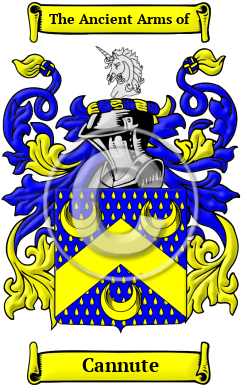
| ![Show Contents]() Cannute History, Family Crest & Coats of Arms Cannute History, Family Crest & Coats of Arms
Etymology of CannuteWhat does the name Cannute mean? The lineage of the name Cannute begins with the Anglo-Saxon tribes in Britain. It is a result of when they lived at the knot, the summit of a rocky hill, from the residence near that place. Early Origins of the Cannute familyThe surname Cannute was first found in Derbyshire where traditionally the name was descended from the Scandinavian King Canute, or Cnut. Drayton sings "The Knot that called was Canutus, bird of old, of that great King of Danes, his name that still doth hold, his appetite to please that far and near was sought, for his, as some have said, from Denmark hither brought." Cnut or Canute the Great (994?-1035), and by Scandinavian writers the Mighty and the Old, was king of the English, Danes, and Norwegians, and was the younger son of Sweyn, king of Denmark. 1 Early feudal rolls provided the king of the time a method of cataloguing holdings for taxation, but today they provide a glimpse into the wide surname spellings in use at that time. Randulfus filius Cnut was listed in the Pipe Rolls for Devon in 1191; Knot pater Alani and Alanus filius Knod were both listed in the Assize Rolls for Lincolnshire in 1202; Radulfus filius Knut was found in the Pipe Rolls for Yorkshire in 1203; Walter and Robert Cnot were in the Pipe Rolls for Suffolk in 1165 and were later Knights Templar in 1185 ; William Cnotte was found in the Curia Regis Rolls for Bedfordshire in 1206; William, John Knotte in the Assize Rolls for Worcestershire in 1221; and Stephen le Knotte was listed in the Subsidy Rolls for Sussex in 1296. 2 The Hundredorum Rolls of 1273 had two listings for the family: Richard Knotte, London; and Peter Cnotte, Salop (Shropshire) while the Yorkshire Poll Tax Rolls of 1379 had the following: Robertus Knotte; Ricardus Notte; Isabella Notte; and Thomas Knot. 3 Up north in Scotland, "A ship of Knut the wealthy, citizen of Berwick, was carried off by Erlind, earl of Orkney, in 1156 (Orkneyinga Saga, Edinburgh, 1873, p. 161.) Hugo Cnot granted an annual-rent of two shillings to the Priory of Inchcolm, c. 1210-1229. The name also occurs in records of Coldingham Priory as Cnoyt. Richard Knut witnessed resignation of the lands of Langholm and Brakanwra, 1281. Adum Knout and John Knout were burgesses of Roxburgh, 1296, and rendered homage [to King Edward I of England] in that year. " 4 Early History of the Cannute familyThis web page shows only a small excerpt of our Cannute research. Another 116 words (8 lines of text) covering the years 1086, 1582, 1606, 1621, 1622, 1626, 1629, 1632, 1633, 1641, 1656, 1681, 1708, 1724, 1729, 1730, 1734, 1763, 1777 and 1811 are included under the topic Early Cannute History in all our PDF Extended History products and printed products wherever possible. Cannute Spelling VariationsOnly recently has spelling become standardized in the English language. As the English language evolved in the Middle Ages, the spelling of names changed also. The name Cannute has undergone many spelling variations, including Cnot, Cnotte, Canute, Cnut, Knot, Knout, Knotte, Knott and many more. Early Notables of the Cannute familyWilliam Knott of Great Gonerby, Lincolnshire. Edward Knott (1582-1656), born with the name of Matthew Wilson, was an English Jesuit controversialist, twice provincial of the Society of Jesus in England. He was born at Catchburn, a township in the parish of Morpeth, Northumberland. During 1626 he was a missioner in the Suffolk district. He was apprehended in 1629, and was committed to the Clink prison in Southwark, but at the instance of the queen he was released and banished in February...
Another 81 words (6 lines of text) are included under the topic Early Cannute Notables in all our PDF Extended History products and printed products wherever possible. Migration of the Cannute family to IrelandSome of the Cannute family moved to Ireland, but this topic is not covered in this excerpt.
Another 148 words (11 lines of text) about their life in Ireland is included in all our PDF Extended History products and printed products wherever possible. Migration of the Cannute familyTo escape the unstable social climate in England of this time, many families boarded ships for the New World with the hope of finding land, opportunity, and greater religious and political freedom. Although the voyages were expensive, crowded, and difficult, those families that arrived often found greater opportunities and freedoms than they could have experienced at home. Many of those families went on to make significant contributions to the rapidly developing colonies in which they settled. Early North American records indicate many people bearing the name Cannute were among those contributors: James Knott who arrived at Virginia in 1617, three years before the "Mayflower"; another James Knott was on record in Virginia in 1623; Eleanor Knott settled in Virginia in 1637.
- Smith, George (ed), Dictionary of National Biography. London: Smith, Elder & Co., 1885-1900. Print
- Reaney, P.H and R.M. Wilson, A Dictionary of English Surnames. London: Routledge, 1991. Print. (ISBN 0-415-05737-X)
- Bardsley, C.W, A Dictionary of English and Welsh Surnames: With Special American Instances. Wiltshire: Heraldry Today, 1901. Print. (ISBN 0-900455-44-6)
- Black, George F., The Surnames of Scotland Their Origin, Meaning and History. New York: New York Public Library, 1946. Print. (ISBN 0-87104-172-3)
 |