| ![Show Contents]() Canene History, Family Crest & Coats of Arms Canene History, Family Crest & Coats of Arms
Etymology of CaneneWhat does the name Canene mean? The origins of the Canene name lie with England's ancient Anglo-Saxon culture. It comes from when the family lived in Hertfordshire where the name is derived from "canon, a member of an ecclesiastical order. There is a place called Canon, near Lisieux in Normandy." 1 The name may have also originated from the French, Canonne, a personal name. 2 The Magni Rotuli Scaccarii Normanniae listed Galfridus and Radulfus Canonicus or Le Chanoin of Normandy, 1180-95 and about the same time the Pipe Rolls listed Gilbert and Robert Canonicus in England in 1189. 3 Early Origins of the Canene familyThe surname Canene was first found in Hertfordshire where "Cannon is an old name in this county, both at Nast Hyde in St. Peter's and at Clothall; there was a John Canon of Ware or Shenley in the time of Henry VI. In the 13th century the name occurred, usually in the form of Canon, in Oxfordshire, Hunts, Cambridgeshire, etc. " 4 The Hundredorum Rolls of 1273 listed John le Cannon, Oxfordshire and William le Canon as both holding lands that at that time. 5 John Canon or Canonicus (fl. 1329), was a schoolman who studied at Oxford, and became a member of the Franciscan order. "He is distinguished by the biographers for his eminence in philosophy, theology, and law, both canon and civil, and four books of commentaries on the 'Sentences' of Peter Lombard, some 'Lecturæ magistrales,' and 'Quæstiones disputatæ,' are ascribed to him. " 6 Hugh Canoun, or Hugh Canon (died c. 1317) was an English-born judge in early fourteenth-century Ireland. He was a justice of the Court of Common Pleas (Ireland) and served as Deputy Justiciar of Ireland. He hailed from he parish of Woodford, Somerset (now Nettlecombe.) William Canynges (1399?-1474), was a "merchant of Bristol, third son of John Canynges, burgess and merchant of that city, and Joan Wotton his wife, came of a family that stood high among the merchants of Bristol, for the elder William Canynges, his grandfather, a wealthy cloth manufacturer, was six times mayor, and thrice a representative of the city in parliament.' 6 Early History of the Canene familyThis web page shows only a small excerpt of our Canene research. Another 183 words (13 lines of text) covering the years 1300, 1456, 1663, 1697, 1707, 1708, 1722, 1827, 1862 and 1890 are included under the topic Early Canene History in all our PDF Extended History products and printed products wherever possible. Canene Spelling VariationsBefore the last few hundred years, the English language had no fast system of spelling rules. For that reason, spelling variations are commonly found in early Anglo-Saxon surnames. Over the years, many variations of the name Canene were recorded, including Canning, Cannings, Cannyng, Caning, Canings, Canyng and many more. Early Notables of the Canene familyRobert Cannon (1663-1722), Dean of Lincoln, born in London in 1663, educated at Eton and at King's College, Cambridge. "He held for a time a fellowship at King's College; was Taxor of...
Another 31 words (2 lines of text) are included under the topic Early Canene Notables in all our PDF Extended History products and printed products wherever possible. Migration of the Canene family to IrelandSome of the Canene family moved to Ireland, but this topic is not covered in this excerpt.
Another 57 words (4 lines of text) about their life in Ireland is included in all our PDF Extended History products and printed products wherever possible. Migration of the Canene familyTo escape oppression and starvation at that time, many English families left for the "open frontiers" of the New World with all its perceived opportunities. In droves people migrated to the many British colonies, those in North America in particular, paying high rates for passages in cramped, unsafe ships. Although many of the settlers did not make the long passage alive, those who did see the shores of North America perceived great opportunities before them. Many of the families that came from England went on to make essential contributions to the emerging nations of Canada and the United States. Research into various historical records revealed some of first members of the Canene family emigrate to North America: John Canninge who settled in Virginia in 1652; William Cannings settled in Barbados in 1680 with his wife, two children, and servants; Elizabeth Canning landed in America in 1754.
The motto was originally a war cry or slogan. Mottoes first began to be shown with arms in the 14th and 15th centuries, but were not in general use until the 17th century. Thus the oldest coats of arms generally do not include a motto. Mottoes seldom form part of the grant of arms: Under most heraldic authorities, a motto is an optional component of the coat of arms, and can be added to or changed at will; many families have chosen not to display a motto.
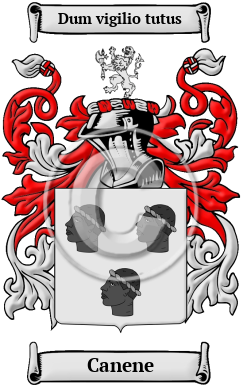
Motto: Dum vigilio tutus
Motto Translation: While I watch I am safe.
- Lower, Mark Anthony, Patronymica Britannica, A Dictionary of Family Names of the United Kingdom. London: John Russel Smith, 1860. Print.
- Barber, Henry, British Family Names London: Elliot Stock, 62 Paternoster Row, 1894. Print.
- The Norman People and Their Existing Descendants in the British Dominions and the United States Of America. Baltimore: Genealogical Publishing, 1975. Print. (ISBN 0-8063-0636-X)
- Guppy, Henry Brougham, Homes of Family Names in Great Britain. 1890. Print.
- Bardsley, C.W, A Dictionary of English and Welsh Surnames: With Special American Instances. Wiltshire: Heraldry Today, 1901. Print. (ISBN 0-900455-44-6)
- Smith, George (ed), Dictionary of National Biography. London: Smith, Elder & Co., 1885-1900. Print
 |