| ![Show Contents]() Blunts History, Family Crest & Coats of Arms Blunts History, Family Crest & Coats of Arms
Etymology of BluntsWhat does the name Blunts mean? The ancient Norman culture that was established in England after the Conquest of 1066 produced the name of Blunts. It was given to a person with blond hair having derived from the Anglo-Norman French word blunt, which means blond. 1 Early Origins of the Blunts familyThe surname Blunts was first found in Suffolk where the Blounts or Blunts, as they are more modernly called, trace their heritage to the Normans, specifically to Rudolph, Count of Guisnes, who nobly assisted Duke William of Normandy to conquer the Saxons at Hastings, in 1066. Sir Robert de Blount (c.1029-1066) had command of the Conqueror's ships during the invasion and was amply rewarded. Sir William, his brother, commanded his foot soldiers at Hastings. 2 These two great nobles received lands in Suffolk, Sir Robert became Baron of Ixworth, Lord of Orford Castle, and Sir William got seven lordships at Saxlingham in the county of Sussex. Each of these branches flourished and there is a record of each succeeding Baron in each estate. Both are recorded in the Domesday Book with their various properties. 3 John de Blund or Blunt (c. 1175-1248), Chancellor of York, was one of the leaders of the movement for the restoration of the University of Oxford to its ancient position as a seat of learning. He was Archbishop of Canterbury-elect in 1232. 4 Stephen le Blount (Blund) (fl. 1320s), was an English Member of Parliament for Lichfield (1326-1327.) In Scotland, the name is more often than not a variant of Blund. John le Blunt of Eskeby from Dumfriesshire, rendered homage to King Edward I of England in 1296. Interestingly, Hugh de Abirbuthenoth, who gifted the church of Garuoch to the monastery of Arnbroath in 1292, was commonly designated Hugo Blundus or Le Blond, from the flaxen color of his hair. However, the first record in Scotland was sometime before 1200 when Rodbert Blundus witnessed a charier by Roger de Quenci. Later Adam Blundus witnessed a confirmation charter by the Chapter of Brechin c. 1212-1218. John Blund who witnessed a charter by Matilda, countess of Angus, c. 1242-1248 is probably the John Blundus who appears as a charter witness in Brechin in 1267. 5 Back in England, the Hundredorum Rolls of 1273 included listings of: Melodia le Blount, Huntingdonshire; Margareta le Blound, Cambridgeshire; Richard le Blont, Wiltshire; Alan le Blund, Oxfordshire; and Richard le Blunt, Wiltshire. 6 Ascelina le Blund, or Blunt was listed in Norfolk in 1272 7 and John le Blont, was listed in Somerset, 1 Edward III (during the first year of Edward III's reign.) 8 The Yorkshire Poll Tax Rolls of 1379 included: Johannes Blont; and Ricardus Blont. 6 Robert de Houton was rector of the church of St. Elphin, Warrington, Lancashire and was confirmed the 3rd of April 1330. 9 Early History of the Blunts familyThis web page shows only a small excerpt of our Blunts research. Another 197 words (14 lines of text) covering the years 1400, 1403, 1493, 1502, 1529, 1540, 1563, 1565, 1580, 1594, 1597, 1600, 1601, 1604, 1606, 1617, 1618, 1624, 1632, 1640, 1649, 1654, 1666, 1670, 1679, 1693, 1697 and 1731 are included under the topic Early Blunts History in all our PDF Extended History products and printed products wherever possible. Blunts Spelling VariationsMultitudes of spelling variations are a hallmark of Anglo Norman names. Most of these names evolved in the 11th and 12th century, in the time after the Normans introduced their own Norman French language into a country where Old and Middle English had no spelling rules and the languages of the court were French and Latin. To make matters worse, medieval scribes spelled words according to sound, so names frequently appeared differently in the various documents in which they were recorded. The name was spelled Blount, Blunt, Blond, Blonde, Blund and others. Early Notables of the Blunts familySir Thomas Blount (d. 1400), supporter of Richard II; Sir Walter Blount (died 1403), soldier and supporter of John of Gaunt (Duke of Lancaster), served as the royal standard bearer, mistaken for the king and killed in combat, appears as a character in Shakespeare's play Henry IV, part 1; Sir James Blount (d. 1493), English commander of the fortress of Hammes; Elizabeth Blount (1502-1540), mistress of Henry VIII; Mountjoy Blount, 1st Earl of Newport (c. 1597-1666), created Baron Mountjoy in the Irish peerage (1617); Charles Blount (1563-1606), English Earl of Devonshire; Charles Blount (1654-1693), English deist and writer; Thomas Blount (1618-1679)...
Another 162 words (12 lines of text) are included under the topic Early Blunts Notables in all our PDF Extended History products and printed products wherever possible. Migration of the Blunts family to IrelandSome of the Blunts family moved to Ireland, but this topic is not covered in this excerpt.
Another 45 words (3 lines of text) about their life in Ireland is included in all our PDF Extended History products and printed products wherever possible.
| Blunts migration to the United States | + |
Because of this political and religious unrest within English society, many people decided to immigrate to the colonies. Families left for Ireland, North America, and Australia in enormous numbers, traveling at high cost in extremely inhospitable conditions. The New World in particular was a desirable destination, but the long voyage caused many to arrive sick and starving. Those who made it, though, were welcomed by opportunities far greater than they had known at home in England. Many of these families went on to make important contributions to the emerging nations of Canada and the United States. Analysis of immigration records indicates that some of the first North American immigrants bore the name Blunts or a variant listed above:
Blunts Settlers in United States in the 18th Century- Conrad Blunts, who landed in America in 1783 10
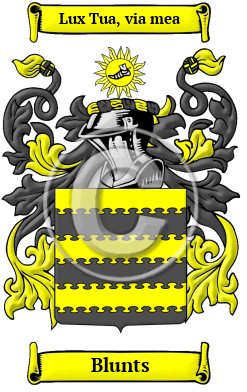
The motto was originally a war cry or slogan. Mottoes first began to be shown with arms in the 14th and 15th centuries, but were not in general use until the 17th century. Thus the oldest coats of arms generally do not include a motto. Mottoes seldom form part of the grant of arms: Under most heraldic authorities, a motto is an optional component of the coat of arms, and can be added to or changed at will; many families have chosen not to display a motto.
Motto: Lux Tua, via mea
Motto Translation: Thy light is my way.
- Smith, Eldson Coles, New Dictionary of American Family Names New York: Harper & Row, 1956. Print
- Burke, John Bernard, The Roll of Battle Abbey. London: Edward Churton, 26, Holles Street, 1848, Print.
- Cleveland, Dutchess of The Battle Abbey Roll with some Account of the Norman Lineages. London: John Murray, Abermarle Street, 1889. Print. Volume 1 of 3
- Smith, George (ed), Dictionary of National Biography. London: Smith, Elder & Co., 1885-1900. Print
- Black, George F., The Surnames of Scotland Their Origin, Meaning and History. New York: New York Public Library, 1946. Print. (ISBN 0-87104-172-3)
- Bardsley, C.W, A Dictionary of English and Welsh Surnames: With Special American Instances. Wiltshire: Heraldry Today, 1901. Print. (ISBN 0-900455-44-6)
- Rye, Walter, A History of Norfolk. London: Elliot Stock, 62, Paternoster Row, 1885. Print
- Dickinson, F.H., Kirby's Quest for Somerset of 16th of Edward the 3rd London: Harrison and Sons, Printers in Ordinary to Her Majesty, St, Martin's Lane, 1889. Print.
- 'Townships: Scarisbrick', in A History of the County of Lancaster: Volume 3, ed. William Farrer and J Brownbill (London, 1907), pp. 265-276. British History Online http://www.british-history.ac.uk/vch/lancs/vol3/pp265-276 [accessed 21 January 2017].
- Filby, P. William, Meyer, Mary K., Passenger and immigration lists index : a guide to published arrival records of about 500,000 passengers who came to the United States and Canada in the seventeenth, eighteenth, and nineteenth centuries. 1982-1985 Cumulated Supplements in Four Volumes Detroit, Mich. : Gale Research Co., 1985, Print (ISBN 0-8103-1795-8)
 |