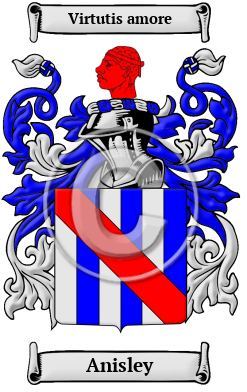
| ![Show Contents]() Anisley History, Family Crest & Coats of Arms Anisley History, Family Crest & Coats of Arms
Etymology of AnisleyWhat does the name Anisley mean? The name Anisley has a long Anglo-Saxon heritage. The name comes from when a family lived at Ansley in Warwickshire, and Annersley in Northumberland. The surname Anisley was originally derived from the Old English name Ansleah. 1 Another source postulates the name came from Annesley, a parish in Nottinghamshire, near Nottingham. 2 The family held this place "from the reign of the Conqueror, 1079." 3 Early Origins of the Anisley familyThe surname Anisley was first found in Oxfordshire where the family held a family seat at Bletchington. "Ralph, surnamed Brito de Annesley, living in the second year of Henry II., (1156) is assumed to have been son of Richard of Annesley, in the county of Nottingham, mentioned in the Domesday Survey. The estate continued in the Annesleys till the death of John de Annesley, Esq., in 1437, when it went to an heiress to the Cahworths." 4 "Areley Castle [in Upper Areley, Staffordshire], the seat of the late Earl of Mountnorris, who, when Viscount Valentia, published his interesting travels in the east, is now the residence of his nephew, A. L. Annesley, Esq., who succeeded to his English and Irish estates." 5 A detailed scan of early rolls revealed 'De Reginal de Anisleg in Anisleg,' Henry III-Edward I in the Testa de Nevill, sive Liber Feodorum, temp. Henry III-Edward I. 6 and Johannes de Anneslegh, recorded in the Hundredorum Rolls for Nottinghamshire in 1273. 2 The source Placita de Quo Warranto, temp. Edward I-III. shows John de Annesley, Yorkshire, 20 Edward I (during the 20th year of King Edward I's reign.) The Yorkshire Poll Tax Rolls of 1379 included as entry for Johannes de Andeslay as holding lands there at that time. From the Nottinghamshire branch, some of the family moved to Scotland where William de Haneslej witnessed a charter by Walter, Bishop of Glasgow, between 1208-1218. He is probably William de Anslee, Canon of Glasgow c. 1220. Magister Thomas de Aneslei was one of a number appointed to settle a dispute between the monks of Kelso and the bishop of Glasgow, and Sir Aymer de Aynesley was one of the knights appointed to settle the law of the marches in 1249. 7 During King Edward I of England's intrusion into Scotland in 1296, the following rendered homage to him: John le fiz Johan de Anesleye of Roxburghshire, and Johan de Anesleye of Crucfut of Lanarkshire. "The seal of the former appended to his homage is broken but shows two geese drinking at a fountain." 7 Early History of the Anisley familyThis web page shows only a small excerpt of our Anisley research. Another 349 words (25 lines of text) covering the years 1066, 1086, 1152, 1357, 1358, 1377, 1464, 1493, 1500, 1567, 1579, 1585, 1598, 1606, 1614, 1616, 1620, 1641, 1645, 1655, 1660, 1673, 1674, 1676, 1677, 1681, 1682, 1685, 1686, 1689, 1690, 1693, 1696, 1701, 1710, 1716, 1727, 1737, 1744, 1761, 1766, 1770, 1793, 1808, 1810, 1816, 1838 and 1844 are included under the topic Early Anisley History in all our PDF Extended History products and printed products wherever possible. Anisley Spelling VariationsSpelling variations in names were a common occurrence before English spelling was standardized a few hundred years ago. In the Middle Ages, even the literate spelled their names differently as the English language incorporated elements of French, Latin, and other European languages. Many variations of the name Anisley have been found, including Annesley, Annesly, Annisley, Annisly, Annersley, Annersly, Anesly and many more. Early Notables of the Anisley familySir Francis Annesley, 1st Baron Mountnorris and 2nd Viscount Valentia (1585-1660), an English statesman; Arthur Annesley, 1st Earl of Anglesey PC (1614-1686), Irish-born, statesman, President of the Council of State and Treasurer of the Navy, Lord Privy Seal (1673 to 1682); and his son, Richard Annesley, 3rd Baron Altham (1655-1701), Dean of Exeter (1681-1701); Arthur Annesley, 4th Baron Altham (1689-1727); Samuel Annesley (c. 1620-1696)...
Another 64 words (5 lines of text) are included under the topic Early Anisley Notables in all our PDF Extended History products and printed products wherever possible. Migration of the Anisley family to IrelandSome of the Anisley family moved to Ireland, but this topic is not covered in this excerpt.
Another 240 words (17 lines of text) about their life in Ireland is included in all our PDF Extended History products and printed products wherever possible.
| Anisley migration to Australia | + |
Anisley Settlers in Australia in the 19th Century- Jonathan Anisley, who arrived in Adelaide, Australia aboard the ship "Asiatic" in 1849 8
- Elizabeth Anisley, who arrived in Adelaide, Australia aboard the ship "Asiatic" in 1849 8
- William Anisley, who arrived in Adelaide, Australia aboard the ship "Asiatic" in 1849 8
The motto was originally a war cry or slogan. Mottoes first began to be shown with arms in the 14th and 15th centuries, but were not in general use until the 17th century. Thus the oldest coats of arms generally do not include a motto. Mottoes seldom form part of the grant of arms: Under most heraldic authorities, a motto is an optional component of the coat of arms, and can be added to or changed at will; many families have chosen not to display a motto.
Motto: Virtutis amore
Motto Translation: Through love to virtue.
- Reaney, P.H and R.M. Wilson, A Dictionary of English Surnames. London: Routledge, 1991. Print. (ISBN 0-415-05737-X)
- Bardsley, C.W, A Dictionary of English and Welsh Surnames: With Special American Instances. Wiltshire: Heraldry Today, 1901. Print. (ISBN 0-900455-44-6)
- Lower, Mark Anthony, Patronymica Britannica, A Dictionary of Family Names of the United Kingdom. London: John Russel Smith, 1860. Print.
- Shirley, Evelyn Philip, The Noble and Gentle Men of England; The Arms and Descents. Westminster: John Bower Nichols and Sons, 1866, Print.
- Lewis, Samuel, A Topographical Dictionary of England. Institute of Historical Research, 1848, Print.
- Testa de Nevill or "Liber Feodorum" or "Book of Fees," thought to have been written by Ralph de Nevill, for King John (1199–1216)
- Black, George F., The Surnames of Scotland Their Origin, Meaning and History. New York: New York Public Library, 1946. Print. (ISBN 0-87104-172-3)
- State Records of South Australia. (Retrieved 2010, November 5) The ASIATIC 1849. Retrieved from http://www.slsa.sa.gov.au/BSA/1849Asiatic.htm
 |