| ![Show Contents]() Wevers History, Family Crest & Coats of Arms Wevers History, Family Crest & Coats of Arms
- Origins Available:
England
Etymology of WeversWhat does the name Wevers mean? The name Wevers reached England in the great wave of migration following the Norman Conquest of 1066. The name Wevers is for a weaver. The surname Wevers was originally derived from the Old English word wefan, meaning a person who weaves cloth from long strands of fibre. 1 Alternatively, the name could have been Norman in origin as the Magni Rotuli Scaccarii Normanniae lists Hubert de Wevre, in Normandy in 1198. The same source notes Robert, Hugh, Ernald, Oger, Serlo, William, Gerard, Gauffrid Textor in Normandy 1180-95. 2 Early Origins of the Wevers familyThe surname Wevers was first found in Cheshire, where they held a family seat at the time of the Conquest, and Lords of the manor of Weaver. 3 They were descended from the Norman, Le Wevere. One of the first records of the family in early rolls was Simon de Wevere in the Assize Rolls for Cheshire in 1259. A few years later in Sussex, we found John le Weuere and William Weuere in the Subsidy Rolls for 1296. 4 Early History of the Wevers familyThis web page shows only a small excerpt of our Wevers research. Another 129 words (9 lines of text) covering the years 1086, 1550, 1603, 1616, 1627, 1630, 1633, 1638, 1639, 1640, 1645, 1649, 1653, 1663, 1673, 1685, 1687 and 1760 are included under the topic Early Wevers History in all our PDF Extended History products and printed products wherever possible. Wevers Spelling VariationsIt is only in the last few hundred years that the English language has been standardized. For that reason, Anglo-Norman surnames like Wevers are characterized by many spelling variations. Scribes and monks in the Middle Ages spelled names they sounded, so it is common to find several variations that refer to a single person. As the English language changed and incorporated elements of other European languages such as Norman French and Latin, even literate people regularly changed the spelling of their names. The variations of the name Wevers include Weaver, Wever, Weever and others. Early Notables of the Wevers familyRobert Wever (fl 1550), an English poet and dramatist; John Weaver (died 1685), an English politician, Member of Parliament for Stamford (1645); Robert Weaver (c.1630-1687), an English politician; and John Weaver (1673-1760), an English dancer and choreographer, and is often regarded as the father of English pantomime.
John Weaver (d. 1685), was an English politician of North Luffenham, Lincolnshire. "In January 1649 Weaver was named one of the commissioners for trying Charles I, but never attended any of the sittings of the court. On 14 April 1653 parliament voted him Scottish lands to the value of 250l. per annum as a reward...
Another 125 words (9 lines of text) are included under the topic Early Wevers Notables in all our PDF Extended History products and printed products wherever possible. Wevers RankingNetherlands, the name Wevers is the 943rd most popular surname with an estimated 2,178 people with that name. 5
| Wevers migration to the United States | + |
Faced with the chaos present in England at that time, many English families looked towards the open frontiers of the New World with its opportunities to escape oppression and starvation. People migrated to North America, as well as Australia and Ireland in droves, paying exorbitant rates for passages in cramped, unsafe ships. Many of the settlers did not make the long passage alive, but those who did see the shores of North America were welcomed with great opportunity. Many of the families that came from England went on to make essential contributions to the emerging nations of Canada and the United States. Some of the first immigrants to cross the Atlantic and come to North America carried the name Wevers, or a variant listed above:
Wevers Settlers in United States in the 19th Century- Helena Wevers, aged 6, who landed in New York, NY in 1849 6
- Johann Theodor Wevers, aged 34, who arrived in New York, NY in 1849 6
| Contemporary Notables of the name Wevers (post 1700) | + |
- Lydia Joyce Wevers ONZM (1950-2021), New Zealand literary historian, literary critic, editor, and book reviewer, an academic at Victoria University of Wellington
- Maarten Laurens Wevers CNZM (b. 1952), New Zealand diplomat and public servant
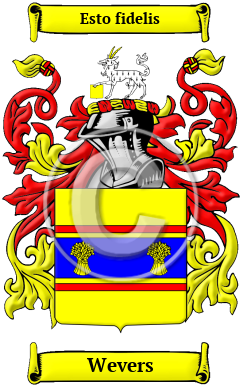
The motto was originally a war cry or slogan. Mottoes first began to be shown with arms in the 14th and 15th centuries, but were not in general use until the 17th century. Thus the oldest coats of arms generally do not include a motto. Mottoes seldom form part of the grant of arms: Under most heraldic authorities, a motto is an optional component of the coat of arms, and can be added to or changed at will; many families have chosen not to display a motto.
Motto: Esto fidelis
Motto Translation: Be Faithful.
- Smith, Eldson Coles, New Dictionary of American Family Names New York: Harper & Row, 1956. Print
- The Norman People and Their Existing Descendants in the British Dominions and the United States Of America. Baltimore: Genealogical Publishing, 1975. Print. (ISBN 0-8063-0636-X)
- Barber, Henry, British Family Names London: Elliot Stock, 62 Paternoster Row, 1894. Print.
- Reaney, P.H and R.M. Wilson, A Dictionary of English Surnames. London: Routledge, 1991. Print. (ISBN 0-415-05737-X)
- "Most Common Last Names in Netherlands." Forebears, https://forebears.io/netherlands/surnames
- Filby, P. William, Meyer, Mary K., Passenger and immigration lists index : a guide to published arrival records of about 500,000 passengers who came to the United States and Canada in the seventeenth, eighteenth, and nineteenth centuries. 1982-1985 Cumulated Supplements in Four Volumes Detroit, Mich. : Gale Research Co., 1985, Print (ISBN 0-8103-1795-8)
 |