| ![Show Contents]() Theyer History, Family Crest & Coats of Arms Theyer History, Family Crest & Coats of Arms
Etymology of TheyerWhat does the name Theyer mean? The name Theyer reached English shores for the first time with the ancestors of the Theyer family as they migrated following the Norman Conquest of 1066. The Theyer family lived in Essex. Their name, however, is a reference to St. Saire, Normandy, the family's place of residence prior to the Norman Conquest of England in 1066. Alternatively, the name could have been a trade name for someone who was "an assayer of metals." 1 And another variation is that it could have been "an Anglo-Norman personal name, as Saher de Quincy, the famous Earl of Winchester." 1 There are at least three other listed origins of the name, but these latter three seem the most probable. Early Origins of the Theyer familyThe surname Theyer was first found in Essex where the family's first listing of the name was found during the reign of Edward II. 1 Omitting the entries as a personal name, we also found: Stephanus filius Seir (1148-1152) and ? filius Saheri (Saieri) c. 1160 in Lincolnshire. Robertus filius Seer was listed in the 12th century in Nottinghamshire and Richard Sayer was listed in the Pipe Rolls of Devon in 1230. Thomas Sare and John Sayer were listed in the Feet of Fines of Essex in 1292. 2 The Thayer variant produced the Pilgrim Fathers and brothers Thomas Thayer (1596-1665) and Richard Thayer (1601-1664) who were born in Thornbury, Devon. The family were originally from Glastonbury, Somerset, the oldest found was John Tahyer, born c. 1450. Early History of the Theyer familyThis web page shows only a small excerpt of our Theyer research. Another 116 words (8 lines of text) covering the years 1560, 1602, 1603, 1625, 1631, 1655, 1695, 1705, 1718 and 1890 are included under the topic Early Theyer History in all our PDF Extended History products and printed products wherever possible. Theyer Spelling VariationsAnglo-Norman names tend to be marked by an enormous number of spelling variations. This is largely due to the fact that Old and Middle English lacked any spelling rules when Norman French was introduced in the 11th century. The languages of the English courts at that time were French and Latin. These various languages mixed quite freely in the evolving social milieu. The final element of this mix is that medieval scribes spelled words according to their sounds rather than any definite rules, so a name was often spelled in as many different ways as the number of documents it appeared in. The name was spelled Sayer, Sayers, Sayres and others. Early Notables of the Theyer family- Thomas Thayre (fl. 1603-1625), was an English medical writer who described himself as a 'chirurgian' in July 1603. John Theyer was an antiquary, son of John Theyer (d. 1631), and grandson of Thomas Th...
Migration of the Theyer family to IrelandSome of the Theyer family moved to Ireland, but this topic is not covered in this excerpt.
Another 61 words (4 lines of text) about their life in Ireland is included in all our PDF Extended History products and printed products wherever possible.
| Theyer migration to New Zealand | + |
Emigration to New Zealand followed in the footsteps of the European explorers, such as Captain Cook (1769-70): first came sealers, whalers, missionaries, and traders. By 1838, the British New Zealand Company had begun buying land from the Maori tribes, and selling it to settlers, and, after the Treaty of Waitangi in 1840, many British families set out on the arduous six month journey from Britain to Aotearoa to start a new life. Early immigrants include: Theyer Settlers in New Zealand in the 19th Century- Daniel Theyer, who arrived in Auckland, New Zealand aboard the ship "Zealandia" in 1861
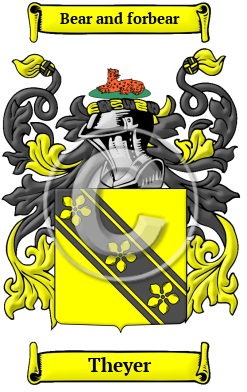
The motto was originally a war cry or slogan. Mottoes first began to be shown with arms in the 14th and 15th centuries, but were not in general use until the 17th century. Thus the oldest coats of arms generally do not include a motto. Mottoes seldom form part of the grant of arms: Under most heraldic authorities, a motto is an optional component of the coat of arms, and can be added to or changed at will; many families have chosen not to display a motto.
Motto: Bear and forbear
- Lower, Mark Anthony, Patronymica Britannica, A Dictionary of Family Names of the United Kingdom. London: John Russel Smith, 1860. Print.
- Reaney, P.H and R.M. Wilson, A Dictionary of English Surnames. London: Routledge, 1991. Print. (ISBN 0-415-05737-X)
 |