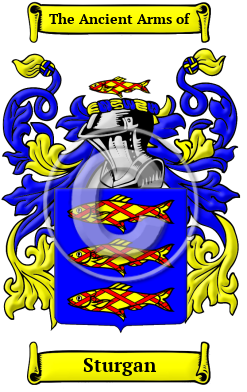
| ![Show Contents]() Sturgan History, Family Crest & Coats of Arms Sturgan History, Family Crest & Coats of Arms
Etymology of SturganWhat does the name Sturgan mean? The history of the name Sturgan begins with the Norman Conquest of England in 1066. This Norman name was soon thereafter given to a person who resembles a sturgeon having derived from the Old French word esturgeon, or Lesturgeon, and indicates that the original bearer bore some fanciful resemblance to the Northern European fish of the same name. 1 2 Eluding to the Norman-French ancestry, we note that "King John granted to N. Sturgon, of Normandy, Stoteville, the estate of Hugh de Gornai, 1203. He was Viscount of Fescamp." 3 Early Origins of the Sturgan familyThe surname Sturgan was first found in Suffolk where they were Lords of the manor of Whepstead from very early times, where they were conjecturally descended from Ralph of Whepstead who held that Lordship after the Norman Conquest in 1066 A.D. from the Abbott of St. Edmund's. According to the Domesday Book survey, Whepstead consisted of a church, eighteen beasts, thirty pigs, and one hundred sheep, and their descendants later erected Manston Hall. 4 Another source claims the family held "an estate in Essex called Sturgeons, formerly Turges Cassus. Turges may be the same name as Turgesius, a celebrated Norwegian king, called by Irish writers Tuirghes, who established his power in Ireland for thirty years. Hence probably the names Sturch, Sturge, Sturges, Sturgess, Sturgis." 5 "The old Suffolk family of Sturgeon held the manor of Manston, Whepstead, from the beginning of the 16th to the close of the last century (G.). "Maister John Sturgeon" was governor of the company of Merchant Adventurers, when they gave a princely reception to Philip of Spain on the occasion of his taking possession of the Low Countries in 1540 (Allen's "Lincolnshire"). At present the name is best represented in and around Bury St. Edmunds. An estate in Writtle parish, Essex, is called Sturgeons or Turges Cassus (Wright's "Essex"). John Sturgeon, or Strogeon, of Hitchin, Herts, was twice sheriff of Hertfordshire and Essex in the reign of Edward IV. " 6 Early feudal rolls provided the king of the time a method of cataloguing holdings for taxation, but today they provide a glimpse into the wide surname spellings in use at that time. Early Cumberland records show William Sturjon in 1281, while down in Essex, Richard Sturioun was listed in the there in the Subsidy Rolls for 1327. A few years later, William Sturgeon was listed in London in 1380. 7 In Yorkshire, Willelmus Sturgeon was listed in the Yorkshire Poll Tax Rolls of 1379. 8 In Scotland, the "surname [is] confined mainly to the shires of Dumfries and Kirkcudbright. Andrew Sturgioun and John Sturgioun were witnesses in Dumfries in 1544. Charles Strugeoun, sheathmaker in Edinburgh in 1608, appears again in 1610 as Strudgeon." 9 Early History of the Sturgan familyThis web page shows only a small excerpt of our Sturgan research. Another 208 words (15 lines of text) covering the years 1544, 1559, 1574, 1611, 1636, 1647, 1655, 1657, 1659, 1661, 1677, 1685, 1705 and 1890 are included under the topic Early Sturgan History in all our PDF Extended History products and printed products wherever possible. Sturgan Spelling VariationsThe English language only became standardized in the last few centuries. For that reason, spelling variations are common among many Anglo-Norman names. The shape of the English language was frequently changed with the introduction of elements of Norman French, Latin, and other European languages; even the spelling of literate people's names were subsequently modified. Sturgan has been recorded under many different variations, including Sturgen, Sturgeon, Stergeon, Sturgion, Sturgione, Strugeon, Strugen, Strugeone and many more. Early Notables of the Sturgan familyJohn Sturgion (fl. 1661), English pamphleteer who was at one time a private in Cromwell's lifeguards. "On 27 Aug. 1655 he was arrested as the author of a pamphlet against the Protector, called 'A Short Discovery of his Highness the Lord Protector's Intentions touching the Anabaptists in the Army'. He was discharged from the lifeguards and for a time...
Another 59 words (4 lines of text) are included under the topic Early Sturgan Notables in all our PDF Extended History products and printed products wherever possible. Migration of the Sturgan family to IrelandSome of the Sturgan family moved to Ireland, but this topic is not covered in this excerpt.
Another 51 words (4 lines of text) about their life in Ireland is included in all our PDF Extended History products and printed products wherever possible. Migration of the Sturgan familyTo escape the uncertainty of the political and religious uncertainty found in England, many English families boarded ships at great expense to sail for the colonies held by Britain. The passages were expensive, though, and the boats were unsafe, overcrowded, and ridden with disease. Those who were hardy and lucky enough to make the passage intact were rewarded with land, opportunity, and social environment less prone to religious and political persecution. Many of these families went on to be important contributors to the young nations of Canada and the United States where they settled. Sturgans were some of the first of the immigrants to arrive in North America: Janet Sturgeon and her husband, who settled in St. John island in 1775; Robert Sturgeon, who came to Maine in 1726; John Sturgeon, who settled in New England in 1740.
- Lower, Mark Anthony, Patronymica Britannica, A Dictionary of Family Names of the United Kingdom. London: John Russel Smith, 1860. Print.
- Harrison, Henry, Surnames of the United Kingdom: A Concise Etymological Dictionary Baltimore: Geneological Publishing Company, 2013. Print
- The Norman People and Their Existing Descendants in the British Dominions and the United States Of America. Baltimore: Genealogical Publishing, 1975. Print. (ISBN 0-8063-0636-X)
- Williams, Dr Ann. And G.H. Martin, Eds., Domesday Book A Complete Translation. London: Penguin, 1992. Print. (ISBN 0-141-00523-8)
- Charnock, Richard, Stephen, Ludus Patronymicus of The Etymology of Curious Surnames. London: Trubner & Co., 60 Paternoster Row, 1868. Print.
- Guppy, Henry Brougham, Homes of Family Names in Great Britain. 1890. Print.
- Reaney, P.H and R.M. Wilson, A Dictionary of English Surnames. London: Routledge, 1991. Print. (ISBN 0-415-05737-X)
- Bardsley, C.W, A Dictionary of English and Welsh Surnames: With Special American Instances. Wiltshire: Heraldry Today, 1901. Print. (ISBN 0-900455-44-6)
- Black, George F., The Surnames of Scotland Their Origin, Meaning and History. New York: New York Public Library, 1946. Print. (ISBN 0-87104-172-3)
 |