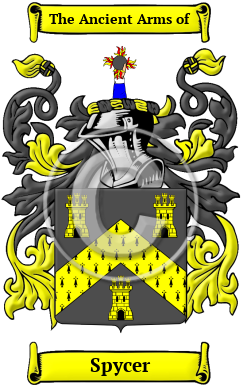
| ![Show Contents]() Spycer History, Family Crest & Coats of Arms Spycer History, Family Crest & Coats of Arms
Etymology of SpycerWhat does the name Spycer mean? Spycer is a name that first reached England following the Norman Conquest in 1066. It is a name for a grocer which was in turn derived from the Old French word espice, of the same meaning. 1 2 "What we now call a grocer, because, inter alia, he deals in figs (grossi), the French call an epicier, or spicer, because he sells spices." 3 Early Origins of the Spycer familyThe surname Spycer was first found in Devon where conjecturally the Spicers were under tenants of the Count of Mortain at the time of the Norman Conquest. Benedict le Spicer was listed in the Rotuli de Oblatis et Finibus, at the time of King John. 4 Some of the first entries in early rolls for the family include: William le Espicer in the Pipe Rolls for Kent in 1184; Bertram le Specier in the Pipe Rolls for Hampshire and in the Assize Rolls for Somerset in 1201; and Hugo le Especer in the Curia Regis Rolls for Cambridge in 1214. 5 Later, the singular form of the name appeared: William Spice in the Feet of Fines for Suffolk in 1326; and Clement Spice in the Feet of Fines for Cambridgeshire in 1399. 5 A search of the Hundredorum Rolls of 1273 revealed: Simon le Spicere, Cambridgeshire; William le Spicere, Oxfordshire; and William Speciar, Lincolnshire. Up in the north of England, the Yorkshire Poll Tax Rolls of 1379 show the name as both a trade name and a surname: Adam Spisar, spicer; and Giliaum Spyser, 1379. 6 Continuing our quest north into Scotland, the name had the same meaning "spicer, dealer in spices," and two early entries, both as a result of the invasion of King Edward I of England: "Rauf le Spicer rendered homage, 1296, and Eustace Lespicer and Martin Lespicer rendered homage at Berwick, 1291." 7 Early History of the Spycer familyThis web page shows only a small excerpt of our Spycer research. Another 96 words (7 lines of text) covering the years 1273, 1296, 1352, 1353, 1356, 1358, 1359, 1592, 1593, 1603, 1629, 1644, 1708, 1743, 1765, 1773, 1774, 1777, 1783, 1792 and 1804 are included under the topic Early Spycer History in all our PDF Extended History products and printed products wherever possible. Spycer Spelling VariationsAnglo-Norman names tend to be marked by an enormous number of spelling variations. This is largely due to the fact that Old and Middle English lacked any spelling rules when Norman French was introduced in the 11th century. The languages of the English courts at that time were French and Latin. These various languages mixed quite freely in the evolving social milieu. The final element of this mix is that medieval scribes spelled words according to their sounds rather than any definite rules, so a name was often spelled in as many different ways as the number of documents it appeared in. The name was spelled Spicer, Spicers, Spice and others. Early Notables of the Spycer familyHenry Spicer (1743?-1804), English miniature-painter, born at Reepham, Norfolk, about 1743, and became a pupil of Gervase Spencer. He worked both on ivory and in enamel, and was one of the ablest miniaturists of the period. He was a member of the Incorporated Society of Artists, and exhibited with them from 1765 to 1783; in 1773 he was secretary to the society. He exhibited for the first time at the Royal Academy in 1774, and about 1777 went to Dublin, where he...
Another 82 words (6 lines of text) are included under the topic Early Spycer Notables in all our PDF Extended History products and printed products wherever possible. Migration of the Spycer family to IrelandSome of the Spycer family moved to Ireland, but this topic is not covered in this excerpt. More information about their life in Ireland is included in all our PDF Extended History products and printed products wherever possible. Migration of the Spycer familyBecause of the political and religious discontent in England, families began to migrate abroad in enormous numbers. Faced with persecution and starvation at home, the open frontiers and generally less oppressive social environment of the New World seemed tantalizing indeed to many English people. The trip was difficult, and not all made it unscathed, but many of those who did get to Canada and the United States made important contributions to the young nations in which they settled. Some of the first North American settlers with Spycer name or one of its variants: Gregory Spicer who settled in Virginia in 1618; two years before the "Mayflower"; Edward, William, Richard and Henry Spicer who settled in Virginia in 1635.
- Smith, Eldson Coles, New Dictionary of American Family Names New York: Harper & Row, 1956. Print
- Arthur, William , An Etymological Dictionary of Family and Christian Names. London: 1857. Print
- Lower, Mark Anthony, Patronymica Britannica, A Dictionary of Family Names of the United Kingdom. London: John Russel Smith, 1860. Print.
- Barber, Henry, British Family Names London: Elliot Stock, 62 Paternoster Row, 1894. Print.
- Reaney, P.H and R.M. Wilson, A Dictionary of English Surnames. London: Routledge, 1991. Print. (ISBN 0-415-05737-X)
- Bardsley, C.W, A Dictionary of English and Welsh Surnames: With Special American Instances. Wiltshire: Heraldry Today, 1901. Print. (ISBN 0-900455-44-6)
- Black, George F., The Surnames of Scotland Their Origin, Meaning and History. New York: New York Public Library, 1946. Print. (ISBN 0-87104-172-3)
 |