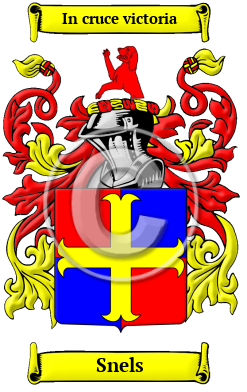
| ![Show Contents]() Snels History, Family Crest & Coats of Arms Snels History, Family Crest & Coats of Arms
Etymology of SnelsWhat does the name Snels mean? The name Snels is rooted in the ancient Anglo-Saxon culture. It was a name for someone who was a brisk or active person. Snels is a nickname surname, which belongs to the category of hereditary surnames. Nicknames form a broad and miscellaneous class of surnames, and can refer directly or indirectly to one's personality, physical attributes, mannerisms, or even their habits of dress. This surname comes from the Old English word smell, which means quick or lively or a descendant of Snell (strong, smart). 1 Early Origins of the Snels familyThe surname Snels was first found in Devon and Cornwall. 2 However, nicknames typically are found throughout ancient England, but in this case, the name was "in use before the Conquest." 3 By example, Johannes filius Snel was found in the Pipe Rolls of Yorkshire in 1196 and Alexander filius Snell was listed in the Assize Rolls for Yorkshire in 1219, but William Snel was a Templar in Kent in 1185 and Edwinus Snell was listed in the Feet of Fines for Norfolk in 1195. 4 The Hundredorum Rolls of 1273 listed Snel in Derbyshire and William Snell in Oxfordshire. The Yorkshire Poll Tax Rolls of 1379 listed Johannes Snell, Willelmus Snell and Ricardus Snell as all holding lands there at that time. 5 Further to the north in Scotland, William Snelle was master of the ship Seinte Marie of Dundee in 1390, William Snell, presbyter Glasguensis, was a notary public in 1449 and Schire William Snell, chaplain, was burgess of Prestwick in 1470. 6 "The Cornish Snells are represented in the district of Liskeard. Snel was a name found in Oxfordshire, Derbyshire, and Shropshire in the 13th century." 2 Early History of the Snels familyThis web page shows only a small excerpt of our Snels research. Another 154 words (11 lines of text) covering the years 1623, 1629, 1638, 1679, 1685, 1694, 1700, 1701, 1702, 1708 and 1717 are included under the topic Early Snels History in all our PDF Extended History products and printed products wherever possible. Snels Spelling VariationsSnels has been spelled many different ways. Before English spelling became standardized over the last few hundred years, spelling variations in names were a common occurrence. As the English language changed in the Middle Ages, absorbing pieces of Latin and French, as well as other languages, the spelling of people's names also changed considerably, even over a single lifetime. Many variations of the name Snels have been found, including Snell, Snel and others. Early Notables of the Snels familySir John Snell (1629-1679), Scottish-born, son of Andrew Snell, smith at McCalanstone in the parish of Colmonell, Ayrshire, founder of the Snell Exhibitions at the University of Oxford; George Snell (died 1701), English clergyman, Canon...
Another 34 words (2 lines of text) are included under the topic Early Snels Notables in all our PDF Extended History products and printed products wherever possible. Migration of the Snels familyIn an attempt to escape the chaos experienced in England, many English families boarded overcrowded and diseased ships sailing for the shores of North America and other British colonies. Those families hardy enough, and lucky enough, to make the passage intact were rewarded with land and a social environment less prone to religious and political persecution. Many of these families became important contributors to the young colonies in which they settled. Early immigration and passenger lists have documented some of the first Snelss to arrive on North American shores: Major and Mrs. Elizabeth Snell who settled in New York State in 1774; with their children Elizabeth, and Richard; Mary Snell settled in Barbados in 1682 with her husband.
The motto was originally a war cry or slogan. Mottoes first began to be shown with arms in the 14th and 15th centuries, but were not in general use until the 17th century. Thus the oldest coats of arms generally do not include a motto. Mottoes seldom form part of the grant of arms: Under most heraldic authorities, a motto is an optional component of the coat of arms, and can be added to or changed at will; many families have chosen not to display a motto.
Motto: In cruce victoria
Motto Translation: Victorious in the Cross.
- Smith, Eldson Coles, New Dictionary of American Family Names New York: Harper & Row, 1956. Print
- Guppy, Henry Brougham, Homes of Family Names in Great Britain. 1890. Print.
- Lower, Mark Anthony, Patronymica Britannica, A Dictionary of Family Names of the United Kingdom. London: John Russel Smith, 1860. Print.
- Reaney, P.H and R.M. Wilson, A Dictionary of English Surnames. London: Routledge, 1991. Print. (ISBN 0-415-05737-X)
- Bardsley, C.W, A Dictionary of English and Welsh Surnames: With Special American Instances. Wiltshire: Heraldry Today, 1901. Print. (ISBN 0-900455-44-6)
- Black, George F., The Surnames of Scotland Their Origin, Meaning and History. New York: New York Public Library, 1946. Print. (ISBN 0-87104-172-3)
 |