| ![Show Contents]() Sambell History, Family Crest & Coats of Arms Sambell History, Family Crest & Coats of Arms
Early Origins of the Sambell familyThe surname Sambell was first found in Renfrewshire (Gaelic: Siorrachd Rinn Friù), a historic county of Scotland, today encompassing the Council Areas of Renfrew, East Renfrewshire, and Iverclyde, in the Strathclyde region of southwestern Scotland, where they held a family seat from early times and their first records appeared on the early census rolls taken by the early Kings of Scotland to determine the rate of taxation of their subjects. Early History of the Sambell familyThis web page shows only a small excerpt of our Sambell research. Another 143 words (10 lines of text) covering the years 1280, 1315, 1489, 1545, 1558, 1564, 1566, 1577, 1591, 1595, 1596, 1600, 1616, 1621, 1625, 1640, 1643, 1644, 1654, 1663, 1666, 1667, 1677, 1680, 1682, 1700, 1741, 1749, 1757, 1782 and 1890 are included under the topic Early Sambell History in all our PDF Extended History products and printed products wherever possible. Sambell Spelling VariationsSpelling variations of this family name include: Semple, Simple, Sempill, Sempell, Symple, Sympell and many more. Early Notables of the Sambell familyLord George Sempill; and Sir James Sempill (1566-1625), Scottish Ambassador to England (1591-1600); Robert Sempill, the Younger (1595?-1663?), Scottish poet, best known for his ballad, "The Life and Death of Habbie Simpson, Piper of Kilbarchan" (c. 1640); and Francis Sempill (1616?-1682), Deputy Sheriff of Renfrewshire (1667.) 1 Hugh Sempill or Semple (1596-1654), was a Scottish mathematician, born at Craigevar and was nephew of Colonel William Sempill. Sir James Sempill (1566-1625) of Beltrees, called by Knox 'the dancer,' was eldest son of John Sempill. His father and mother were special favourites of the queen, from whom they received on 9 May 1564-1545 the...
Another 125 words (9 lines of text) are included under the topic Early Sambell Notables in all our PDF Extended History products and printed products wherever possible. Migration of the Sambell family to IrelandSome of the Sambell family moved to Ireland, but this topic is not covered in this excerpt.
Another 123 words (9 lines of text) about their life in Ireland is included in all our PDF Extended History products and printed products wherever possible.
| Sambell migration to Australia | + |
Sambell Settlers in Australia in the 19th Century- Mr. Joseph Sambell, (b. 1825), aged 17 born in Falmouth, Cornwall, UK convicted in Falmouth on 10th January 1842, sentenced for 7 years for stealing pencils, transported aboard the ship "Equestrian" in 1844 to Van Diemen's Land, Tasmania, Australia 2
- Mr. Joseph Sambell, (b. 1827), aged 15, Cornish settler convicted in Cornwall, UK on 10th January 1844, sentenced for 7 years for stealing 2 pencils from Mrs. Dixon at Falmouth, transported aboard the ship "Equestrian" on 25th January 1844 to Van Diemen's Land, Tasmania, Australia 3
- Mr. Joseph Sambell, (Youlding), Cornish convict who was convicted in Falmouth, Cornwall, England for 7 years, transported aboard the "Equestrian" on 25th January 1844, arriving in Tasmania (Van Diemen's Island) 4
| Contemporary Notables of the name Sambell (post 1700) | + |
- Darryl Lloyd Sambell (1945-2001), Australian talent manager and music promoter from the mid-1960s who managed teen pop idol, Johnny Farnham
- William Austin Tyers "Bill" Sambell (1910-1974), Australian rower born in Melbourne, Victoria, Australia who competed for Great Britain at the 1932 Summer Olympics
- Jack Sambell (1908-1982), Australian footballer who played with Melbourne (1933-1934)
- Geoffrey Sambell (1914-1980), Australian Anglican bishop and World War 2 army chaplain, born at Broadford, Victoria
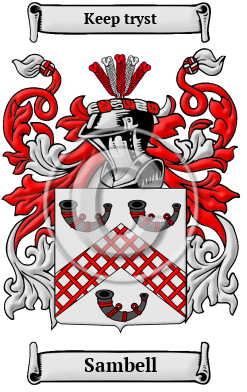
The motto was originally a war cry or slogan. Mottoes first began to be shown with arms in the 14th and 15th centuries, but were not in general use until the 17th century. Thus the oldest coats of arms generally do not include a motto. Mottoes seldom form part of the grant of arms: Under most heraldic authorities, a motto is an optional component of the coat of arms, and can be added to or changed at will; many families have chosen not to display a motto.
Motto: Keep tryst
- Black, George F., The Surnames of Scotland Their Origin, Meaning and History. New York: New York Public Library, 1946. Print. (ISBN 0-87104-172-3)
- Cornwall Online Parish Clerks. (Retrieved 30th May 2018). Retrieved from http://www.opc-cornwall.org/Resc/pdfs/tasmanian_convicts_cornish.pdf
- Cornwall Online Parish Clerks. (Retrieved 30th May 2018). Retrieved from http://www.opc-cornwall.org/Resc/pdfs/emigration_australia_convicts.pdf
- Convict Records Voyages to Australia (Retrieved 4th May 2022). https://convictrecords.com.au/ships/equestrian
 |