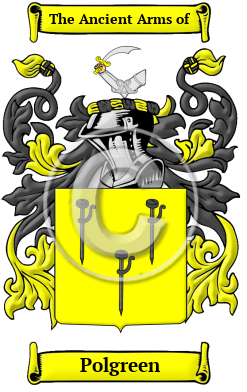
| ![Show Contents]() Polgreen History, Family Crest & Coats of Arms Polgreen History, Family Crest & Coats of Arms
Etymology of PolgreenWhat does the name Polgreen mean? The name Polgreen comes from the ancient Norman culture that was established in Britain after the Conquest of 1066. It was a name for a person who had made a pilgrimage to the Holy Land or some devotional area in Europe such as the tomb of St. Thomas a Beckett at Canterbury. 1 The modern French form, Pèlerin was a frequent entry in the Hundredorum Rolls. 2 Occasionally used as a personal name: Pelerin appears in the Pipe Rolls for Sussex in 1206 and was sometimes given to or adopted by a pilgrim. 1 Early Origins of the Polgreen familyThe surname Polgreen was first found in Norfolk, where the family held lands after the Norman Conquest. 3 According to the Magni Rotuli Scaccarii Normanniae, Robert, John, and Thomas Pelerin were all registered in Normandy between 1180 and 1195. 4 Hugo Pllegrim was listed as a Knights Templar in Warwickshire in 1185. William Pegerim, Pegrum was registered in the Curia Regis Rolls for Dorset in 1200 and Eustace Pelrim was registered at Ely, Cambridgeshire in 1221. Robert Peregrine was recorded in the Assize Rolls for Somerset in 1243. 1 Continuing our quest, we found William Pylegrim in Huntingdonshire in 1251; Robert Pelrin, Pelgrim in the Assize Rolls for Cambridgeshire in 1260; William Pegrin in the Hundredorum Rolls for Cambridgeshire in 1275; and Symon Pegrym in the Subsidy Rolls for Suffolk in 1327. 1 Early History of the Polgreen familyThis web page shows only a small excerpt of our Polgreen research. Another 44 words (3 lines of text) covering the years 1189, 1200 and 1273 are included under the topic Early Polgreen History in all our PDF Extended History products and printed products wherever possible. Polgreen Spelling VariationsAnglo-Norman names are characterized by a multitude of spelling variations. When the Normans became the ruling people of England in the 11th century, they introduced a new language into a society where the main languages of Old and later Middle English had no definite spelling rules. These languages were more often spoken than written, so they blended freely with one another. Contributing to this mixing of tongues was the fact that medieval scribes spelled words according to sound, ensuring that a person's name would appear differently in nearly every document in which it was recorded. The name has been spelled Pilgrim, Pilgrime, Pilgram, Pegram, Pegrem, Pelerin, Peregrine and many more. Early Notables of the Polgreen familyMore information is included under the topic Early Polgreen Notables in all our PDF Extended History products and printed products wherever possible. Migration of the Polgreen family to IrelandSome of the Polgreen family moved to Ireland, but this topic is not covered in this excerpt. More information about their life in Ireland is included in all our PDF Extended History products and printed products wherever possible.
| Polgreen migration to Australia | + |
Polgreen Settlers in Australia in the 19th Century- Joseph Polgreen, aged 40, a miner, who arrived in South Australia in 1853 aboard the ship "Calabar" 5
- William Polgreen, aged 18, a miner, who arrived in South Australia in 1853 aboard the ship "Calabar" 5
- Mary Polgreen, aged 14, a domestic servant, who arrived in South Australia in 1853 aboard the ship "Calabar" 5
- Reaney, P.H and R.M. Wilson, A Dictionary of English Surnames. London: Routledge, 1991. Print. (ISBN 0-415-05737-X)
- Harrison, Henry, Surnames of the United Kingdom: A Concise Etymological Dictionary Baltimore: Geneological Publishing Company, 2013. Print
- Guppy, Henry Brougham, Homes of Family Names in Great Britain. 1890. Print.
- The Norman People and Their Existing Descendants in the British Dominions and the United States Of America. Baltimore: Genealogical Publishing, 1975. Print. (ISBN 0-8063-0636-X)
- South Australian Register Tuesday 2nd August 1853. (Retrieved 2010, November 5) Calabar 1853. Retrieved http://www.theshipslist.com/ships/australia/williamstuart1853.shtml
 |