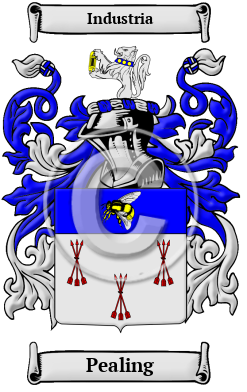
| ![Show Contents]() Pealing History, Family Crest & Coats of Arms Pealing History, Family Crest & Coats of Arms
Etymology of PealingWhat does the name Pealing mean? The name Pealing is of Anglo-Saxon origin and came from when the family lived by the palisade. Peel was a square tower in olden times. 1 2 While the name is generally believed to be Anglo-Saxon, one source notes the name could have been Norman: "Radulphus Pele occurs in Normandy 1180; Robertus Piel 1180-95; William Pele 1198 (Magni Rotuli Scaccarii Normanniae). Of these, Robert, son of Robert le Pele (c. t. Henry II.), gave lands in Monk Bretton, York, to the abbey there. From this northern family descended the Peels of Yorkshire and Lancashire, ancestors of the celebrated minister of England, Sir Robert Peel." 3 Early Origins of the Pealing familyThe surname Pealing was first found in Lincolnshire where Walter Pele was registered in the Assize Rolls for 1202. In 1238, Henry Pele was listed in the Feet of Fines for Yorkshire and later, Robert Peel was recorded in Nottinghamshire in 1382. Somerset records show Robert de Pele there in 1199. 4 "Many old mansions still bear the name of 'the Peel' in the North of England. Peel Castle in Furness is well known, and no doubt 'John Peel' of Cumberland hunting celebrity got his name from that spot. The name is still well known in that county. " 2 "Within my recollection, almost every old house in the dales of Rede and Tyne was what is called a peel-house, built for securing the inhabitants and their cattle in moss-trooping times." 5 Early History of the Pealing familyThis web page shows only a small excerpt of our Pealing research. Another 103 words (7 lines of text) covering the years 1556, 1565, 1598, 1890 and 1965 are included under the topic Early Pealing History in all our PDF Extended History products and printed products wherever possible. Pealing Spelling VariationsIt is only in the last few hundred years that the English language has been standardized. For that reason, early Anglo-Saxon surnames like Pealing are characterized by many spelling variations. As the English language changed and incorporated elements of other European languages, even literate people changed the spelling of their names. Scribes and monks in the Middle Ages spelled names they sounded, so it is common to find several variations that refer to a single person. The variations of the name Pealing include: Peel, Peal, Peale, Peele and others. Early Notables of the Pealing familyGeorge Peele (c1556-1598), Elizabethan translator, poet, and dramatist who some claim collaborated with William Shakespeare on the play Titus Andronicus; and Sir Robert Peel, statesman, who as Home Secretary, two-time Prime Minister of the United Kingdom, he re-organized the London Police Force. One of his sons Arthur Wellesley Peel was speaker of the...
Another 52 words (4 lines of text) are included under the topic Early Pealing Notables in all our PDF Extended History products and printed products wherever possible. Migration of the Pealing family to IrelandSome of the Pealing family moved to Ireland, but this topic is not covered in this excerpt.
Another 57 words (4 lines of text) about their life in Ireland is included in all our PDF Extended History products and printed products wherever possible.
| Pealing migration to Australia | + |
Emigration to Australia included the First Fleet of convicts, tradespeople and early settlers. Early immigrants include: First Fleet - Miss Hannah Pealing, (Peeling), (1769 - 1799), aged 18, British settler convicted in London, England in 1787, sentenced to 7 years for stealing, transported aboard the ship "Lady Juliana" leaving in 1789 arriving in New South Wales, Australia in 1790 6
The motto was originally a war cry or slogan. Mottoes first began to be shown with arms in the 14th and 15th centuries, but were not in general use until the 17th century. Thus the oldest coats of arms generally do not include a motto. Mottoes seldom form part of the grant of arms: Under most heraldic authorities, a motto is an optional component of the coat of arms, and can be added to or changed at will; many families have chosen not to display a motto.
Motto: Industria
Motto Translation: Industrious.
- Halliwell, James Orchard. A Dictionary of Archaic and Provincial WordsLondon: John Russel Smith, Old Compton Street, Soho, 1848, Digital, 2 Vols
- Bardsley, C.W, A Dictionary of English and Welsh Surnames: With Special American Instances. Wiltshire: Heraldry Today, 1901. Print. (ISBN 0-900455-44-6)
- The Norman People and Their Existing Descendants in the British Dominions and the United States Of America. Baltimore: Genealogical Publishing, 1975. Print. (ISBN 0-8063-0636-X)
- Reaney, P.H and R.M. Wilson, A Dictionary of English Surnames. London: Routledge, 1991. Print. (ISBN 0-415-05737-X)
- Lower, Mark Anthony, Patronymica Britannica, A Dictionary of Family Names of the United Kingdom. London: John Russel Smith, 1860. Print.
- Convict Records of Australia. Retrieved 4th February 2021 from https://convictrecords.com.au/ships
 |