| ![Show Contents]() Oyry History, Family Crest & Coats of Arms Oyry History, Family Crest & Coats of Arms
Etymology of OyryWhat does the name Oyry mean? The Dalriadan kingdom of ancient Scotland was the home of the ancestors of the Oyry family. Their name indicates that they lived on a bank, or on the edge of a hill. The Oyry surname arose independently from different sources. In some instances, it came from the Old English word ora, which means "edge" and was probably a name for someone who lived on a bank, or on the edge of a hill. Oyry also came form the Old Norse name Orri, which meant "black rooster." 1 It also emerged from the Gaelic word, odhar, which meant "pale" and would have been a nickname that became a surname. 2 Early Origins of the Oyry familyThe surname Oyry was first found in Renfrewshire (Gaelic: Siorrachd Rinn Friù), a historic county of Scotland, today encompassing the Council Areas of Renfrew, East Renfrewshire, and Iverclyde, in the Strathclyde region of southwestern Scotland. "It is a numerous name in the West end of the shire of Renfrew in the parish of Lochwinnoch. Hew Orr rendered homage in 1296 [to King Edward I of England]. Four persons named Or were summoned to answer charges made against them by the abbot of Paisley, 1503. John Or was witness in Glasgow, 1550, Matthew Ore in Paisley, 1654, and James Orre in Barneth, 1678." 3 There are also scattered entries for the family in England. The Hundredorum Rolls of 1273 list Egidiu de Or in Kent and later the Yorkshire Poll Tax Rolls of 1379 include: Matilda Orre; and Johannes Ore. 4 Roger Orre was listed in the Assize Rolls for Lincolnshire in 1202 and William Orre was listed at Wakefield, Yorkshire in 1277. Robert Orre was found in Kent in the Subsidy Rolls for 1334-1335. Agnes de Ore was listed in the Pipe Rolls for Wiltshire, 1210-1211 and Peter de Ore was found in Warwickshire, 1264-1265. William de Ore was found in the Subsidy Rolls for Kent in 1334-1335. 5 And to the far south of England in Devon, "the original Cathedral of Crediton was dedicated to the Virgin, and stood on or near the site of the present Collegiate Church of the Holy Cross. Herein it is recorded that on the 1st of August, 1315, one Thomas Orey, of Keynesham, who had been totally blind, recovered his sight after spending two days in prayer before the altar of St. Nicholas. Bishop Stapledon, being satisfied of the truth of the miracle, ordered the bells to be rung and a solemn thanksgiving offered, and set forth the event in his 'Register.' " 6 Early History of the Oyry familyThis web page shows only a small excerpt of our Oyry research. Another 237 words (17 lines of text) covering the years 1296, 1503, 1512, 1550, 1578, 1613, 1640, 1654, 1678, 1717, 1740, 1748, 1770, 1797, 1798, 1816 and 1890 are included under the topic Early Oyry History in all our PDF Extended History products and printed products wherever possible. Oyry Spelling VariationsTranslation in medieval times was an undeveloped science and was often carried out without due care. For this reason, many early Scottish names appeared radically altered when written in English. The spelling variations of Oyry include Orr, Ore, Orre, Orey and others. Early Notables of the Oyry familyHugh Orr (1717-1798), Scottish born inventor, son of Robert Orr of Lochwinnoch, Renfrewshire, born at Lochwinnoch on 13 Jan. 1717. "Brought up to the trade of a gunsmith and door-lock filer, at the age of twenty he emigrated to America, and in June 1740 he settled at Bridgewater, in Massachusetts, where he manufactured scythes and edge-tools. He set up the first trip-hammer ever constructed in Massachusetts, and he succeeded in spreading the manufacture of edge-tools through Massachusetts, Rhode Island, and Connecticut. In 1748 he made five hundred muskets for the province of Massachusetts Bay, believed to have been the first weapons...
Another 109 words (8 lines of text) are included under the topic Early Oyry Notables in all our PDF Extended History products and printed products wherever possible. Migration of the Oyry family to IrelandSome of the Oyry family moved to Ireland, but this topic is not covered in this excerpt.
Another 210 words (15 lines of text) about their life in Ireland is included in all our PDF Extended History products and printed products wherever possible. Migration of the Oyry familyThe descendants of the Dalriadan families who made the great crossing of the Atlantic still dot communities along the east coast of the United States and Canada. In the American War of Independence, many of the settlers traveled north to Canada as United Empire Loyalists. Clan societies and highland games have allowed Canadian and American families of Scottish descent to recover much of their lost heritage. Investigation of the origins of family names on the North American continent has revealed that early immigrants bearing the name Oyry or a variant listed above include: Alexander Orr who arrived in New York state in 1803; Arthur, Charles, George, Hannah, James, John, Martha, Mary, Patrick, Robert, Samuel, Thomas and William all arrived in Pennsylvania between 1840 and 1860..
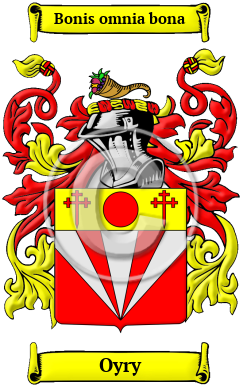
The motto was originally a war cry or slogan. Mottoes first began to be shown with arms in the 14th and 15th centuries, but were not in general use until the 17th century. Thus the oldest coats of arms generally do not include a motto. Mottoes seldom form part of the grant of arms: Under most heraldic authorities, a motto is an optional component of the coat of arms, and can be added to or changed at will; many families have chosen not to display a motto.
Motto: Bonis omnia bona
Motto Translation: All things are good to the good.
- Barber, Henry, British Family Names London: Elliot Stock, 62 Paternoster Row, 1894. Print.
- Smith, Eldson Coles, New Dictionary of American Family Names New York: Harper & Row, 1956. Print
- Black, George F., The Surnames of Scotland Their Origin, Meaning and History. New York: New York Public Library, 1946. Print. (ISBN 0-87104-172-3)
- Bardsley, C.W, A Dictionary of English and Welsh Surnames: With Special American Instances. Wiltshire: Heraldry Today, 1901. Print. (ISBN 0-900455-44-6)
- Reaney, P.H and R.M. Wilson, A Dictionary of English Surnames. London: Routledge, 1991. Print. (ISBN 0-415-05737-X)
- Worth, R.N., A History of Devonshire London: Elliot Stock, 62, Paternoster Row, E.G., 1895. Digital
 |