| ![Show Contents]() Murdoc History, Family Crest & Coats of Arms Murdoc History, Family Crest & Coats of Arms
Etymology of MurdocWhat does the name Murdoc mean? The name Murdoc is an age-old Dalriadan-Scottish nickname for a person associated with the sea. The name Murdoc derives from one of two Gaelic names which have become indistinguishable from each other. The first of these, Muireach, means belonging to the sea or a mariner. The second name is Murchadh, which means sea warrior. 1 Early Origins of the Murdoc familyThe surname Murdoc was first found in Ayrshire (Gaelic: Siorrachd Inbhir Àir), formerly a county in the southwestern Strathclyde region of Scotland, that today makes up the Council Areas of South, East, and North Ayrshire, where they held a family seat from early times. "Murdac was Dean of Appleby, Westmorland, 1175. Walter Murdac, Morthaich, or Murdoch was a person of prominence in the reign of William the Lion and figures as witness in several charters and other Murthacs or Murdaks are mentioned about the same time and in the following century. Murdoch, second duke of Albany, executed in 1425, is referred to in English records as: Mordac, Mordake, Mordik, Mordoc, Mordok, Mordyk, Moreduc, Mourdac, and Murthak. William Murdoch (1754-1839), inventor of gas-lighting, was proclaimed a deity by Nassred-din, Shah of Persia, who believed him to be a re-incarnation of Merodach or Marduk, 'god of light.' " 1 In England, "Robert filius Murdac, and ' one Meurdoch ' occur in Domesday [Book of 1086.]" 2 Another source notes that in Yorkshire, "Murdac, Murdoc, Meurdoch were all listed in the Domesday Book. And this source notes the name was "introduced into Yorkshire before the Conquest by Norwegians from Ireland." 3 In early rolls the name appeared as a forename and surname: Mariedoc Bohhan in the Pipe Rolls for Shropshire in 1160; Geoffrey Murdac in the Pipe Rolls for Yorkshire in 1130; Roger Murdac in the Pipe Rolls for Staffordshire in 1182; Ralph Murdac in Derbyshire in 1197; Sibilla Murdac in the Pipe Rolls for Gloucestershire in 1199; and Nicholas Murdoc in Berkshire. 3 Another source confirms that Murdac, was Dean of Appleby, 32 Henry II (during the 32nd year of King Henry III's reign) 4 and Murdac de Gunton was listed in Warwickshire and Leicestershire, Henry III-Edward I 5 Early History of the Murdoc familyThis web page shows only a small excerpt of our Murdoc research. Another 160 words (11 lines of text) covering the years 1175, 1214, 1296, 1420, 1680 and 1890 are included under the topic Early Murdoc History in all our PDF Extended History products and printed products wherever possible. Murdoc Spelling VariationsThe translation of Gaelic names in the Middle Ages was not a task undertaken with great care. Records from that era show an enormous number of spelling variations, even in names referring to the same person. Over the years Murdoc has appeared as Murdock, Murdoch, Murtoch, Murtough and others. Early Notables of the Murdoc familyMore information is included under the topic Early Murdoc Notables in all our PDF Extended History products and printed products wherever possible. Migration of the Murdoc family to IrelandSome of the Murdoc family moved to Ireland, but this topic is not covered in this excerpt.
Another 57 words (4 lines of text) about their life in Ireland is included in all our PDF Extended History products and printed products wherever possible.
| Murdoc migration to the United States | + |
Dalriadan families proliferated in North America. Their descendants still populate many communities in the eastern parts of both the United States and Canada. Some settled in Canada as United Empire Loyalists, in the wake of the American War of Independence. Families on both sides of the border have recovered much of their heritage in the 20th century through Clan societies and highland games. Analysis of immigration records indicates that some of the first North American immigrants bore the name Murdoc or a variant listed above:
Murdoc Settlers in United States in the 19th Century- William Murdoc, who landed in Mississippi in 1848 6
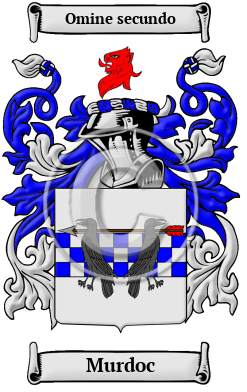
The motto was originally a war cry or slogan. Mottoes first began to be shown with arms in the 14th and 15th centuries, but were not in general use until the 17th century. Thus the oldest coats of arms generally do not include a motto. Mottoes seldom form part of the grant of arms: Under most heraldic authorities, a motto is an optional component of the coat of arms, and can be added to or changed at will; many families have chosen not to display a motto.
Motto: Omine secundo
Motto Translation: With favourable omen.
- Black, George F., The Surnames of Scotland Their Origin, Meaning and History. New York: New York Public Library, 1946. Print. (ISBN 0-87104-172-3)
- Lower, Mark Anthony, Patronymica Britannica, A Dictionary of Family Names of the United Kingdom. London: John Russel Smith, 1860. Print.
- Reaney, P.H and R.M. Wilson, A Dictionary of English Surnames. London: Routledge, 1991. Print. (ISBN 0-415-05737-X)
- Bardsley, C.W, A Dictionary of English and Welsh Surnames: With Special American Instances. Wiltshire: Heraldry Today, 1901. Print. (ISBN 0-900455-44-6)
- Testa de Nevill or "Liber Feodorum" or "Book of Fees," thought to have been written by Ralph de Nevill, for King John (1199–1216)
- Filby, P. William, Meyer, Mary K., Passenger and immigration lists index : a guide to published arrival records of about 500,000 passengers who came to the United States and Canada in the seventeenth, eighteenth, and nineteenth centuries. 1982-1985 Cumulated Supplements in Four Volumes Detroit, Mich. : Gale Research Co., 1985, Print (ISBN 0-8103-1795-8)
 |