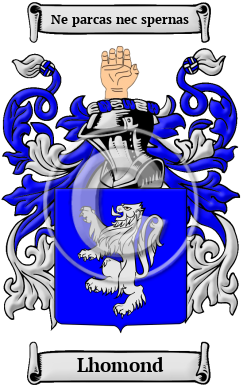
| ![Show Contents]() Lhomond History, Family Crest & Coats of Arms Lhomond History, Family Crest & Coats of Arms
Etymology of LhomondWhat does the name Lhomond mean? The distinguished surname Lhomond came to Scotland from Normandy in the 11th century. The surname Lhomond comes from the medieval given name Lagman. Lhomond is a patronymic surname, which belongs to the category of hereditary surnames. Lhomond is derived from the Gaelic name "MacErcharwhich" which comes from the Old Norman "Logmadr." Both words mean " the law man." The Clan's early history is linked with an ancient King of Dalriada, Comgall, who was killed in 537 AD. It is from this king that the district of Cowal received its name. The Kindred of Comgall (Clan Lamont) is mentioned in the 7th century records Senchus Fern Alban (an account of the men of Scotland) and the earliest territories of the Clan included the island of Bute and Arran. Early Origins of the Lhomond familyThe surname Lhomond was first found in Argyllshire (Gaelic erra Ghaidheal), the region of western Scotland corresponding roughly with the ancient Kingdom of Dál Riata, in the Strathclyde region of Scotland, now part of the Council Area of Argyll and Bute, where they were granted lands by King David. One of the first known records is of John Lamont, who, in 1296, rendered homage to King Edward I of England during the latter's brief conquest of Scotland. John Lamont is described as Chief of the Clan Lamont, son of Lagman, who was son of Gilcom M'Ferchar. His brother, Molmure, also a knight, married Christina, daughter of Alexander in 1290. However, earlier records show a reference to a Ladhmunn who was son of David, the son of King Malcolm III of Scotland. The link between Ladhmunn and Ferchar, a Chief in Cowal about 1200, is not clear, even though this Ferchar had two sons, Duncan and Malcolm, both of whom granted lands to the monks at Paisley. By this time the Clan had developed branches at Perth, Argyll, the Clan seat at Cowal, and was establishing its Castles at Toward and Ascog. Early History of the Lhomond familyThis web page shows only a small excerpt of our Lhomond research. Another 350 words (25 lines of text) covering the years 1456, 1539, 1663, 1890, 1906, 1929 and 1953 are included under the topic Early Lhomond History in all our PDF Extended History products and printed products wherever possible. Lhomond Spelling VariationsSpelling variations of this family name include: Lamont, Lamonte, Lamond, Lammon, Lamon, Lamount and many more. Early Notables of the Lhomond familyMore information is included under the topic Early Lhomond Notables in all our PDF Extended History products and printed products wherever possible. Migration of the Lhomond family to IrelandSome of the Lhomond family moved to Ireland, but this topic is not covered in this excerpt.
Another 40 words (3 lines of text) about their life in Ireland is included in all our PDF Extended History products and printed products wherever possible. Migration of the Lhomond familySome of the first settlers of this family name or some of its variants were: John Lammon who settled in New York in 1710; James Lamon settled in Philadelphia in 1814; Robert Lamond settled in New England in 1718; John Lamont settled in New Hampshire in 1718.
| Contemporary Notables of the name Lhomond (post 1700) | + |
- Charles François Lhomond (1727-1794), French grammarian and educator
The motto was originally a war cry or slogan. Mottoes first began to be shown with arms in the 14th and 15th centuries, but were not in general use until the 17th century. Thus the oldest coats of arms generally do not include a motto. Mottoes seldom form part of the grant of arms: Under most heraldic authorities, a motto is an optional component of the coat of arms, and can be added to or changed at will; many families have chosen not to display a motto.
Motto: Ne parcas nec spernas
Motto Translation: Neither spare nor dispose.
 |