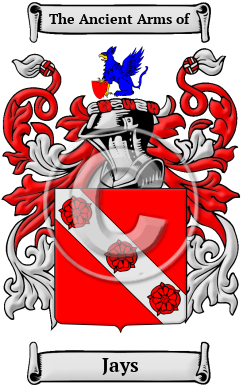
| ![Show Contents]() Jays History, Family Crest & Coats of Arms Jays History, Family Crest & Coats of Arms
Etymology of JaysWhat does the name Jays mean? The name Jays came to England with the ancestors of the Jays family in the Norman Conquest of 1066. The Jays family lived in Herefordshire. Their name, however, derives from the family's place of residence prior to the Norman Conquest of England in 1066, De Gai, Normandy. 1 Others sources claim the name is a nickname for ' the jay,' a chatterer, a smartly dressed person. 2 3 4 Early Origins of the Jays familyThe surname Jays was first found in Herefordshire at Heath, with Jay, a township, in the parish of Leintwardine, union of Ludlow, hundred of Wigmore. 5 This small township had only 55 inhabitants in the late 1800s and comprises the hamlets of Heath and Jay. 6 7 One of the first records of the family was Gilber Jai (Gai) who was listed in the Pipe Rolls for Lincolnshire in 1202. A few years later, Tandy de Jay was listed in the Assize Rolls for Shropshire in 1221 and Walter le Jay was found in the Assize Rolls for Somerset in 1225. 8 In Somerset, William le Jay was listed there 1 Edward III (during the first year of King Edward III's reign.) 9 "Brian de Jay was the last Master of the English Knights Templars. He was the only Englishman of note slain at the battle of Falkirk in 1298 and his fellow Master of the Order in Scotland, fighting along with Jay, was also killed." 10 Early History of the Jays familyThis web page shows only a small excerpt of our Jays research. Another 105 words (8 lines of text) covering the years 1495, 1511, 1529, 1530, 1534, 1553, 1630, 1697, 1699, 1722, 1734 and 1790 are included under the topic Early Jays History in all our PDF Extended History products and printed products wherever possible. Jays Spelling VariationsMultitudes of spelling variations are a hallmark of Anglo Norman names. Most of these names evolved in the 11th and 12th century, in the time after the Normans introduced their own Norman French language into a country where Old and Middle English had no spelling rules and the languages of the court were French and Latin. To make matters worse, medieval scribes spelled words according to sound, so names frequently appeared differently in the various documents in which they were recorded. The name was spelled Jay, Jaye, Jayes and others. Early Notables of the Jays familyGeorge Joye (also Joy and Jaye) (c. 1495 - 1553), a 16th-century Bible translator who produced the first printed translation of several books of the Old Testament into English (1530-1534), as well as the first English Primer (1529). Francis Joy (1697?-1790), was a printer, papermaker, and journalist, born at Belfast about 1697. "His family claims descent from Captain Thomas Joy, a follower of Arthur Chichester, Lord Chichester of Belfast. Francis Joy is said to have been originally a tailor; but the authority for this statement adds, with manifest exaggeration, that on setting up as a printer he 'by mere dint of genius...
Another 132 words (9 lines of text) are included under the topic Early Jays Notables in all our PDF Extended History products and printed products wherever possible. Migration of the Jays familyBecause of this political and religious unrest within English society, many people decided to immigrate to the colonies. Families left for Ireland, North America, and Australia in enormous numbers, traveling at high cost in extremely inhospitable conditions. The New World in particular was a desirable destination, but the long voyage caused many to arrive sick and starving. Those who made it, though, were welcomed by opportunities far greater than they had known at home in England. Many of these families went on to make important contributions to the emerging nations of Canada and the United States. Analysis of immigration records indicates that some of the first North American immigrants bore the name Jays or a variant listed above: Thomas Jay settled in Virginia in 1635; William Jay settled in Barbados in 1663; Thomas Jay settled in Barbados in 1654.
- The Norman People and Their Existing Descendants in the British Dominions and the United States Of America. Baltimore: Genealogical Publishing, 1975. Print. (ISBN 0-8063-0636-X)
- Bardsley, C.W, A Dictionary of English and Welsh Surnames: With Special American Instances. Wiltshire: Heraldry Today, 1901. Print. (ISBN 0-900455-44-6)
- Smith, Eldson Coles, New Dictionary of American Family Names New York: Harper & Row, 1956. Print
- Harrison, Henry, Surnames of the United Kingdom: A Concise Etymological Dictionary Baltimore: Geneological Publishing Company, 2013. Print
- Lewis, Samuel, A Topographical Dictionary of England. Institute of Historical Research, 1848, Print.
- Lower, Mark Anthony, Patronymica Britannica, A Dictionary of Family Names of the United Kingdom. London: John Russel Smith, 1860. Print.
- Barber, Henry, British Family Names London: Elliot Stock, 62 Paternoster Row, 1894. Print.
- Reaney, P.H and R.M. Wilson, A Dictionary of English Surnames. London: Routledge, 1991. Print. (ISBN 0-415-05737-X)
- Dickinson, F.H., Kirby's Quest for Somerset of 16th of Edward the 3rd London: Harrison and Sons, Printers in Ordinary to Her Majesty, St, Martin's Lane, 1889. Print.
- Cleveland, Dutchess of The Battle Abbey Roll with some Account of the Norman Lineages. London: John Murray, Abermarle Street, 1889. Print. Volume 2 of 3
 |