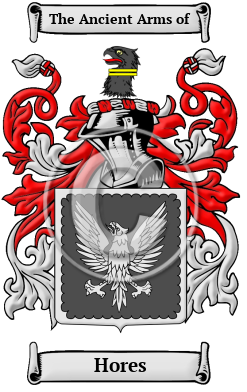
| ![Show Contents]() Hores History, Family Crest & Coats of Arms Hores History, Family Crest & Coats of Arms
Etymology of HoresWhat does the name Hores mean? The name Hores comes from the ancient Anglo-Saxon culture of Britain. It was a name for a person who had grey hair or appeared aged. A broad and miscellaneous class of surnames, nickname surnames, referred to a characteristic of the first person who used the name. They can describe the bearer's favored style of clothing, appearance, habits, or character. 1 Alternatively, the name could have been Norman in origin. In this case, it was derived from the "Norman-French pronunciation of Aure, with an aspirate. The name Aure, Alre, or Auré was a Breton name, derived from Auray, in Bretagne, of which the family were hereditary Castellans." 2 Another source claims the name was from Ore in Sussex and literally meant "dweller by the bank" from the Old English word "ora." 3 Early Origins of the Hores familyThe surname Hores was first found in Suffolk and Middlesex and other counties throughout Britain. By example, William Hore was listed in Suffolk in 1188, Robert, William le Hore was listed in the Assize Rolls of Staffordshire in 1203. Gilbert de Hore was listed in the Pipe Rolls of Sussex in 1200 and Richard de la Hore was listed in the Pipe Rolls of Devon in 1230. 3 The Hundredorum Rolls of 1273 listed: Adam le Hore in Derbyshire, John le Horre in Norfolk, and Alicia la Hore in Oxfordshire. Kirby's Quest of Somerset lists Richard le Hore there temp. 1 Edward III. 1 4 In southern England in the parish of St. Ervan, Cornwall early records of another branch of the family were found. "Another reputed manor in this parish called Trenowth, was for several generations the property and residence of a family called Hore, with whom it remained so late as the time of Norden; but this estate has long since ceased to be considered as a manor." 5 Early History of the Hores familyThis web page shows only a small excerpt of our Hores research. Another 117 words (8 lines of text) covering the years 1188, 1203, 1208, 1230, 1235, 1622, 1630, 1638, 1648, 1675, 1704, 1707, 1710, 1712, 1713, 1719, 1773, 1792 and 1797 are included under the topic Early Hores History in all our PDF Extended History products and printed products wherever possible. Hores Spelling VariationsOnly recently has spelling become standardized in the English language. As the English language evolved in the Middle Ages, the spelling of names changed also. The name Hores has undergone many spelling variations, including Hoar, Hoare, Hore and others. Early Notables of the Hores familyLeonard Hoar (1630-1675), an English-born early American settler, minister and educator born in Gloucestershire arriving in America c. 1638, who later became President of Harvard College. He was the fourth son of Charles Hoare. Some time after the death of his father in 1638 he emigrated with his mother to America. 6
John Hoar (1622-1704), was an American militia leader & Indian liaison in colonial Massachusetts during King Philip's War, best known for securing the release of Mary Rowlandson from Indian captivity at Redemption Rock
Sir Richard Hoare (1648-1719), was Sheriff of London in 1710, Lord Mayor of London for the year of...
Another 136 words (10 lines of text) are included under the topic Early Hores Notables in all our PDF Extended History products and printed products wherever possible. Migration of the Hores family to IrelandSome of the Hores family moved to Ireland, but this topic is not covered in this excerpt.
Another 64 words (5 lines of text) about their life in Ireland is included in all our PDF Extended History products and printed products wherever possible. Migration of the Hores familyTo escape the unstable social climate in England of this time, many families boarded ships for the New World with the hope of finding land, opportunity, and greater religious and political freedom. Although the voyages were expensive, crowded, and difficult, those families that arrived often found greater opportunities and freedoms than they could have experienced at home. Many of those families went on to make significant contributions to the rapidly developing colonies in which they settled. Early North American records indicate many people bearing the name Hores were among those contributors: Thomas Hoar settled in Barbados in 1685; John Hoar settled in Salem in 1823; Edward Hoare settled in Barbados in 1685; John Hoare settled in New England in 1630.
- Bardsley, C.W, A Dictionary of English and Welsh Surnames: With Special American Instances. Wiltshire: Heraldry Today, 1901. Print. (ISBN 0-900455-44-6)
- The Norman People and Their Existing Descendants in the British Dominions and the United States Of America. Baltimore: Genealogical Publishing, 1975. Print. (ISBN 0-8063-0636-X)
- Reaney, P.H and R.M. Wilson, A Dictionary of English Surnames. London: Routledge, 1991. Print. (ISBN 0-415-05737-X)
- Dickinson, F.H., Kirby's Quest for Somerset of 16th of Edward the 3rd London: Harrison and Sons, Printers in Ordinary to Her Majesty, St, Martin's Lane, 1889. Print.
- Hutchins, Fortescue, The History of Cornwall, from the Earliest Records and Traditions to the Present Time. London: William Penaluna, 1824. Print
- Smith, George (ed), Dictionary of National Biography. London: Smith, Elder & Co., 1885-1900. Print
 |