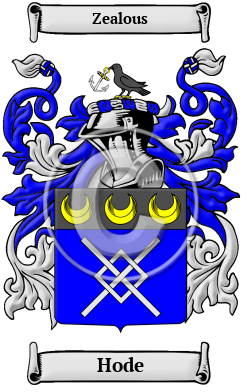
| ![Show Contents]() Hode History, Family Crest & Coats of Arms Hode History, Family Crest & Coats of Arms
Etymology of HodeWhat does the name Hode mean? The name Hode is rooted in the ancient Anglo-Saxon culture. It is a name for someone who worked as a maker of hoods. The surname Hode is derived from the Old English words hod, hud, hood, and hodde, which all come from the Old English word hod, which means hood. 1 2 Occasionally, Hode may be a local surname derived from the settlement of Hood in Rattery in Devon. "In the poem 'Robin Hood(e) and Guy(e) of Gisborne' the name is variantly Hood and Hoode; but the form is Hode in 'A Lytell Geste [Story] of Robyn Hode.'" 3 "The leader of the Surrey men in A.D. 853 was named Huda (Anglo-Saxon Chron., s.a.)." 4 Early Origins of the Hode familyThe surname Hode was first found in Devon where Osberus Hod was the first record of the name in the source Old English Bynames c. 1100-1130. In Cambridgeshire, Walter Hod was listed there c. 1200 and Gilbert Hodde was listed in the Assize Rolls for Somerset in 1225. Robert Hood (Hod) was listed in the Pipe Rolls for Yorkshire in 1230 and Philip Hodde, Hudde was found in Canterbury in 1305. 5 In Somerset, John Hod was listed there 1 Edward III (during the first year of King Edward III's reign.) 6 The Yorkshire Poll Tax Rolls of 1379 included the name in a compound forms: Matilda Hud-doghter and Emma Hud-wyf. 7 In Scotland, "a composition between Andrew, bishop of Moray and Robert Hude (or Hod) relating to the manor of Lamanbrid was made in 1225. Robertus Hud of Leth (Leith), witness in an Inchcolm charter c. 1220-26. Robertus Hod received a payment from the sheriff of Aberdeen, 1264." 4 Early History of the Hode familyThis web page shows only a small excerpt of our Hode research. Another 256 words (18 lines of text) covering the years 1220, 1264, 1320, 1332, 1447, 1467, 1524, 1567, 1573, 1582, 1598, 1668, 1689, 1724, 1752, 1758, 1762, 1798, 1814, 1816 and 1890 are included under the topic Early Hode History in all our PDF Extended History products and printed products wherever possible. Hode Spelling VariationsIt is only in the last few hundred years that the English language has been standardized. For that reason, early Anglo-Saxon surnames like Hode are characterized by many spelling variations. As the English language changed and incorporated elements of other European languages, even literate people changed the spelling of their names. The variations of the name Hode include: Hood, Hoods, Hude, Hud, Hudd, Hode, Hoode and others. Early Notables of the Hode familyThomas Hood (fl. 1582-1598), the English mathematician, son of Thomas Hood, a merchant tailor of London, entered Merchant Taylors' School 7 Nov. 1567, and matriculated at Cambridge as a pensioner of Trinity College in November 1573. 8
Paul Hood D.D. (died 1668), was an English academic administrator at the University of Oxford.
Viscount Samuel Hood (1724-1816), 1st Viscount Hood, was a British...
Another 61 words (4 lines of text) are included under the topic Early Hode Notables in all our PDF Extended History products and printed products wherever possible. Migration of the Hode family to IrelandSome of the Hode family moved to Ireland, but this topic is not covered in this excerpt.
Another 70 words (5 lines of text) about their life in Ireland is included in all our PDF Extended History products and printed products wherever possible.
| Hode migration to the United States | + |
Many English families tired of political and religious strife left Britain for the new colonies in North America. Although the trip itself offered no relief - conditions on the ships were extremely cramped, and many travelers arrived diseased, starving, and destitute - these immigrants believed the opportunities that awaited them were worth the risks. Once in the colonies, many of the families did indeed prosper and, in turn, made significant contributions to the culture and economies of the growing colonies. An inquiry into the early roots of North American families has revealed a number of immigrants bearing the name Hode or a variant listed above:
Hode Settlers in United States in the 19th Century- Matheren Hode, who landed in Mississippi in 1854 9
- H Hode, who arrived in San Francisco, California in 1855 9
The motto was originally a war cry or slogan. Mottoes first began to be shown with arms in the 14th and 15th centuries, but were not in general use until the 17th century. Thus the oldest coats of arms generally do not include a motto. Mottoes seldom form part of the grant of arms: Under most heraldic authorities, a motto is an optional component of the coat of arms, and can be added to or changed at will; many families have chosen not to display a motto.
Motto: Zealous
- Smith, Eldson Coles, New Dictionary of American Family Names New York: Harper & Row, 1956. Print
- Lower, Mark Anthony, Patronymica Britannica, A Dictionary of Family Names of the United Kingdom. London: John Russel Smith, 1860. Print.
- Harrison, Henry, Surnames of the United Kingdom: A Concise Etymological Dictionary Baltimore: Geneological Publishing Company, 2013. Print
- Black, George F., The Surnames of Scotland Their Origin, Meaning and History. New York: New York Public Library, 1946. Print. (ISBN 0-87104-172-3)
- Reaney, P.H and R.M. Wilson, A Dictionary of English Surnames. London: Routledge, 1991. Print. (ISBN 0-415-05737-X)
- Dickinson, F.H., Kirby's Quest for Somerset of 16th of Edward the 3rd London: Harrison and Sons, Printers in Ordinary to Her Majesty, St, Martin's Lane, 1889. Print.
- Bardsley, C.W, A Dictionary of English and Welsh Surnames: With Special American Instances. Wiltshire: Heraldry Today, 1901. Print. (ISBN 0-900455-44-6)
- Smith, George (ed), Dictionary of National Biography. London: Smith, Elder & Co., 1885-1900. Print
- Filby, P. William, Meyer, Mary K., Passenger and immigration lists index : a guide to published arrival records of about 500,000 passengers who came to the United States and Canada in the seventeenth, eighteenth, and nineteenth centuries. 1982-1985 Cumulated Supplements in Four Volumes Detroit, Mich. : Gale Research Co., 1985, Print (ISBN 0-8103-1795-8)
 |