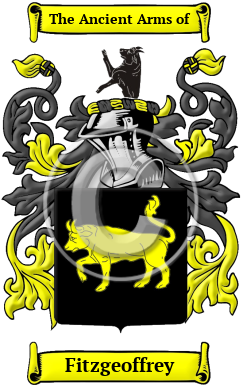
| ![Show Contents]() Fitzgeoffrey History, Family Crest & Coats of Arms Fitzgeoffrey History, Family Crest & Coats of Arms
- Origins Available:
England
Etymology of FitzgeoffreyWhat does the name Fitzgeoffrey mean? The Norman prefix "Fitz," meant "son of" and was used with the father's name, until the father died. When patronymic names became surnames the Fitz became a permanent part of the surname. It has been suggested that the FitzGeoffrey surname came from Geoffrey, Earl of Essex. Early Origins of the Fitzgeoffrey familyThe surname Fitzgeoffrey was first found in Bedfordshire (Old English: Bedanfordscir), located in Southeast-central England, formerly part of the Anglo-Saxon kingdom of Mercia, where they held a family seat as Lords of the Manor. After the Battle of Hastings in 1066, William, Duke of Normandy, having prevailed over King Harold, granted most of Britain to his many victorious Barons. It was not uncommon to find a Baron, or a Bishop, with 60 or more Lordships scattered throughout the country. These he gave to his sons, nephews and other junior lines of his family and they became known as under-tenants. They adopted the Norman system of surnames which identified the under-tenant with his holdings so as to distinguish him from the senior stem of the family. After many rebellious wars between his Barons, Duke William, commissioned a census of all England to determine in 1086, settling once and for all, who held which land. He called the census the Domesday Book, 1 indicating that those holders registered would hold the land until the end of time. Hence, conjecturally, the surname is descended from the tenant of the lands of Blackburn Hall in Bedfordshire who was recorded in the Domesday Book census of 1086. Sir John Fitzgeoffrey was one of the Barons who rebelled against King John and was at Runnymede in 1215 at the signing of the Magna Carta. Early History of the Fitzgeoffrey familyThis web page shows only a small excerpt of our Fitzgeoffrey research. Another 70 words (5 lines of text) covering the years 1511, 1575, 1611, 1617 and 1638 are included under the topic Early Fitzgeoffrey History in all our PDF Extended History products and printed products wherever possible. Fitzgeoffrey Spelling VariationsEndless spelling variations are a prevailing characteristic of Norman surnames. Old and Middle English lacked any definite spelling rules, and the introduction of Norman French added an unfamiliar ingredient to the English linguistic stew. French and Latin, the languages of the court, also influenced spellings. Finally, Medieval scribes generally spelled words according to how they sounded, so one person was often referred to by different spellings in different documents. The name has been spelled FitzGefferey, FitzGeofferey, FitzGeferey, FitzGeffrey, FitzGeoffry, FitzGeoffrey and many more. Early Notables of the Fitzgeoffrey familyCharles Fitzgeffrey (1575?-1638), Cornish poet and divine, born at Fowey in Cornwall about 1575, son of Alexander Fitzgeffrey, a clergyman who had migrated from Bedfordshire. 2 Henry Fitzgeffrey (fl. 1617), English writer of satires and epigrams, "is commonly assumed to have been a son of Charles Fitzgeffrey, but...
Another 47 words (3 lines of text) are included under the topic Early Fitzgeoffrey Notables in all our PDF Extended History products and printed products wherever possible. Migration of the Fitzgeoffrey familyTo escape the political and religious persecution within England at the time, many English families left for the various British colonies abroad. The voyage was extremely difficult, though, and the cramped, dank ships caused many to arrive in the New World diseased and starving. But for those who made it, the trip was most often worth it. Many of the families who arrived went on to make valuable contributions to the emerging nations of Canada and the United States. An inquiry into the early roots of North American families reveals a number of immigrants bearing the name Fitzgeoffrey or a variant listed above: George Fitzgeffrey, who arrived in Virginia in 1623; and William Fitzgeffrey, who arrived in Virginia in 1623.
- Williams, Dr Ann. And G.H. Martin, Eds., Domesday Book A Complete Translation. London: Penguin, 1992. Print. (ISBN 0-141-00523-8)
- Smith, George (ed), Dictionary of National Biography. London: Smith, Elder & Co., 1885-1900. Print
 |