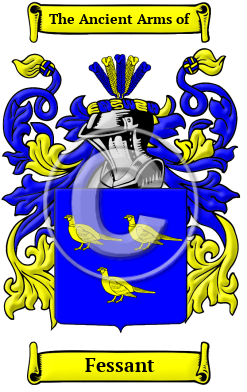
| ![Show Contents]() Fessant History, Family Crest & Coats of Arms Fessant History, Family Crest & Coats of Arms
Etymology of FessantWhat does the name Fessant mean? The ancient name Fessant is a Norman name that would have been developed in England after the Norman Conquest of England in 1066. This name was a name given to a pheasant, derived from the Middle English word "fesaunt" 1 which in turn was derived from the Old French word "faisain." 2 Not all of the family emigrated to England, as the Magni Rotuli Scaccarii Normanniae lists Radulphus le Paisant in Normandy 1180-1195. 3 Early Origins of the Fessant familyThe surname Fessant was first found in Sussex where John Falsant was listed in the Pipe Rolls for 1166. Later, Thomas Fesaunt was found in the Assize Rolls for Warwickshire in 1221 and Richard le Feisant, le Falsant was found in Jersey in 1229. In Oxfordshire, Roger Fesant was listed at Oseney in 1241. 1 Again, in Oxfordshire the Hundredorum Rolls of 1273 included an entry for Robert Fesuant. The Close Rolls of Edward III included an entry for John ffesaunt. 2 (The use of "ff" was not uncommon at this time.) Willelmus Faysand was listed in the Yorkshire Poll Tax Rolls of 1379. In Norfolk, we found William Fesaunt was rector of Wood Rysing, Norfolk in 1380. 4 On the lighter side, one researcher noted that "In England I have heard of a Miss Partridge, who married a Mr. Pheasant, and her sister married a Mr. Partridge. There was some other bird in the family." 5 This researcher postulates "this name, as well as Fesant, Fazan, Fazon, are probably from Lepheasant, near St. Austel, [Cornwall, England.]" Early History of the Fessant familyThis web page shows only a small excerpt of our Fessant research. Another 139 words (10 lines of text) covering the years 1172, 1476, 1510, 1550, 1580, 1600, 1642, 1643, 1649 and 1767 are included under the topic Early Fessant History in all our PDF Extended History products and printed products wherever possible. Fessant Spelling VariationsBefore the last few hundred years the English language had no fixed system of spelling rules. For that reason, spelling variations occurred commonly in Anglo Norman surnames. Over the years, many variations of the name Fessant were recorded, including Phessant, Pheasant, Pheassant, Phessent, Fessant, Fesant, Fessant, Vessent and many more. Early Notables of the Fessant familyPeter Phesant (1580-1649), an English judge, son of Peter Phesant, barrister-at-law, of Gray's Inn. He was born probably at his father's manor of Barkwith, Lincolnshire. He...
Another 26 words (2 lines of text) are included under the topic Early Fessant Notables in all our PDF Extended History products and printed products wherever possible. Migration of the Fessant family to IrelandSome of the Fessant family moved to Ireland, but this topic is not covered in this excerpt.
Another 62 words (4 lines of text) about their life in Ireland is included in all our PDF Extended History products and printed products wherever possible. Migration of the Fessant familyThe unstable environment in England at this time caused numerous families to board ships and leave in search of opportunity and freedom from persecution abroad in places like Ireland, Australia, and particularly the New World. The voyage was extremely difficult, however, and only taken at great expense. The cramped conditions and unsanitary nature of the vessels caused many to arrive diseased and starving, not to mention destitute from the enormous cost. Still opportunity in the emerging nations of Canada and the United States was far greater than at home and many went on to make important contributions to the cultures of their adopted countries. An examination of many early immigration records reveals that people bearing the name Fessant arrived in North America very early: the name represented in many forms and recorded from the mid 17th century in the great migration from Europe. Migrants settled in the eastern seaboard from Newfoundland, to Maine, to Virginia, the Carolinas, and to the islands..
- Reaney, P.H and R.M. Wilson, A Dictionary of English Surnames. London: Routledge, 1991. Print. (ISBN 0-415-05737-X)
- Bardsley, C.W, A Dictionary of English and Welsh Surnames: With Special American Instances. Wiltshire: Heraldry Today, 1901. Print. (ISBN 0-900455-44-6)
- The Norman People and Their Existing Descendants in the British Dominions and the United States Of America. Baltimore: Genealogical Publishing, 1975. Print. (ISBN 0-8063-0636-X)
- Rye, Walter, A History of Norfolk. London: Elliot Stock, 62, Paternoster Row, 1885. Print
- Charnock, Richard, Stephen, Ludus Patronymicus of The Etymology of Curious Surnames. London: Trubner & Co., 60 Paternoster Row, 1868. Print.
 |