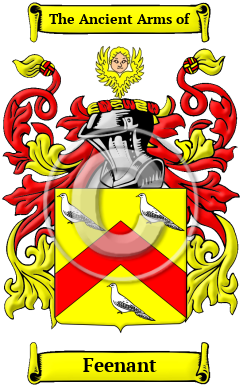
| ![Show Contents]() Feenant History, Family Crest & Coats of Arms Feenant History, Family Crest & Coats of Arms
Etymology of FeenantWhat does the name Feenant mean? The roots of the Feenant surname in Ireland are somewhat unclear; it seems that the name was both native Irish Gaelic, and Norman. The Gaelic name ó Fionnáin seems to be derived from Gaelic word "fionn," which means "fair," and has been Anglicized as "Finan" and "Fanning," both of which are Norman names that came to Ireland in the 12th century. As a Norman name, Feenant is generally thought to be derived from the Norman personal name Panin. Early Origins of the Feenant familyThe surname Feenant was first found in Limerick (Irish: Luimneach) located in Southwestern Ireland, in the province of Munster, where Fanningstoown, previously known as Ballyfanning can be found, as well as in neighboring Tipperary where this Norman family settled at Ballingarry. 1 One line of thinking is that they were originally from Fainent in Normandy, and arrived in England during the Norman Conquest of 1066, and came to Ireland in the 12th century. 2 Saint Finan (d. 661), was ordained in Scotland according to the rites of the Columban church. His diocese at Lindisfarne embraced nearly all Northumbria. He rose to become Bishop of Lindisfarne and and succeeded in the see of Lindisfarne in 652. 3 In England, Thomas Fannyng was listed in the Feet of Fines for Essex in 1405 where it is possibly a variant of Fenning. 4 David Fenning was listed in Norfolk c. 1248 and John ffening was recorded there in 1290. 4 Early History of the Feenant familyThis web page shows only a small excerpt of our Feenant research. Another 157 words (11 lines of text) covering the years 1636, 1651 and 1901 are included under the topic Early Feenant History in all our PDF Extended History products and printed products wherever possible. Feenant Spelling VariationsChurch officials and medieval scribes often spelled early surnames as they sounded. This practice often resulted in many spelling variations of even a single name. Early versions of the name Feenant included: Feenan, Fanning, Fannin, Fanningley, Fannon, Finan, Finnan, O'Finan and many more. Early Notables of the Feenant familyMore information is included under the topic Early Feenant Notables in all our PDF Extended History products and printed products wherever possible. Migration of the Feenant familyIn the mid-19th century, Ireland experienced one of the worst periods in its entire history. During this decade in order to ease the pressure of the soil, which was actually depleted by the effects of the previous years' grain crops, landowners forced tenant farmers and peasants onto tiny plots of land that barely provided the basic sustenance a family required. Conditions were worsened, though, by the population of the country, which was growing fast to roughly eight million. So when the Great Potato Famine of the mid-1840s hit, starvation and diseases decimated the population. Thousands of Irish families left the country for British North America and the United States. The new immigrants were often accommodated either in the opening western frontiers or as cheap unskilled labor in the established centers. In early passenger and immigration lists there are many immigrants bearing the name Feenant: Edmund Fanning, who settled in New London, CT in 1653; Andrew Fanning, who settled in New England in 1678; John Fanning, who settled in Boston Massachusetts in 1766.
- MacLysaght, Edward, More Irish Families. Dublin: Irish Academic Press, 1982. Print. (ISBN 0-7165-0126-0)
- The Norman People and Their Existing Descendants in the British Dominions and the United States Of America. Baltimore: Genealogical Publishing, 1975. Print. (ISBN 0-8063-0636-X)
- Smith, George (ed), Dictionary of National Biography. London: Smith, Elder & Co., 1885-1900. Print
- Reaney, P.H and R.M. Wilson, A Dictionary of English Surnames. London: Routledge, 1991. Print. (ISBN 0-415-05737-X)
 |