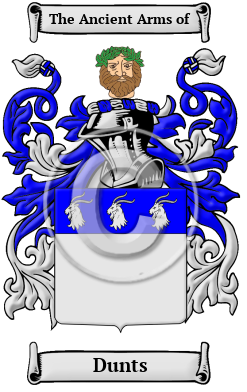
| ![Show Contents]() Dunts History, Family Crest & Coats of Arms Dunts History, Family Crest & Coats of Arms
- Origins Available:
England
Etymology of DuntsWhat does the name Dunts mean? The ancestry of the name Dunts dates from the ancient Anglo-Saxon culture of Britain. It comes from when the family lived in Dunton of which there are five parishes in England. Parishes can be found in Bedfordshire, Buckinghamshire, Norfolk, Leicestershire and Essex. The last is of particular importance. Now known as Dunton-Waylett, it dates back to the Domesday Book of 1086. "At the time of the Norman survey, the manor of Dunton Hall belonged to Odo, Bishop of Bayeaux, by whom it was bestowed on the abbey of Bec, in Normandy; and on the suppression of alien priories it was granted to King's College, Cambridge." The Waylett suffix like the suffix for Dunton-Basset (Leicestershire) were added later to denote the family who held their family seat there. Actually there are more entries in the Domesday Book that should be mentioned now: Dodintone, Buckinghamshire; Donitone, Bedfordshire; Dontuna, Norfolk; and Donitone, Leicestershire. All of these place names evolved to be known as Dunton. 1 The manor of Dunton, with Doughton was " given by Henry VII. to Ralph de Hauville, to be held by service of keeping the king's falcons; it passed in the reign of Elizabeth to Lord Chief Justice Coke." 2 As far as the etymology of the name, there are two schools of thought. The first is the it meant "farmstead on a hill," from the Old English "dun" + "tan." 3 The second was an "estate associated with a man called Dudda or Dodda," from the Old English personal name + "tun." 1 Early Origins of the Dunts familyThe surname Dunts was first found in Norfolk where Gilbert de Dunton was registered in the Testa de Nevill, sive Liber Feodorum, temp. Henry III-Edward I. The same source notes John de Dunton, Lincolnshire. 4 The Hundredorum Rolls of 1273 listed Isabella de Dunton, Salop (Shropshire) and Jordan de Duntone, Oxfordshire. 5 The Subsidy Rolls of Worcestershire listed Richard de la Duntun in 1275 and Ralph de Dunton was listed in the Subsidy Rolls for Sussex in 1296. 6 Early History of the Dunts familyThis web page shows only a small excerpt of our Dunts research. Another 77 words (6 lines of text) covering the years 1280, 1400, 1593, 1659, 1660 and 1733 are included under the topic Early Dunts History in all our PDF Extended History products and printed products wherever possible. Dunts Spelling VariationsSpelling variations in names were a common occurrence before English spelling was standardized a few hundred years ago. In the Middle Ages, even the literate spelled their names differently as the English language incorporated elements of French, Latin, and other European languages. Many variations of the name Dunts have been found, including Dunton, Duntin and others. Early Notables of the Dunts familyJohn Dunton (1659-1733), and English writer, publisher and bookseller; he produced a periodical called the Athenian Gazette. "His father, grandfather, and great-grandfather were all named John Dunton, and had all been clergymen. His father had been fellow of Trinity College, Cambridge, and at the time of his birth...
Another 48 words (3 lines of text) are included under the topic Early Dunts Notables in all our PDF Extended History products and printed products wherever possible.
| Dunts migration to the United States | + |
Families began migrating abroad in enormous numbers because of the political and religious discontent in England. Often faced with persecution and starvation in England, the possibilities of the New World attracted many English people. Although the ocean trips took many lives, those who did get to North America were instrumental in building the necessary groundwork for what would become for new powerful nations. Some of the first immigrants to cross the Atlantic and come to North America bore the name Dunts, or a variant listed above:
Dunts Settlers in United States in the 18th Century- Hans Michael Dunts, who landed in Pennsylvania in 1737 7
- Mills, A.D., Dictionary of English Place-Names. Oxford: Oxford University Press, 1991. Print. (ISBN 0-19-869156-4)
- Lewis, Samuel, A Topographical Dictionary of England. Institute of Historical Research, 1848, Print.
- Harrison, Henry, Surnames of the United Kingdom: A Concise Etymological Dictionary Baltimore: Geneological Publishing Company, 2013. Print
- Testa de Nevill or "Liber Feodorum" or "Book of Fees," thought to have been written by Ralph de Nevill, for King John (1199–1216)
- Bardsley, C.W, A Dictionary of English and Welsh Surnames: With Special American Instances. Wiltshire: Heraldry Today, 1901. Print. (ISBN 0-900455-44-6)
- Reaney, P.H and R.M. Wilson, A Dictionary of English Surnames. London: Routledge, 1991. Print. (ISBN 0-415-05737-X)
- Filby, P. William, Meyer, Mary K., Passenger and immigration lists index : a guide to published arrival records of about 500,000 passengers who came to the United States and Canada in the seventeenth, eighteenth, and nineteenth centuries. 1982-1985 Cumulated Supplements in Four Volumes Detroit, Mich. : Gale Research Co., 1985, Print (ISBN 0-8103-1795-8)
 |