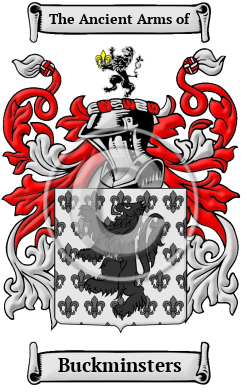
| ![Show Contents]() Buckminsters History, Family Crest & Coats of Arms Buckminsters History, Family Crest & Coats of Arms
- Origins Available:
England
Etymology of BuckminstersWhat does the name Buckminsters mean? The name Buckminsters was brought to England in the wave of migration that followed the Norman Conquest of 1066. The Buckminsters family lived in the settlement of Buckminster, Leicestershire. The surname's derived from residence at location. The place name itself is derived from the Old English elements, Bucca, which was a nickname for a person with a supposed resemblance to a goat, and mynster, meaning monastery. 1 Early Origins of the Buckminsters familyThe surname Buckminsters was first found in Leicestershire at Buckminster, a parish, in the union of Melton-Mowbray, hundred of Framland. Buckminster Park, the family seat of the Earl of Dysart, is a noble mansion situated in a park well stocked with deer and embellished with timber. 2 The parish dates back to the Domesday Book of 1086, where it was recorded as Bucheminstre 3 The Pipe Rolls of 1180 record Adam de Bucemenistre in Leicestershire as the first record of the family in early rolls. 4 The Writs of Parliament record Simon de Bokminstre, 1295 and Simon de Bukminstre, 1297 which are presumably entries for the same person. 5 The source Testa de Nevill, sive Liber Feodorum, temp. Henry III-Edward I. includes an entry for Roger de Bukeminstre, Lincolnshire, Henry III-Edward I (during the reigns of Henry II and Edward I. 6 Early History of the Buckminsters familyThis web page shows only a small excerpt of our Buckminsters research. Another 97 words (7 lines of text) covering the years 1513, 1514, 1530, 1532, 1539, 1541, 1545, 1546, 1566, 1618, 1623, 1629 and 1769 are included under the topic Early Buckminsters History in all our PDF Extended History products and printed products wherever possible. Buckminsters Spelling VariationsSpelling variations in names were a common occurrence in the eras before English spelling was standardized a few hundred years ago. In the Middle Ages, even the literate regularly changed the spellings of their names as the English language incorporated elements of French, Latin, and other European languages. Many variations of the name Buckminsters have been found, including Buckminster, Buckmaster, Buckmasters, Buckminsters, Buckmisters, Buckmuster and many more. Early Notables of the Buckminsters familyThomas Buckmaster (fl. 1566), English divine and astronomer, described in one of his works as a professor of physics, of what university has not been ascertained. William Buckmaster (d. 1545), was Vice-Chancellor of Cambridge University, graduating at Peterhouse, Cambridge, B.A. in 1513-1514. "He became rector of Barchester, Warwickshire (23...
Another 49 words (4 lines of text) are included under the topic Early Buckminsters Notables in all our PDF Extended History products and printed products wherever possible. Migration of the Buckminsters familyFor many English families, the social climate in England was oppressive and lacked opportunity for change. For such families, the shores of Ireland, Australia, and the New World beckoned. They left their homeland at great expense in ships that were overcrowded and full of disease. Many arrived after the long voyage sick, starving, and without a penny. But even those were greeted with greater opportunity than they could have experienced back home. Numerous English settlers who arrived in the United States and Canada at this time went on to make important contributions to the developing cultures of those countries. Many of those families went on to make significant contributions to the rapidly developing colonies in which they settled. Early North American records indicate many people bearing the name Buckminsters were among those contributors: John Buckmuster, who arrived in Virginia in 1624; Thomas Buckmaster who settled in Boston, Massachusetts in 1630; William Buckminster, who settled in Boston, Massachusetts in 1850.
- Mills, A.D., Dictionary of English Place-Names. Oxford: Oxford University Press, 1991. Print. (ISBN 0-19-869156-4)
- Lewis, Samuel, A Topographical Dictionary of England. Institute of Historical Research, 1848, Print.
- Williams, Dr Ann. And G.H. Martin, Eds., Domesday Book A Complete Translation. London: Penguin, 1992. Print. (ISBN 0-141-00523-8)
- Reaney, P.H and R.M. Wilson, A Dictionary of English Surnames. London: Routledge, 1991. Print. (ISBN 0-415-05737-X)
- Bardsley, C.W, A Dictionary of English and Welsh Surnames: With Special American Instances. Wiltshire: Heraldry Today, 1901. Print. (ISBN 0-900455-44-6)
- Testa de Nevill or "Liber Feodorum" or "Book of Fees," thought to have been written by Ralph de Nevill, for King John (1199–1216)
 |