| ![Show Contents]() Brush History, Family Crest & Coats of Arms Brush History, Family Crest & Coats of Arms
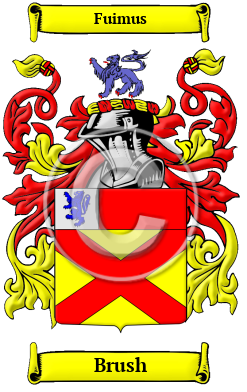
Etymology of BrushWhat does the name Brush mean? The origins of the great Scottish surname Brush actually lie off of the British Isles, as Brush (or Brus) was a name carried to England in the great wave of migration from Normandy following the Norman Conquest of 1066. The Brush family originally lived in Normandy. The exact location of the place from which the family name is derived is under dispute, as one may expect of such a prominent name. The traditional interpretation is that the name is derived from the place-name Brix, in La Manche. It is argued, however, that there is no real evidence in support of this, and that the name is actually derived from the place-name Le Brus, in Calvados. 1 Brush Coat of Arms CreationWhen Robert Bruce became King of Scotland, he adopted the Royal crest. The Earl of Elgin (a Bruce) has as a crest a lion armed, and the motto, "Fuimus " (We have been great). 2 Early Origins of the Brush familyThe surname Brush was first found in Yorkshire where Robert de Bruis was granted ninety-four manors. His son Robert de Bruys traveled north with Earl David of Huntingdon who later became King of Scotland and was granted large estates in Annandale, Scotland about 1150. Robert de Bruys had two sons: Robert and William. Robert, who became known as Robert the Bruce, would later claim the crown of Scotland and unite Scotland against the English. He defeated the English army soundly in the Battle of Bannockburn in 1314. "Robert, 'the Bruce of Bannockburn,' was arguably the most illustrious monarch that ever swayed the Scottish sceptre." 3 As a result of this battle Scotland gained its independence from England as declared in the Treaty of Northampton (1328). King Robert the Bruce died the next year at Cardross. Although he had instructed to one of his most trusted followers to bury his heart in the Holy Land, they were stopped in Spain and therefore returned to Scotland. His heart is buried at Melrose in Dunfermeline. The Earls of Elgin are descended from the Bruces of Clackmannan. Early History of the Brush familyThis web page shows only a small excerpt of our Brush research. Another 128 words (9 lines of text) covering the years 1274, 1318, 1329, 1548, 1550, 1599, 1611, 1625, 1629, 1663, 1669, 1679, 1681, 1686, 1688, 1700, 1735 and 1890 are included under the topic Early Brush History in all our PDF Extended History products and printed products wherever possible. Brush Spelling VariationsSpelling variations of this family name include: Brywiss, Broyse, Bruce, Bruice, Bruise, Brus, Broys, Brywass, Brues, Brywess, Bruwes, Bruys, Bruze, Brwze, Brywes, Bruse, Braose, Bruis, Browse and many more. Early Notables of the Brush familyRobert Bruce (1274-1329), King of Scotland. His body is buried in Dunfermline Abbey, while his heart is buried in Melrose Abbey. His embalmed heart was to be taken on crusade by his lieutenant and friend Sir James Douglas to the Holy Land but Douglas only made it as far as Granada, Spain. Other notables include: Edward Bruce, 1st Lord Kinloss PC (1548-1611), a Scottish lawyer and judge; Sir George Bruce of Carnock (c. 1550-1625), a Scottish merchant and engineer...
Another 79 words (6 lines of text) are included under the topic Early Brush Notables in all our PDF Extended History products and printed products wherever possible. Brush RankingIn the United States, the name Brush is the 5,206th most popular surname with an estimated 4,974 people with that name. 4 Migration of the Brush family to IrelandSome of the Brush family moved to Ireland, but this topic is not covered in this excerpt.
Another 50 words (4 lines of text) about their life in Ireland is included in all our PDF Extended History products and printed products wherever possible.
| Brush migration to the United States | + |
Brush Settlers in United States in the 17th Century- Thomas Brush, who arrived in New York in 1653 5
- John Brush, who arrived in Virginia in 1663 5
Brush Settlers in United States in the 18th Century- Richard Brush, who arrived in New England in 1731 5
- Michel Brush, aged 19, who landed in Pennsylvania in 1738 5
- Augusteen Brush, aged 14, who landed in Pennsylvania in 1738 5
Brush Settlers in United States in the 19th Century- Mr. James Brush, aged 40, British settler who arrived in New York aboard the ship "Louisa" in 1825
- G C Brush, who arrived in San Francisco, California in 1850 5
- J Brush, who landed in San Francisco, California in 1850 5
- S Brush, who landed in San Francisco, California in 1850 5
| Brush migration to Canada | + |
Brush Settlers in Canada in the 18th Century- Mr. R. Brush U.E. who settled in Saint John, New Brunswick c. 1783 6
- Mr. Samuel Brush U.E. who settled in Saint John, New Brunswick c. 1783 6
| Brush migration to Australia | + |
Brush Settlers in Australia in the 19th Century- Mr. Andrew Brush, (b. 1800), aged 28, Irish convict who was convicted in County Tyrone, Ireland for 7 years for stealing, transported aboard the "Fergusson" on 16th November 1828, arriving in New South Wales, Australia, he died on board in 1828 7
| Contemporary Notables of the name Brush (post 1700) | + |
- Ben Joseph "Joey" Brush Jr. (1955-2015), American businessman and politician, Member of the Georgia Senate (1992-1993)
- Major-General Rapp Brush (1889-1958), American Commanding General 40th Division, Philippines (1942-1945) 8
- John Tomlinson Brush (1845-1912), American sports executive, former owner of the New York Giants
- Charles Francis Brush (1849-1929), American inventor, entrepreneur
- Paul Brush (b. 1958), English former professional footballer
- Richard Brush (b. 1984), English football goalkeeper
- Howard Brush Dean III (b. 1948), American physician and Democratic politician, governor of Vermont from 1991-2003
- Joseph Brush Fenton, American Democratic Party politician, Candidate for Michigan land commissioner, 1876 9
The motto was originally a war cry or slogan. Mottoes first began to be shown with arms in the 14th and 15th centuries, but were not in general use until the 17th century. Thus the oldest coats of arms generally do not include a motto. Mottoes seldom form part of the grant of arms: Under most heraldic authorities, a motto is an optional component of the coat of arms, and can be added to or changed at will; many families have chosen not to display a motto.
Motto: Fuimus
Motto Translation: We have been
| Suggested Readings for the name Brush | + |
- The Descendants of Thomas and Richard Brush of Huntington, Long Island by Stuart Brush.
- Brush, Sammis, Kelsey, and Allied Families by Fannie Neumann.
- The Norman People and Their Existing Descendants in the British Dominions and the United States Of America. Baltimore: Genealogical Publishing, 1975. Print. (ISBN 0-8063-0636-X)
- Polson, Alexander, The Romance of Scottish Crests and Mottoes. Inverness: Walter Alexander, Inglis Street 1929. Print
- Burke, John Bernard, The Roll of Battle Abbey. London: Edward Churton, 26, Holles Street, 1848, Print.
- "What are the 5,000 Most Common Last Names in the U.S.?". NameCensus.com, https://namecensus.com/last-names/
- Filby, P. William, Meyer, Mary K., Passenger and immigration lists index : a guide to published arrival records of about 500,000 passengers who came to the United States and Canada in the seventeenth, eighteenth, and nineteenth centuries. 1982-1985 Cumulated Supplements in Four Volumes Detroit, Mich. : Gale Research Co., 1985, Print (ISBN 0-8103-1795-8)
- Rubincam, Milton. The Old United Empire Loyalists List. Genealogical Publishing Co., Inc, 1976. (Originally published as; United Empire Loyalists. The Centennial of the Settlement of Upper Canada. Rose Publishing Company, 1885.) ISBN 0-8063-0331-X
- Convict Records Voyages to Australia (Retrieved 4th October 2022). https://convictrecords.com.au/ships/fergusson
- Generals of World War II. (Retrieved 2011, November 3) Rapp Brush. Retrieved from http://generals.dk/general/Brush/Rapp/USA.html
- The Political Graveyard: Alphabetical Name Index. (Retrieved 2015, December 9) . Retrieved from http://politicalgraveyard.com/alpha/index.html
 |