| ![Show Contents]() Braing History, Family Crest & Coats of Arms Braing History, Family Crest & Coats of Arms
Etymology of BraingWhat does the name Braing mean? When the ancestors of the Braing family emigrated to England following the Norman Conquest in 1066 they brought their family name with them. They lived in Gloucestershire. The family is believed to have been from Brain, near Hainaut in Normandy where they were nobles of the order of St. Empire or at Brain in Anjou. 1 Early Origins of the Braing familyThe surname Braing was first found in Norfolk where Ketell Brain was recorded in the Pipe Rolls of 1166. Later Walter Brayn was found in the Subsidy Rolls for Worcestershire in 1275. 2 Matthew de Brain occurs in Yorkshire 1199. 1 The Hundredorum Rolls of 1273 recorded Alicia Brayn, Cambridgeshire; Helena Brayn, Huntingdonshire; and John Brayn, Cambridgeshire. 3 "A family of Brain held lands in the parish of Little Dean [Gloucestershire] from the time of Elizabeth up to last century, and the name still occurs there. The Brains also owned the manor of Stanton [Chippenham, Wiltshire] 300 years ago. This is an ancient English name: it was represented in Hunts in the reign of Edward I." 4 Further to the north in Scotland, Thomas Brayne of Baldowy was witness in 1462, and David Brane, artium magister, 1477. David Brane was witness in Aberdeen, 1492. John Brane signed the Band of Dumfries, 1570, Roger Brain in Allegawin, parish of Glenbervie, 1601, and four more of the name are recorded in Brechin Commissariot Record. 5 In Scotland, the name often appears as MacBryane. 2 Early History of the Braing familyThis web page shows only a small excerpt of our Braing research. Another 125 words (9 lines of text) covering the years 1580, 1605, 1686 and 1751 are included under the topic Early Braing History in all our PDF Extended History products and printed products wherever possible. Braing Spelling VariationsSpelling variations in names were a common occurrence in the eras before English spelling was standardized a few hundred years ago. In the Middle Ages, even the literate regularly changed the spellings of their names as the English language incorporated elements of French, Latin, and other European languages. Many variations of the name Braing have been found, including Brain, Braine, Brayne, Brane, Brayn and others. Early Notables of the Braing familyMore information is included under the topic Early Braing Notables in all our PDF Extended History products and printed products wherever possible. Migration of the Braing familyFor many English families, the social climate in England was oppressive and lacked opportunity for change. For such families, the shores of Ireland, Australia, and the New World beckoned. They left their homeland at great expense in ships that were overcrowded and full of disease. Many arrived after the long voyage sick, starving, and without a penny. But even those were greeted with greater opportunity than they could have experienced back home. Numerous English settlers who arrived in the United States and Canada at this time went on to make important contributions to the developing cultures of those countries. Many of those families went on to make significant contributions to the rapidly developing colonies in which they settled. Early North American records indicate many people bearing the name Braing were among those contributors: Elizabeth Brain who settled in New England in 1754; Richard Braine settled in Virginia in 1653; John Braine settled in Virginia in 1654; Robert Brayne settled in New England in 1663..
| Contemporary Notables of the name Braing (post 1700) | + |
- Ian Braing Osorio (b. 1985), Honduran footballer
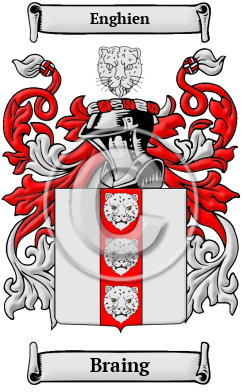
The motto was originally a war cry or slogan. Mottoes first began to be shown with arms in the 14th and 15th centuries, but were not in general use until the 17th century. Thus the oldest coats of arms generally do not include a motto. Mottoes seldom form part of the grant of arms: Under most heraldic authorities, a motto is an optional component of the coat of arms, and can be added to or changed at will; many families have chosen not to display a motto.
Motto: Enghien
- The Norman People and Their Existing Descendants in the British Dominions and the United States Of America. Baltimore: Genealogical Publishing, 1975. Print. (ISBN 0-8063-0636-X)
- Reaney, P.H and R.M. Wilson, A Dictionary of English Surnames. London: Routledge, 1991. Print. (ISBN 0-415-05737-X)
- Bardsley, C.W, A Dictionary of English and Welsh Surnames: With Special American Instances. Wiltshire: Heraldry Today, 1901. Print. (ISBN 0-900455-44-6)
- Guppy, Henry Brougham, Homes of Family Names in Great Britain. 1890. Print.
- Black, George F., The Surnames of Scotland Their Origin, Meaning and History. New York: New York Public Library, 1946. Print. (ISBN 0-87104-172-3)
 |