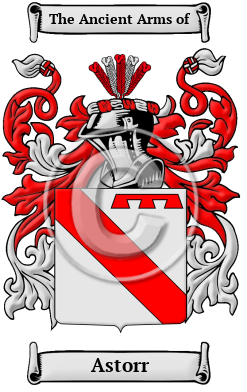
| ![Show Contents]() Astorr History, Family Crest & Coats of Arms Astorr History, Family Crest & Coats of Arms
- Origins Available:
England
Etymology of AstorrWhat does the name Astorr mean? The surname Astorr has multiple possible origins. First of all, the name could have been from L’Estre, near Valognes, Normandy. 1 In this case, the first record of the family was that of Richard de l’Estre who held lands in Dorset from the time of the Conquest. 2 The same rolls includes an entry for William del Estre, Devon, Henry III-Edward I. 3 In 1165, Richard de l’Estre held a barony of four knights’ fees in Somerset 4 Secondly, the name could have been a nickname for someone who has a connection with the Christian festival of Easter, such as someone born or baptized at that time. 5 Finally, the name could have been derived from a group of villages so named in Essex having derived from the Old English word "eowestre," meaning sheepfold 6 or the Anglo-Saxon word Eásthere or Esthere, derived from "East" + the Old English word "here" meaning "army." 7 Early Origins of the Astorr familyThe surname Astorr was first found in Essex. 8 9 A scan of early 12th century records show Jordan del estre in Leicestershire and later the Feet of Fines for Cambridgeshire included Robert del Estre in 1272. John de Estre was listed in the Feet of Fines for Essex in 1345. 6 By the time of the Hundredorum Rolls of 1273, the name was more widespread as that census includes entries for Robert de le Estre, Suffolk; and Robert del Ester, Cambridgeshire. 3 Early History of the Astorr familyThis web page shows only a small excerpt of our Astorr research. Another 119 words (8 lines of text) covering the years 1783 and 1848 are included under the topic Early Astorr History in all our PDF Extended History products and printed products wherever possible. Astorr Spelling VariationsMultitudes of spelling variations are a hallmark of Anglo Norman names. Most of these names evolved in the 11th and 12th century, in the time after the Normans introduced their own Norman French language into a country where Old and Middle English had no spelling rules and the languages of the court were French and Latin. To make matters worse, medieval scribes spelled words according to sound, so names frequently appeared differently in the various documents in which they were recorded. The name was spelled Astor, Aster, Astur, Astorr, Asterr, Asturr, Estor, Ester, Esturr, Astoria, Estoria, E'Stur, Stur and many more. Early Notables of the Astorr familyMore information is included under the topic Early Astorr Notables in all our PDF Extended History products and printed products wherever possible. Migration of the Astorr familyBecause of this political and religious unrest within English society, many people decided to immigrate to the colonies. Families left for Ireland, North America, and Australia in enormous numbers, traveling at high cost in extremely inhospitable conditions. The New World in particular was a desirable destination, but the long voyage caused many to arrive sick and starving. Those who made it, though, were welcomed by opportunities far greater than they had known at home in England. Many of these families went on to make important contributions to the emerging nations of Canada and the United States. Analysis of immigration records indicates that some of the first North American immigrants bore the name Astorr or a variant listed above: J.J. Astor, aged 59; who arrived (with child) in New York in 1822 and moved westward.
- The Norman People and Their Existing Descendants in the British Dominions and the United States Of America. Baltimore: Genealogical Publishing, 1975. Print. (ISBN 0-8063-0636-X)
- Testa de Nevill or "Liber Feodorum" or "Book of Fees," thought to have been written by Ralph de Nevill, for King John (1199–1216)
- Bardsley, C.W, A Dictionary of English and Welsh Surnames: With Special American Instances. Wiltshire: Heraldry Today, 1901. Print. (ISBN 0-900455-44-6)
- Liber Niger Scutarii ("Black Book of the Exchequer"), containing reports by county on feudal holdings in England in 1166 (reign of Henry II)
- Hanks, Patricia and Flavia Hodges, A Dictionary of Surnames. Oxford: Oxford University Press, 1988. Print. (ISBN 0-19-211592-8)
- Reaney, P.H and R.M. Wilson, A Dictionary of English Surnames. London: Routledge, 1991. Print. (ISBN 0-415-05737-X)
- Harrison, Henry, Surnames of the United Kingdom: A Concise Etymological Dictionary Baltimore: Geneological Publishing Company, 2013. Print
- Lower, Mark Anthony, Patronymica Britannica, A Dictionary of Family Names of the United Kingdom. London: John Russel Smith, 1860. Print.
- Barber, Henry, British Family Names London: Elliot Stock, 62 Paternoster Row, 1894. Print.
 |