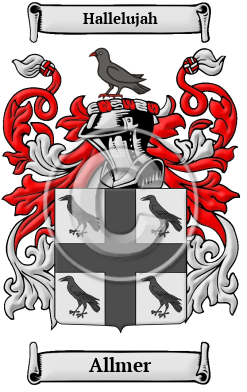
| ![Show Contents]() Allmer History, Family Crest & Coats of Arms Allmer History, Family Crest & Coats of Arms
- Origins Available:
Ireland
Etymology of AllmerWhat does the name Allmer mean? Despite the fact that the Irish already had developed a system of hereditary surnames, the Anglo-Norman invaders imported their own naming principles. The Strongbow invasion marked the first introduction of non-Gaelic elements into Ireland. One of the most common types of surnames at this time was the patronymic surname, which was formed from the name of the initial bearer's father. Often, and especially in the case of French names, this was done through the addition of a diminutive suffix to the given name, such as -ot, -et, -un, -in, or -el. Occasionally, two suffixes were combined to form a double diminutive, as in the combinations of -el-in, -el-ot, -in-ot, and -et-in. Another way of forming patronymic names used by the Strongbownians was the use of the prefix Fitz-, which was derived from the French word fils, and ultimately from the Latin filius,: both mean son. Although this prefix probably originated in Flanders or Normandy, it is now unknown in France and is found only in Ireland. The surname Allmer is derived from the Anglo-Saxon personal name Ædelmær, which literally means "noble, famous." The Gaelic form of the surname Allmer is Aighlmear. Early Origins of the Allmer familyThe surname Allmer was first found in Essex, where they were tenants in chief and Lords of the manor of Aylmer. "This family trace their name and descent from Ailmer or Athelmare, Earl of Cornwall, in the time of King Ethelred. Allmor, in Welsh, signifies a valley or dale." 1 "This Anglo-Saxon name came to Ireland after the Norman invasion and, settling in Leinster, families so called became hibernicized." 2 Early History of the Allmer familyThis web page shows only a small excerpt of our Allmer research. Another 82 words (6 lines of text) covering the years 1172, 1650, 1678 and 1720 are included under the topic Early Allmer History in all our PDF Extended History products and printed products wherever possible. Allmer Spelling VariationsMedieval scribes and church officials spelt names simply the way they sounded, which explains the various name spelling variations of the name Allmer that were encountered when researching that surname. The many spelling variations included: Ailmer, Aylmer, Elmer, Elmore, Ellmore, Ellmer and others. Early Notables of the Allmer familyMatthew Aylmer (c.1650-1720), Lord Aylmer, Admiral and Commander-in-Chief, the second son of Sir Christopher Aylmer of Balrath, County Meath. "He entered the navy under the protection of the Duke of Buckingham, as a lieutenant, in 1678. Early in the following year...
Another 41 words (3 lines of text) are included under the topic Early Allmer Notables in all our PDF Extended History products and printed products wherever possible.
| Allmer migration to New Zealand | + |
Emigration to New Zealand followed in the footsteps of the European explorers, such as Captain Cook (1769-70): first came sealers, whalers, missionaries, and traders. By 1838, the British New Zealand Company had begun buying land from the Maori tribes, and selling it to settlers, and, after the Treaty of Waitangi in 1840, many British families set out on the arduous six month journey from Britain to Aotearoa to start a new life. Early immigrants include: Allmer Settlers in New Zealand in the 19th Century- Mr. Allmer, British settler travelling from London aboard the ship "Queen of the Deep" arriving in Auckland, New Zealand on 14th June 1854 3
The motto was originally a war cry or slogan. Mottoes first began to be shown with arms in the 14th and 15th centuries, but were not in general use until the 17th century. Thus the oldest coats of arms generally do not include a motto. Mottoes seldom form part of the grant of arms: Under most heraldic authorities, a motto is an optional component of the coat of arms, and can be added to or changed at will; many families have chosen not to display a motto.
Motto: Hallelujah
- Arthur, William , An Etymological Dictionary of Family and Christian Names. London: 1857. Print
- MacLysaght, Edward, More Irish Families. Dublin: Irish Academic Press, 1982. Print. (ISBN 0-7165-0126-0)
- New Zealand Yesteryears Passenger Lists 1800 to 1900 (Retrieved 26th March 2019). Retrieved from http://www.yesteryears.co.nz/shipping/passlist.html
 |