| ![Show Contents]() Yorkes History, Family Crest & Coats of Arms Yorkes History, Family Crest & Coats of Arms
Etymology of YorkesWhat does the name Yorkes mean? The ancestors of the bearers of the Yorkes family name are thought have lived in ancient Anglo-Saxon England. They were first found in Yorkshire, the largest county in northern England, which is divided into three administrative ridings: North Riding, West Riding, and East Riding. The town of York was the military capital of Roman Britain, the capital of Northumbria, and was the seat of an Archbishop. Yorkshire was also the home of the House of York, which was an English royal dynasty from 1461 to 1485. The reigning members of the House of York were Edward IV, Edward V and Richard III. Their rivalry with the House of Lancaster resulted in the Wars of the Roses, which lasted from 1455 to 1485 and ended when the Lancastrian Henry VII united the two houses by marrying Elizabeth, the daughter of Edward IV. The surname Yorkes belongs to the large category of Anglo-Saxon habitation names, which are derived from pre-existing names for towns, villages, parishes, or farmsteads. Early Origins of the Yorkes familyThe surname Yorkes was first found in Wiltshire where they were first listed at Carne, and soon after the Conquest branched to Fillack in Cornwall, and Wellington in Somerset. The church parish of Guilden Morden in Cambridgeshire has an interesting story about the family. "The parish appears to have taken the affix to its name from the decoration of the steeple of its church with stripes of gilding. It is recorded that Charles Yorke, son of the first lord Hardwicke, died suddenly while the patent for raising him to the peerage by the title of Baron Morden, taken from this place, was in preparation." 1 And in Wimpole, Cambridgeshire more early records were found of the family. The reader should note that Philip Yorke, 1st Baron Hardwicke, Lord Chancellor of Great Britain from 1737 to 1756 was the first Earl of Hardwicke. "This place, which is on the road from Royston to Huntingdon, is remarkable as the residence of the Earl of Hardwicke, whose magnificent seat of Wimpole Hall, splendidly embellished, and surrounded by a beautiful demesne, was visited by Her Majesty and Prince Albert in October 1843. The church, which has been enlarged by fitting up a private chapel with seats, contains various monuments to the Yorke family, including one to the memory of Lord Chancellor Hardwicke, who was interred here." 1 One of the first records was William of York (d. 1256), Bishop of Salisbury. " In 1242 he was one of the king's two representatives sent to the parliament of 29 Jan. to ask for money and counsel for the French war, and when the king departed for Gascony he, the archbishop of York, and William de Cantelupe were entrusted with the custody of the realm. " 2 Early History of the Yorkes familyThis web page shows only a small excerpt of our Yorkes research. Another 164 words (12 lines of text) covering the years 1461, 1549, 1569, 1572, 1588, 1595, 1609, 1654, 1658, 1666, 1687, 1689, 1690, 1695, 1705, 1707, 1711, 1716, 1764 and 1770 are included under the topic Early Yorkes History in all our PDF Extended History products and printed products wherever possible. Yorkes Spelling VariationsUntil quite recently, the English language has lacked a definite system of spelling rules. Consequently, Anglo-Saxon surnames are characterized by a multitude of spelling variations. Changes in Anglo-Saxon names were influenced by the evolution of the English language, as it incorporated elements of French, Latin, and other languages. Although Medieval scribes and church officials recorded names as they sounded, so it is common to find one person referred to by several different spellings of his surname, even the most literate people varied the spelling of their own names. Variations of the name Yorkes include York, Yorke and others. Early Notables of the Yorkes familySir John York or Yorke (died 1569?), an English merchant and politician, Master of the Mint, Sheriff of London in 1549
Rowland Yorke or York (d. 1588), was a soldier of fortune and is conjectured to have been one of the ten sons of Sir John York. "Being of an adventurous disposition, he volunteered for the Netherlands under Captain Thomas Morgan (d. 1595) in 1572. His heir was Edmund Yorke, who was executed at Tyburn in 1595 for attempting to assassinate Queen Elizabeth. " 2
William Yorke (1609-1666), was an English lawyer and politician...
Another 91 words (6 lines of text) are included under the topic Early Yorkes Notables in all our PDF Extended History products and printed products wherever possible. Migration of the Yorkes family to IrelandSome of the Yorkes family moved to Ireland, but this topic is not covered in this excerpt. More information about their life in Ireland is included in all our PDF Extended History products and printed products wherever possible. Migration of the Yorkes familySearching for a better life, many English families migrated to British colonies. Unfortunately, the majority of them traveled under extremely harsh conditions: overcrowding on the ships caused the majority of the immigrants to arrive diseased, famished, and destitute from the long journey across the ocean. For those families that arrived safely, modest prosperity was attainable, and many went on to make invaluable contributions to the development of the cultures of the new colonies. Research into the origins of individual families in North America revealed records of the immigration of a number of people bearing the name Yorkes or a variant listed above: John York, who arrived in Barbados in 1635; James York and his wife Catherine, who settled in Virginia in 1635; Sarah York, who settled in Jamaica in 1722.
The motto was originally a war cry or slogan. Mottoes first began to be shown with arms in the 14th and 15th centuries, but were not in general use until the 17th century. Thus the oldest coats of arms generally do not include a motto. Mottoes seldom form part of the grant of arms: Under most heraldic authorities, a motto is an optional component of the coat of arms, and can be added to or changed at will; many families have chosen not to display a motto.
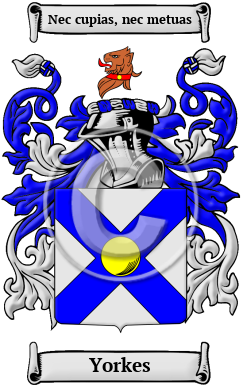
Motto: Nec cupias, nec metuas
Motto Translation: Neither desire nor fear.
- Lewis, Samuel, A Topographical Dictionary of England. Institute of Historical Research, 1848, Print.
- Smith, George (ed), Dictionary of National Biography. London: Smith, Elder & Co., 1885-1900. Print
 |