| ![Show Contents]() Trenchard History, Family Crest & Coats of Arms Trenchard History, Family Crest & Coats of Arms
- Origins Available:
England
Etymology of TrenchardWhat does the name Trenchard mean? Trenchard is an ancient Norman name that arrived in England after the Norman Conquest of 1066. It is a name for a soldier. Looking back even further, we found the name was originally derived from the Old French word trenchire, meaning a swordsman, soldier, or man of war. 1 Anciently the family came from Normandy, France and while the family became a noted English family shortly after the Conquest, not all of the family made the trip as the Magni Rotuli Scaccarii Normanniae lists Richard Trenchart in Normandy in 1198. 2 Early Origins of the Trenchard familyThe surname Trenchard was first found in the Domesday Book of 1086 where Ralph Trencart, Trenchard was listed as holding lands in Somerset. 3 Later Robert Trenchart was listed in the Pipe Rolls of 1166 as holding lands in Hampshire. 1 "Baldwin de Ripariis, Earl of Devon, granted Hordhill, in the Isle of Wight, to the ancestor of this family, Paganus Trenchard, temp. Henry I. The name is most probably derived from the Old French trencher, to carve; and it may refer to the occupation of the original bearer, either as a carver of viands, or as owner of a trenchant blade in war." 4 The family rose to prominence in Dorset and was most notable in this area for centuries. Early History of the Trenchard familyThis web page shows only a small excerpt of our Trenchard research. Another 133 words (10 lines of text) covering the years 1509, 1548, 1582, 1586, 1588, 1601, 1613, 1621, 1625, 1630, 1640, 1657, 1662, 1684, 1695, 1713, 1720, 1723, 1754, 1758, 1873, 1919, 1923, 1930, 1936, 1951, 1956, 1979, 1983, 1987 and 1999 are included under the topic Early Trenchard History in all our PDF Extended History products and printed products wherever possible. Trenchard Spelling VariationsA multitude of spelling variations characterize Norman surnames. Many variations occurred because Old and Middle English lacked any definite spelling rules. The introduction of Norman French to England also had a pronounced effect, as did the court languages of Latin and French. Therefore, one person was often referred to by several different spellings in a single lifetime. The various spellings include Trenchard, Trancherd, Trencher, Trenchar and others. Early Notables of the Trenchard family- George Trenchard (c. 1548-1630), of Wolveton and later of Lytchett Matravers, Dorset, an English politician; George Trenchard, an English politician, Member of Parliament (MP) for Dorset in 1601; and...
- John Trenchard (1586-1662), was an English politician who sat in the House of Commons, Member of Parliament for Wareham (1621-1625); Sir Thomas Trenchard (1582-1657) of Wolverton, was knighted by King...
- John Trenchard (1662-1723) was an English writer and Commonwealthman, best known for writing a series of 144 essays with Thomas Gordon entitled Cato's Letters (1720-1723), condemning corruption and la...
| Trenchard migration to the United States | + |
Many English families left England, to avoid the chaos of their homeland and migrated to the many British colonies abroad. Although the conditions on the ships were extremely cramped, and some travelers arrived diseased, starving, and destitute, once in the colonies, many of the families prospered and made valuable contributions to the cultures of what would become the United States and Canada. Research into the origins of individual families in North America has revealed records of the immigration of a number of people bearing the name Trenchard or a variant listed above:
Trenchard Settlers in United States in the 17th Century- Hen Trenchard, who landed in Virginia in 1666 5
- Attorney General George Trenchard, who settled in New Jersey in 1686
Trenchard Settlers in United States in the 19th Century- Joseph Trenchard, who arrived in New York in 1837 5
| Trenchard migration to Canada | + |
Trenchard Settlers in Canada in the 19th Century- Benjamin C. Trenchard was a fisherman of Bay Roberts, Newfoundland in 1860 6
| Trenchard migration to Australia | + |
Trenchard Settlers in Australia in the 19th Century- Mr. William Trenchard, English convict who was convicted in Dorset, England for life, transported aboard the "Burrell" on 22nd July 1830, arriving in New South Wales 7
- Mr. Jabez Trenchard, (b. 1825), aged 18, English convict who was convicted in Taunton, Somerset, England for 10 years for stealing, transported aboard the "Cressy" on 28th April 1843, arriving in Tasmania (Van Diemen's Land) 8
| Trenchard migration to New Zealand | + |
Emigration to New Zealand followed in the footsteps of the European explorers, such as Captain Cook (1769-70): first came sealers, whalers, missionaries, and traders. By 1838, the British New Zealand Company had begun buying land from the Maori tribes, and selling it to settlers, and, after the Treaty of Waitangi in 1840, many British families set out on the arduous six month journey from Britain to Aotearoa to start a new life. Early immigrants include: Trenchard Settlers in New Zealand in the 19th Century- Guy Trenchard, aged 19, a labourer, who arrived in Nelson, New Zealand aboard the ship "Chile" in 1874
| Contemporary Notables of the name Trenchard (post 1700) | + |
- Edward Trenchard (1785-1824), American captain of the United States Navy who saw service in the Quasi-War with France, the First Barbary War, the War of 1812, and the Second Barbary War, father of Rear Admiral Stephen Decatur Trenchard
- Rear Admiral Stephen Decatur Trenchard (1818-1883), American naval officer
- Justice Thomas Whitaker Trenchard (1863-1942), American New Jersey Supreme Court Judge
- Herbert William Trenchard (1857-1934), English chess master
- Thomas Trenchard (1923-1987), 2nd Viscount Trenchard
- Hugh Montague Trenchard (1873-1956), British Chief of the Air Staff during World War I, created 1st Viscount Trenchard in 1936
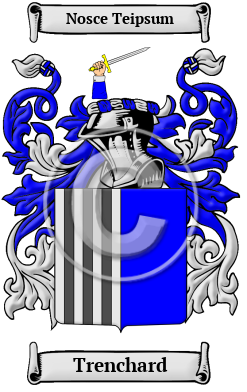
The motto was originally a war cry or slogan. Mottoes first began to be shown with arms in the 14th and 15th centuries, but were not in general use until the 17th century. Thus the oldest coats of arms generally do not include a motto. Mottoes seldom form part of the grant of arms: Under most heraldic authorities, a motto is an optional component of the coat of arms, and can be added to or changed at will; many families have chosen not to display a motto.
Motto: Nosce Teipsum
Motto Translation: Know thyself.
- Reaney, P.H and R.M. Wilson, A Dictionary of English Surnames. London: Routledge, 1991. Print. (ISBN 0-415-05737-X)
- The Norman People and Their Existing Descendants in the British Dominions and the United States Of America. Baltimore: Genealogical Publishing, 1975. Print. (ISBN 0-8063-0636-X)
- Williams, Dr Ann. And G.H. Martin, Eds., Domesday Book A Complete Translation. London: Penguin, 1992. Print. (ISBN 0-141-00523-8)
- Lower, Mark Anthony, Patronymica Britannica, A Dictionary of Family Names of the United Kingdom. London: John Russel Smith, 1860. Print.
- Filby, P. William, Meyer, Mary K., Passenger and immigration lists index : a guide to published arrival records of about 500,000 passengers who came to the United States and Canada in the seventeenth, eighteenth, and nineteenth centuries. 1982-1985 Cumulated Supplements in Four Volumes Detroit, Mich. : Gale Research Co., 1985, Print (ISBN 0-8103-1795-8)
- Seary E.R., Family Names of the Island of Newfoundland, Montreal: McGill's-Queen's Universtity Press 1998 ISBN 0-7735-1782-0
- Convict Records Voyages to Australia (Retrieved 5th November 2020). Retrieved from https://convictrecords.com.au/ships/burrell
- Convict Records Voyages to Australia (Retrieved 21st May 2021). Retrieved from https://convictrecords.com.au/ships/cressy
 |