| ![Show Contents]() Trancher History, Family Crest & Coats of Arms Trancher History, Family Crest & Coats of Arms
- Origins Available:
England
Etymology of TrancherWhat does the name Trancher mean? The name Trancher arrived in England after the Norman Conquest of 1066. It is a name for a soldier. Looking back even further, we found the name was originally derived from the Old French word trenchire, meaning a swordsman, soldier, or man of war. 1 Anciently the family came from Normandy, France and while the family became a noted English family shortly after the Conquest, not all of the family made the trip as the Magni Rotuli Scaccarii Normanniae lists Richard Trenchart in Normandy in 1198. 2 Early Origins of the Trancher familyThe surname Trancher was first found in the Domesday Book of 1086 where Ralph Trencart, Trenchard was listed as holding lands in Somerset. 3 Later Robert Trenchart was listed in the Pipe Rolls of 1166 as holding lands in Hampshire. 1 "Baldwin de Ripariis, Earl of Devon, granted Hordhill, in the Isle of Wight, to the ancestor of this family, Paganus Trenchard, temp. Henry I. The name is most probably derived from the Old French trencher, to carve; and it may refer to the occupation of the original bearer, either as a carver of viands, or as owner of a trenchant blade in war." 4 The family rose to prominence in Dorset and was most notable in this area for centuries. Early History of the Trancher familyThis web page shows only a small excerpt of our Trancher research. Another 133 words (10 lines of text) covering the years 1509, 1548, 1582, 1586, 1588, 1601, 1613, 1621, 1625, 1630, 1640, 1657, 1662, 1684, 1695, 1713, 1720, 1723, 1754, 1758, 1873, 1919, 1923, 1930, 1936, 1951, 1956, 1979, 1983, 1987 and 1999 are included under the topic Early Trancher History in all our PDF Extended History products and printed products wherever possible. Trancher Spelling VariationsNorman surnames are characterized by a multitude of spelling variations. The frequent changes in surnames are largely due to the fact that the Old and Middle English languages lacked definite spelling rules. The introduction of Norman French to England, as well as the official court languages of Latin and French, also had pronounced influences on the spelling of surnames. Since medieval scribes and church officials recorded names as they sounded, rather than adhering to any specific spelling rules, it was common to find the same individual referred to with different spellings. The name has been spelled Trenchard, Trancherd, Trencher, Trenchar and others. Early Notables of the Trancher familyGeorge Trenchard (c. 1548-1630), of Wolveton and later of Lytchett Matravers, Dorset, an English politician; George Trenchard, an English politician, Member of Parliament (MP) for Dorset in 1601; and George Trenchard (c. 1684-1758), of Lytchett Matravers, near Poole, Dorset, a British landowner and Whig politician who sat in the House of Commons for 35 years between 1713 and 1754.
John Trenchard (1586-1662), was an English politician who sat in the House of Commons, Member of Parliament for Wareham (1621-1625); Sir Thomas Trenchard (1582-1657) of...
Another 83 words (6 lines of text) are included under the topic Early Trancher Notables in all our PDF Extended History products and printed products wherever possible. Migration of the Trancher familyMany English families emigrated to North American colonies in order to escape the political chaos in Britain at this time. Unfortunately, many English families made the trip to the New World under extremely harsh conditions. Overcrowding on the ships caused the majority of the immigrants to arrive diseased, famished, and destitute from the long journey across the stormy Atlantic. Despite these hardships, many of the families prospered and went on to make invaluable contributions to the development of the cultures of the United States and Canada. Early North American immigration records have revealed a number of people bearing the name Trancher or a variant listed above: Symon Trencherd, who settled in Virginia in 1637. Attorney General George Trenchard of New Jersey settled there in 1686; he was from Somerset in England, he was succeeded by Edward Trenchard of New York City. In Newfoundland, Benjamin Trencher was a blacksmith of Lower Island Cove in 1838.
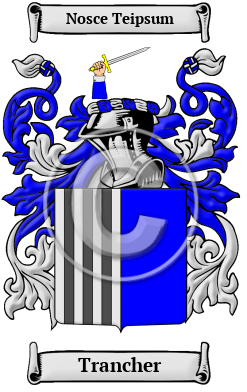
The motto was originally a war cry or slogan. Mottoes first began to be shown with arms in the 14th and 15th centuries, but were not in general use until the 17th century. Thus the oldest coats of arms generally do not include a motto. Mottoes seldom form part of the grant of arms: Under most heraldic authorities, a motto is an optional component of the coat of arms, and can be added to or changed at will; many families have chosen not to display a motto.
Motto: Nosce Teipsum
Motto Translation: Know thyself.
- Reaney, P.H and R.M. Wilson, A Dictionary of English Surnames. London: Routledge, 1991. Print. (ISBN 0-415-05737-X)
- The Norman People and Their Existing Descendants in the British Dominions and the United States Of America. Baltimore: Genealogical Publishing, 1975. Print. (ISBN 0-8063-0636-X)
- Williams, Dr Ann. And G.H. Martin, Eds., Domesday Book A Complete Translation. London: Penguin, 1992. Print. (ISBN 0-141-00523-8)
- Lower, Mark Anthony, Patronymica Britannica, A Dictionary of Family Names of the United Kingdom. London: John Russel Smith, 1860. Print.
 |