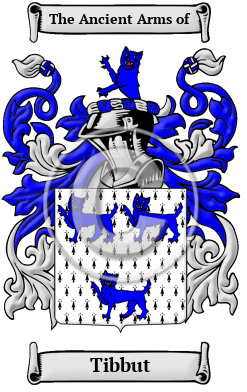
| ![Show Contents]() Tibbut History, Family Crest & Coats of Arms Tibbut History, Family Crest & Coats of Arms
- Origins Available:
England
Etymology of TibbutWhat does the name Tibbut mean? Tibbut is a name that dates far back into the mists of early British history to the days of the Anglo-Saxon tribes. It is derived from the Old French personal name Theobald, which comes from the Germanic name Theudebald. It probably came to England in the wake of the Norman invasion of 1066, when King William actively encouraged immigration of skilled craftsmen and administrators from the continent. Theobald means "people bold" and was a common continental name. Patronymic surnames arose out of the vernacular and religious given name traditions. The vernacular or regional naming tradition is the oldest and most pervasive type of patronymic surname. According to this custom, names were originally composed of vocabulary elements from the local language. Vernacular names that were derived from ancient Germanic personal names have cognates in most European languages. For example, the court of Charlemagne (742-814) was Christian and Latin-speaking, but the Frankish dialect of Old German was commonly used for personal names. Vernacular names were widespread throughout Normandy. Accordingly, many typical English and French names are in fact, originally of Germanic origin and often have cognates in other European countries. This particular patronym is derived from a diminutive of the name Theobald; a common diminutive of Theobald was Tib, Tib-et is a double diminutive (a diminutive of a diminutive) of the name. 1 Early Origins of the Tibbut familyThe surname Tibbut was first found in Worcestershire where John Tybote was listed in the Subsidy Rolls for 1327. Later Stephen Tybet was recorded in the Subsidy Rolls for Staffordshire in 1332. Much later in Suffolk, Jaraes Tibbett was listed in 1674. 2 Early History of the Tibbut familyThis web page shows only a small excerpt of our Tibbut research. Another 64 words (5 lines of text) are included under the topic Early Tibbut History in all our PDF Extended History products and printed products wherever possible. Tibbut Spelling VariationsIt is only in the last few hundred years that the English language has been standardized. For that reason, early Anglo-Saxon surnames like Tibbut are characterized by many spelling variations. As the English language changed and incorporated elements of other European languages, even literate people changed the spelling of their names. The variations of the name Tibbut include: Tibbits, Tibbets, Tibbit, Tibbet and others. Early Notables of the Tibbut familyMore information is included under the topic Early Tibbut Notables in all our PDF Extended History products and printed products wherever possible.
| Tibbut migration to the United States | + |
Many English families tired of political and religious strife left Britain for the new colonies in North America. Although the trip itself offered no relief - conditions on the ships were extremely cramped, and many travelers arrived diseased, starving, and destitute - these immigrants believed the opportunities that awaited them were worth the risks. Once in the colonies, many of the families did indeed prosper and, in turn, made significant contributions to the culture and economies of the growing colonies. An inquiry into the early roots of North American families has revealed a number of immigrants bearing the name Tibbut or a variant listed above:
Tibbut Settlers in United States in the 17th Century- Henry Tibbut, who arrived in Virginia in 1663 3
| Tibbut migration to New Zealand | + |
Emigration to New Zealand followed in the footsteps of the European explorers, such as Captain Cook (1769-70): first came sealers, whalers, missionaries, and traders. By 1838, the British New Zealand Company had begun buying land from the Maori tribes, and selling it to settlers, and, after the Treaty of Waitangi in 1840, many British families set out on the arduous six month journey from Britain to Aotearoa to start a new life. Early immigrants include: Tibbut Settlers in New Zealand in the 19th Century- Mrs. Mary Anne Tibbut, British settler travelling from London aboard the ship "Euphemus" arriving in Auckland, New Zealand on 12th February 1857 4
- Miss Marianne Tibbut, British settler travelling from London aboard the ship "Euphemus" arriving in Auckland, New Zealand on 12th February 1857 4
- Mr. Alfred Tibbut, British settler travelling from London aboard the ship "Euphemus" arriving in Auckland, New Zealand on 12th February 1857 4
- Miss Amelia Tibbut, British settler travelling from London aboard the ship "Euphemus" arriving in Auckland, New Zealand on 12th February 1857 4
- Harrison, Henry, Surnames of the United Kingdom: A Concise Etymological Dictionary Baltimore: Geneological Publishing Company, 2013. Print
- Reaney, P.H and R.M. Wilson, A Dictionary of English Surnames. London: Routledge, 1991. Print. (ISBN 0-415-05737-X)
- Filby, P. William, Meyer, Mary K., Passenger and immigration lists index : a guide to published arrival records of about 500,000 passengers who came to the United States and Canada in the seventeenth, eighteenth, and nineteenth centuries. 1982-1985 Cumulated Supplements in Four Volumes Detroit, Mich. : Gale Research Co., 1985, Print (ISBN 0-8103-1795-8)
- New Zealand Yesteryears Passenger Lists 1800 to 1900 (Retrieved 17th October 2018). Retrieved from http://www.yesteryears.co.nz/shipping/passlist.html
 |