| ![Show Contents]() Thorpes History, Family Crest & Coats of Arms Thorpes History, Family Crest & Coats of Arms
- Origins Available:
England
Etymology of ThorpesWhat does the name Thorpes mean? The name Thorpes is part of the ancient legacy of the Anglo-Saxon tribes of Britain. It is a product of when the family lived in the area referred to as the thorp which is the Old English word for village, farmstead or hamlet. 1 The surname Thorpes is a habitation name that was originally derived from pre-existing names for towns, villages, parishes, or farmsteads. In this case the place-name Thorpe was found in various locations in England. The variants Throop and Throup hail from a village in the civil parish of Throop and Holdenhurst, in the Bournemouth, Christchurch and Poole district, in Dorset, England. It is generally believed that Throop, Pennsylvania takes it's name from the Dorset village. Early Origins of the Thorpes familyThe surname Thorpes was first found in Yorkshire, Surrey, Essex, Lincolnshire, Durham and other locations throughout Britain. The Domesday Book of 1086 lists six locations in Britain all having the spelling Torp. 2 "The Thorps of Ryton, county Durham, as said to be descended from Robert Thorpe, of Thorpe, near Wellwyke, in Holderness, who flourished in the reign of King John. " 3 The Hundredorum Rolls of 1237 lists: Adam de la Throppe in Wiltshire; Augustinus de Thorpe in Suffolk; and Warin de Thorpe in Cambridgeshire. 4 The Pipe Rolls of Northumberland list William de Torp in 1158 and the Assize Rolls of Cheshire in 1287 list Robert be Thorp. The Subsidy Rolls of Cumberland (Cumbria) list Jak de Thorp in 1332. 5 Another branch of the family was found at Thorpe in Surrey in later years. "The manor appears to have been held under the abbots of Chertsey in the 15th century, by a family named Thorpe: after the Dissolution, Queen Elizabeth granted the lands to Sir John Wolley, her Latin secretary." 6 One of the first on record was Robert de Thorpe (fl. 1290), an English judge, who "appears to have been head of an ancient family residing at Thorpe Thewles, near Stockton, Durham, and to have descended from Geoffrey de Torp, who in 1166 held that estate of the bishopric of Durham as half a knight's fee." 7 John de Thorpe (d. 1324), Baron Thorpe, was an English judge, apparently son of Robert de Thorpe of North Creak and Ashwell-Thorpe, Norfolk. "By his wife Maud, [he] came of a family of wealth and importance in Norfolk and Suffolk. His son, Robert de Thorpe or Thorp (1294?-1330), Baron de Thorpe, was also a judge and was thirty years old at his father's death. " 7 Early History of the Thorpes familyThis web page shows only a small excerpt of our Thorpes research. Another 82 words (6 lines of text) covering the years 1346, 1350, 1361, 1407, 1565, 1569, 1595, 1655 and 1665 are included under the topic Early Thorpes History in all our PDF Extended History products and printed products wherever possible. Thorpes Spelling VariationsThe first dictionaries that appeared in the last few hundred years did much to standardize the English language. Before that time, spelling variations in names were a common occurrence. The language was changing, incorporating pieces of other languages, and the spelling of names changed with it. Thorpes has been spelled many different ways, including Thorp, Thorpe, Thropp, Thrupp, Throop, Throup and others. Early Notables of the Thorpes familySir William de Thorpe (died 1361), an English lawyer, and Chief Justice of the King's Bench from 26 November 1346 to 26 October 1350; John Thorpe (1565-1655), English architect; William Thorpe, putative author of "The Testimony of William Thorpe" in 1407; and Thomas Thorpe (c.1569)...
Another 45 words (3 lines of text) are included under the topic Early Thorpes Notables in all our PDF Extended History products and printed products wherever possible. Migration of the Thorpes familyThousands of English families in this era began to emigrate the New World in search of land and freedom from religious and political persecution. Although the passage was expensive and the ships were dark, crowded, and unsafe, those who made the voyage safely were rewarded with opportunities unavailable to them in their homeland. Research into passenger and immigration lists has revealed some of the very first Thorpess to arrive in North America: John Thorpe was a settler at St. John's Newfoundland in 1814; Elizabeth Thorp settled with her daughter Elizabeth in Rhode Island in 1635; William Thorp settled in Boston in 1637.
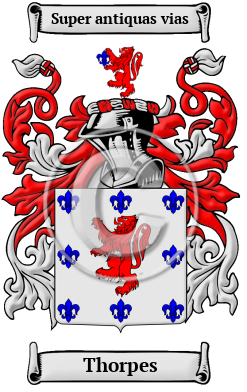
The motto was originally a war cry or slogan. Mottoes first began to be shown with arms in the 14th and 15th centuries, but were not in general use until the 17th century. Thus the oldest coats of arms generally do not include a motto. Mottoes seldom form part of the grant of arms: Under most heraldic authorities, a motto is an optional component of the coat of arms, and can be added to or changed at will; many families have chosen not to display a motto.
Motto: Super antiquas vias
Motto Translation: Upon the ancient tracks.
- Mills, A.D., Dictionary of English Place-Names. Oxford: Oxford University Press, 1991. Print. (ISBN 0-19-869156-4)
- Williams, Dr Ann. And G.H. Martin, Eds., Domesday Book A Complete Translation. London: Penguin, 1992. Print. (ISBN 0-141-00523-8)
- Lower, Mark Anthony, Patronymica Britannica, A Dictionary of Family Names of the United Kingdom. London: John Russel Smith, 1860. Print.
- Bardsley, C.W, A Dictionary of English and Welsh Surnames: With Special American Instances. Wiltshire: Heraldry Today, 1901. Print. (ISBN 0-900455-44-6)
- Reaney, P.H and R.M. Wilson, A Dictionary of English Surnames. London: Routledge, 1991. Print. (ISBN 0-415-05737-X)
- Lewis, Samuel, A Topographical Dictionary of England. Institute of Historical Research, 1848, Print.
- Smith, George (ed), Dictionary of National Biography. London: Smith, Elder & Co., 1885-1900. Print
 |