
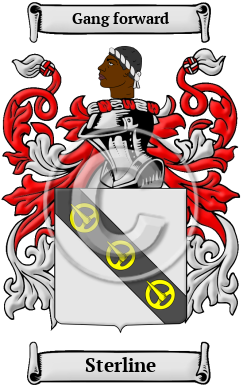
Show ContentsSterline History, Family Crest & Coats of Arms

Etymology of Sterline

What does the name Sterline mean?

The Pictish clans of ancient Scotland were the ancestors of the first people to use the name Sterline. It comes from in the town of Stirling in the county of the same name. Stirling was a royal residence from 1226.

Early Origins of the Sterline family

The surname Sterline was first found in Stirlingshire, where they held a family seat at Stirling from very early times, some say, well before the Norman Conquest. The name was anciently spelt Stryvelin, and one of the first references was of Gilbertus de Striuelin who witnessed the donation of Perdeyc by King David to the church of Glasgow in 1136 and Walter de Stryvelin witnessing a deed by Prince Henry, son of King David 1st of Scotland in the same year.

Peter de Striuelin was witness to the donation of the church of Karreden to the abbey of Hollyrood around 1158. Thomas de Stervlen was witness to a charter made by King Alexander II in 1224 and was Archdeacon of Glasgow in 1228. Sir Gilbert de Striuelyng witnessed legal proceedings in Aberdeen around 1250. Sir John Stirling of Moray swore fealty in 1291, and Andreu de Strivelyn and Henry de Strivelyn both swore an oath of allegiance to King Edward I of England during the latter's short conquest of Scotland in 1296. The Stirlings of Keir, where the Clan seat resides, claim to have an unbroken line of chiefs that stretches from 1160 to 1677. Sir Alexander de Strivelyn, the fifth Laird of Cadder died in 1304. 1

Early History of the Sterline family

This web page shows only a small excerpt of our Sterline research. Another 135 words (10 lines of text) covering the years 1524, 1621, 1640, 1666, 1669, 1678, 1692, 1770, 1790, 1878 and 1890 are included under the topic Early Sterline History in all our PDF Extended History products and printed products wherever possible.

Sterline Spelling Variations

Translation has done much to alter the appearance of many Scottish names. It was a haphazard process that lacked a basic system of rules. Spelling variations were a common result of this process. Sterline has appeared Stirling, Sterling, Sturling, Strivelynd and others.

Early Notables of the Sterline family

Another 36 words (3 lines of text) are included under the topic Early Sterline Notables in all our PDF Extended History products and printed products wherever possible.

Migration of the Sterline family to Ireland

Some of the Sterline family moved to Ireland, but this topic is not covered in this excerpt.
Another 89 words (6 lines of text) about their life in Ireland is included in all our PDF Extended History products and printed products wherever possible.

Migration of the Sterline family

Many Scots left their country to travel to the North American colonies in search of the freedom they could not find at home. Of those who survived the difficult voyage, many found the freedom they so desired. There they could choose their own beliefs and allegiances. Some became United Empire Loyalists and others fought in the American War of Independence. The Clan societies and highland games that have sprung up in the last century have allowed many of these disparate Scots to recover their collective national identity. A search of immigration and passenger ship lists revealed many early settlers bearing the Sterline name: David and John Sterling who settled in Boston Massachusetts in 1651; Thomas Sterling settled in Virginia in 1655; followed by William in 1656; Will Sterling settled in Georgia in 1734.


The Sterline Motto +

The motto was originally a war cry or slogan. Mottoes first began to be shown with arms in the 14th and 15th centuries, but were not in general use until the 17th century. Thus the oldest coats of arms generally do not include a motto. Mottoes seldom form part of the grant of arms: Under most heraldic authorities, a motto is an optional component of the coat of arms, and can be added to or changed at will; many families have chosen not to display a motto.

Motto: Gang forward
Motto Translation: Go forward.


  1. Black, George F., The Surnames of Scotland Their Origin, Meaning and History. New York: New York Public Library, 1946. Print. (ISBN 0-87104-172-3)


Houseofnames.com on Facebook