| ![Show Contents]() Squirrel History, Family Crest & Coats of Arms Squirrel History, Family Crest & Coats of Arms
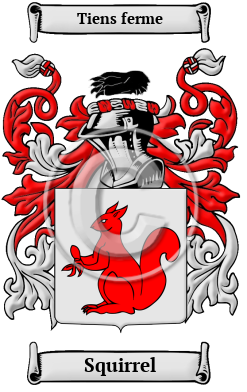
Etymology of SquirrelWhat does the name Squirrel mean? Squirrel is a name that first reached England following the Norman Conquest in 1066. It is a name for a squire. Looking back even further, we found the name was originally derived from the Old French word escuyer, which indicated someone of the social rank immediately below a knight. 1 2 As by way of confirmation, Chaucer in his Canterbury Tales noted " With hym ther was his sone, a yong Squier." Another source claim the name was derived from the Old French word "esquirel" or "esquireul," which means "squirrel" in English and presumably eludes to the squirrel on the family Coat of Arms. 3 Early Origins of the Squirrel familyThe surname Squirrel was first found in Devon where the source Old English Bynames lists Alword se Scuir as living there and holding lands (1100-1130.) Later in Suffolk at Bury St Edmonds, William Scuer was recorded c. 1180 and in Gloucestershire, Richard Lesquier was listed in the Pipe Rolls of 1197. In Rutland, records there show Simon Esquier in the Curia Regis Rolls for 1206. Roger le Esquier was listed in the Feet of Fines for Essex in 1228 and Roger Squier was listed in Devon in 1293. 3 In Cornwall, "the church of St. Keverne is ornamented with a lofty steeple, which, standing on rising ground, is a conspicuous object at a great distance. Within the church there are memorials of the several families of Bogan, Sandys, and Squier." 4 "Squire is a numerous name in Barnstaple [Devon] and its neighbourhood. The mayors of that town in 1353 and 1471 bore this name." 5 The Hundredorum Rolls of 1273 included listings of John le Squier, Cambridgeshire; and William Squier, Huntingdonshire. Later the Yorkshire Poll Tax Rolls of Yorkshire listed Thomas Squier; and Agnes Squier as holding lands there at that time. 6 In the New World, the family rose to prominence particularly in Newfoundland, where Sir Richard Squires (1880-1940) was Newfoundland's 6th Prime Minister (1919-1923.) Today, many of the family reside there with both spellings, Squire and Squires. Early History of the Squirrel familyThis web page shows only a small excerpt of our Squirrel research. Another 94 words (7 lines of text) covering the years 1296, 1387, 1595, 1598, 1677 and 1700 are included under the topic Early Squirrel History in all our PDF Extended History products and printed products wherever possible. Squirrel Spelling VariationsAnglo-Norman names tend to be marked by an enormous number of spelling variations. This is largely due to the fact that Old and Middle English lacked any spelling rules when Norman French was introduced in the 11th century. The languages of the English courts at that time were French and Latin. These various languages mixed quite freely in the evolving social milieu. The final element of this mix is that medieval scribes spelled words according to their sounds rather than any definite rules, so a name was often spelled in as many different ways as the number of documents it appeared in. The name was spelled Squire, Squair, Skair, Skuyer, Squires and others. Early Notables of the Squirrel familyEdward Squire (died 1598), alleged conspirator, "originally followed the calling of a scrivener at Greenwich, where he married and had children. He then obtained a post in Queen Elizabeth's stables, but, being 'a man of wit above his vocation,' gave up his position to become a sailor. In August 1595 he started with Drake on his last voyage to the West Indies, being on board the Francis, a small barque. Late in October the Francis separated from the rest of the fleet off Guadeloupe, and was captured by five Spanish ships. Squire...
Another 91 words (6 lines of text) are included under the topic Early Squirrel Notables in all our PDF Extended History products and printed products wherever possible. Migration of the Squirrel family to IrelandSome of the Squirrel family moved to Ireland, but this topic is not covered in this excerpt. More information about their life in Ireland is included in all our PDF Extended History products and printed products wherever possible.
| Squirrel migration to New Zealand | + |
Emigration to New Zealand followed in the footsteps of the European explorers, such as Captain Cook (1769-70): first came sealers, whalers, missionaries, and traders. By 1838, the British New Zealand Company had begun buying land from the Maori tribes, and selling it to settlers, and, after the Treaty of Waitangi in 1840, many British families set out on the arduous six month journey from Britain to Aotearoa to start a new life. Early immigrants include: Squirrel Settlers in New Zealand in the 19th Century- George Squirrel, who arrived in Auckland, New Zealand aboard the ship "Empress" in 1865
The motto was originally a war cry or slogan. Mottoes first began to be shown with arms in the 14th and 15th centuries, but were not in general use until the 17th century. Thus the oldest coats of arms generally do not include a motto. Mottoes seldom form part of the grant of arms: Under most heraldic authorities, a motto is an optional component of the coat of arms, and can be added to or changed at will; many families have chosen not to display a motto.
Motto: Tiens ferme
Motto Translation: Hold firm.
- Smith, Eldson Coles, New Dictionary of American Family Names New York: Harper & Row, 1956. Print
- Lower, Mark Anthony, Patronymica Britannica, A Dictionary of Family Names of the United Kingdom. London: John Russel Smith, 1860. Print.
- Reaney, P.H and R.M. Wilson, A Dictionary of English Surnames. London: Routledge, 1991. Print. (ISBN 0-415-05737-X)
- Hutchins, Fortescue, The History of Cornwall, from the Earliest Records and Traditions to the Present Time. London: William Penaluna, 1824. Print
- Guppy, Henry Brougham, Homes of Family Names in Great Britain. 1890. Print.
- Bardsley, C.W, A Dictionary of English and Welsh Surnames: With Special American Instances. Wiltshire: Heraldry Today, 1901. Print. (ISBN 0-900455-44-6)
 |