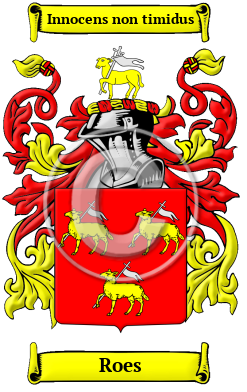
| ![Show Contents]() Roes History, Family Crest & Coats of Arms Roes History, Family Crest & Coats of Arms
Etymology of RoesWhat does the name Roes mean? The name Roes comes from the ancient Norman culture that was established in Britain after the Conquest of 1066. It was a name for a person with red hair. Looking back even further, we found the name was originally derived from the Old French nickname le rous, meaning redhead. 1 Further to the north in Scotland, the name has a different meaning, specifically "row, signifies a low, small, narrow peninsula." 2 Early Origins of the Roes familyThe surname Roes was first found in Norfolk where Turchil le Roux was granted lands by King William after his attendance upon him at Hastings. His son Ralph the Red (Roux) went with King Henry to the Crusades and held the Castle of Pont-echanfre near Bernai in Vexin Normandy. He died in the wreck of the "Blanche Neuf" with the King's two sons and their estates became divided. 3 Peter Rowe (died c.1401) was an Irish jurist who held the office of Lord Chief Justice of Ireland intermittently between 1388 and 1397. Whilehe was born in Ireland, he is thought to have been born to a family which was of English origin, but which had long been settled in Ireland. In Somerset, England "Leighland, in the parish of Old Cleeve, was the property of the Poyntz family. From them it descended to the Rowes, in the reign of William III. John Rowe, as I learn from the parish register of Arlington, married Ursula Chi chester, on 25th November, 1697, yet left no issue; but to him William Widdicombe, Esq., devised his estate of Bickham, adjoining. Robert Rowe, the nephew of the said John, married Prudence Chichester, 15th August, 1706, and had several children; one of them, Elizabeth, became the wife of John Needham, of Hilston, county Monmouth." 4 Early History of the Roes familyThis web page shows only a small excerpt of our Roes research. Another 119 words (8 lines of text) covering the years 1368, 1388, 1426, 1441, 1477, 1525, 1559, 1569, 1580, 1581, 1592, 1595, 1607, 1626, 1640, 1641, 1644, 1646, 1654, 1657, 1661, 1672, 1674, 1677, 1705, 1715, 1717, 1718, 1719, 1737, 1747 and 1890 are included under the topic Early Roes History in all our PDF Extended History products and printed products wherever possible. Roes Spelling VariationsAnglo-Norman names are characterized by a multitude of spelling variations. When the Normans became the ruling people of England in the 11th century, they introduced a new language into a society where the main languages of Old and later Middle English had no definite spelling rules. These languages were more often spoken than written, so they blended freely with one another. Contributing to this mixing of tongues was the fact that medieval scribes spelled words according to sound, ensuring that a person's name would appear differently in nearly every document in which it was recorded. The name has been spelled Rowe, Roe, Row and others. Early Notables of the Roes familyJohn Row or Rauf (fl. 1388) of Totnes, Devon, an English politician, Member of the Parliament of England for Totnes in February 1388.
Sir Thomas Roe (c. 1581-1644), was an English diplomat, Chancellor of the Order of the Garter; Sir Thomas Rowe, Lord Mayor of London in 1559; Owen Rowe, (c. 1592-1661), was an English haberdasher in London, one of the regicides of King Charles I; Sir William Rowe, was Lord Mayor of London in 1592; Sir Henry Rowe, was Lord Mayor of London in 1607; Nicholas Rowe (1674-1718), was an English poet and miscellaneous writer, appointed Poet Laureate in 1715; John...
Another 159 words (11 lines of text) are included under the topic Early Roes Notables in all our PDF Extended History products and printed products wherever possible. Migration of the Roes family to IrelandSome of the Roes family moved to Ireland, but this topic is not covered in this excerpt.
Another 68 words (5 lines of text) about their life in Ireland is included in all our PDF Extended History products and printed products wherever possible.
| Roes migration to the United States | + |
For many English families, the political and religious disarray that plagued their homeland made the frontiers of the New World an attractive prospect. Thousands migrated, aboard cramped disease-ridden ships. They arrived sick, poor, and hungry, but were welcomed in many cases with far greater opportunity than at home in England. Many of these hardy settlers went on to make important contributions to the emerging nations in which they landed. Among early immigrants bearing the name Roes or a variant listed above were:
Roes Settlers in United States in the 17th Century- Tho Roes, who arrived in Virginia in 1698 5
Roes Settlers in United States in the 19th Century- Cath Roes, who landed in North America in 1832-1849 5
The motto was originally a war cry or slogan. Mottoes first began to be shown with arms in the 14th and 15th centuries, but were not in general use until the 17th century. Thus the oldest coats of arms generally do not include a motto. Mottoes seldom form part of the grant of arms: Under most heraldic authorities, a motto is an optional component of the coat of arms, and can be added to or changed at will; many families have chosen not to display a motto.
Motto: Innocens non timidus
Motto Translation: Innocent but not fearful.
- Barber, Henry, British Family Names London: Elliot Stock, 62 Paternoster Row, 1894. Print.
- Lower, Mark Anthony, Patronymica Britannica, A Dictionary of Family Names of the United Kingdom. London: John Russel Smith, 1860. Print.
- The Norman People and Their Existing Descendants in the British Dominions and the United States Of America. Baltimore: Genealogical Publishing, 1975. Print. (ISBN 0-8063-0636-X)
- Oliver, George, Collections Illustrating the History of the Catholic Religion in the Counties of Cornwall, Devon, Dorset, Somerset, Wilts, and Gloucester London: Charles Dolman, 61, New Bond Street, 1857. Print
- Filby, P. William, Meyer, Mary K., Passenger and immigration lists index : a guide to published arrival records of about 500,000 passengers who came to the United States and Canada in the seventeenth, eighteenth, and nineteenth centuries. 1982-1985 Cumulated Supplements in Four Volumes Detroit, Mich. : Gale Research Co., 1985, Print (ISBN 0-8103-1795-8)
 |