| ![Show Contents]() Richitt History, Family Crest & Coats of Arms Richitt History, Family Crest & Coats of Arms
Etymology of RichittWhat does the name Richitt mean? The name Richitt reached England in the great wave of migration following the Norman Conquest of 1066. The Richitt family lived in Hampshire. Their name, however, is a reference to Riche, in Lorraine, France, the family's place of residence prior to the Norman Conquest of England in 1066. 1 Another equally valid derivation of the name suggests that it is patronymic, which means it was adapted from the first name of the original bearer's father. According to this version it comes from the Norman personal name Richard. Richitt is a classic example of an English polygenetic surname, which is a surname that was developed in a number of different locations and adopted by various families independently. The name was "probably an abbreviation of Richard, than an epithet implying wealth," 2 3 but may have also have originated in France as "Riche was near Nancy, in Lorraine." 1 "Rich is a characteristic west of England name, being most frequent in Somerset and Wiltshire. Those of Somerset are most numerous in the Bridgewater district, whilst those of Wiltshire are most frequent in the Malmesbury district. Le Rich was the name of a Hampshire family of the 14th century." 4 Early Origins of the Richitt familyThe surname Richitt was first found in Hampshire where the first on record include Edmund Rich, Saint Edmund (1175-1240) English churchman, who became Archbishop of Canterbury. He was born at Abingdon and his father's name was Edward or Reinald Rich. His father withdrew to the monastery of Evesham, or more probably to Ensham, near Oxford. 5 Godwinus Dius, Le Riche was listed in the Pipe Rolls for Lincolnshire in 1177 and 1185. The same rolls included and entry for Mosse le Riche in Gloucestershire in 1195 and in Sussex we found William Riche in the Subsidy Rolls for 1296. Thomas filius Ricun, was listed in the Hundredorum Rolls in Huntingdonshire in 1274. 6 Robert Rich (fl. 1240), was an English biographer, second son of Reginald and Mabel Rich of Abingdon, and younger brother of St. Edmund Rich, Archbishop of Canterbury. Another source notes that the Hundredorum Rolls of 1273 also included three listings of the family with early spellings, all found in Oxfordshire: Henry le Ryche; Hugo le Ryche; and Bruman le Riche. 7 Over in Somerset, Kirby's Quest listed William le Riche and John le Riche, Somerset, 1 Edward III (during the first year of King Edward III's reign.) 8 Early History of the Richitt familyThis web page shows only a small excerpt of our Richitt research. Another 111 words (8 lines of text) covering the years 1496, 1540, 1547, 1567, 1587, 1594, 1601, 1611, 1619, 1620, 1625, 1640, 1648, 1657, 1658, 1659, 1660, 1667, 1673, 1675, 1678, 1689, 1692, 1699 and 1714 are included under the topic Early Richitt History in all our PDF Extended History products and printed products wherever possible. Richitt Spelling VariationsBefore the advent of the printing press and the first dictionaries, the English language was not standardized. Sound was what guided spelling in the Middle Ages, so one person's name was often recorded under several variations during a single lifetime. Spelling variations were common, even among the names of the most literate people. Known variations of the Richitt family name include Rich, Riche, Richin, Riching, Richins, Richings and others. Early Notables of the Richitt familyRichard Rich (c. 1496-1567), 1st Baron Rich, Lord Chancellor of England during the reign of King Edward VI; Barnabe Rich (1540-1620), English author and soldier; Sir Edwin Rich (c. 1594-1675), an English lawyer and politician who sat in the House of Commons in 1640; Robert Rich (1587-1658) 2nd Earl of Warwick, an English colonial administrator, admiral, and puritan; Robert Rich, 3rd Earl of Warwick (1611-1659); Jeremiah Rich (died c. 1660), an English stenographer who published a pioneering system of shorthand writing; Charles Rich...
Another 82 words (6 lines of text) are included under the topic Early Richitt Notables in all our PDF Extended History products and printed products wherever possible. Migration of the Richitt family to IrelandSome of the Richitt family moved to Ireland, but this topic is not covered in this excerpt. More information about their life in Ireland is included in all our PDF Extended History products and printed products wherever possible. Migration of the Richitt familyTo escape the political and religious chaos of this era, thousands of English families began to migrate to the New World in search of land and freedom from religious and political persecution. The passage was expensive and the ships were dark, crowded, and unsafe; however, those who made the voyage safely were encountered opportunities that were not available to them in their homeland. Many of the families that reached the New World at this time went on to make important contributions to the emerging nations of the United States and Canada. Research into various historical records has revealed some of first members of the Richitt family to immigrate North America: Jo Richings, who arrived in Virginia in 1658; Edward and Elizabeth Rich, who arrived in Virginia in 1663; Miles, Joseph, and Abraham Rich who also came to Virginia in 1663.
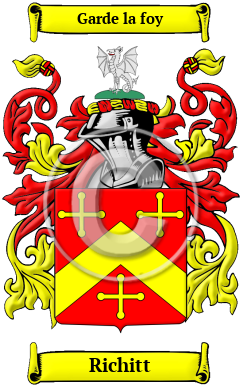
The motto was originally a war cry or slogan. Mottoes first began to be shown with arms in the 14th and 15th centuries, but were not in general use until the 17th century. Thus the oldest coats of arms generally do not include a motto. Mottoes seldom form part of the grant of arms: Under most heraldic authorities, a motto is an optional component of the coat of arms, and can be added to or changed at will; many families have chosen not to display a motto.
Motto: Garde la foy
Motto Translation: Keep the faith.
- The Norman People and Their Existing Descendants in the British Dominions and the United States Of America. Baltimore: Genealogical Publishing, 1975. Print. (ISBN 0-8063-0636-X)
- Lower, Mark Anthony, Patronymica Britannica, A Dictionary of Family Names of the United Kingdom. London: John Russel Smith, 1860. Print.
- Arthur, William , An Etymological Dictionary of Family and Christian Names. London: 1857. Print
- Guppy, Henry Brougham, Homes of Family Names in Great Britain. 1890. Print.
- Smith, George (ed), Dictionary of National Biography. London: Smith, Elder & Co., 1885-1900. Print
- Reaney, P.H and R.M. Wilson, A Dictionary of English Surnames. London: Routledge, 1991. Print. (ISBN 0-415-05737-X)
- Bardsley, C.W, A Dictionary of English and Welsh Surnames: With Special American Instances. Wiltshire: Heraldry Today, 1901. Print. (ISBN 0-900455-44-6)
- Dickinson, F.H., Kirby's Quest for Somerset of 16th of Edward the 3rd London: Harrison and Sons, Printers in Ordinary to Her Majesty, St, Martin's Lane, 1889. Print.
 |