| ![Show Contents]() Rammes History, Family Crest & Coats of Arms Rammes History, Family Crest & Coats of Arms
Etymology of RammesWhat does the name Rammes mean? The name Rammes reached English shores for the first time with the ancestors of the Rammes family as they migrated following the Norman Conquest of 1066. The Rammes family lived in Essex. Their name, however, is a reference to the Castle of Rames, at Bolbec, in the arrondissement of Havre, France, the family's place of residence prior to the Norman Conquest of England in 1066. Richard de Ariete (Ram) was listed in Normandy temp. King John. 1 Early Origins of the Rammes familyThe surname Rammes was first found in Essex where they held a family seat as Lords of the Manor of Metinges. Roger de Rames was granted sixteen acres at Metinges, as well as land at Ramesdune under Robert Grenon. In Breseta in Suffolk, Roger de Rames was chief tenant. These lands were granted to Roger for his assistance at the Battle of Hastings by William, Duke of Normandy in his victory over King Harold. Early History of the Rammes familyThis web page shows only a small excerpt of our Rammes research. Another 99 words (7 lines of text) covering the years 1564, 1599, 1605, 1615, 1634 and 1684 are included under the topic Early Rammes History in all our PDF Extended History products and printed products wherever possible. Rammes Spelling VariationsAnglo-Norman names tend to be marked by an enormous number of spelling variations. This is largely due to the fact that Old and Middle English lacked any spelling rules when Norman French was introduced in the 11th century. The languages of the English courts at that time were French and Latin. These various languages mixed quite freely in the evolving social milieu. The final element of this mix is that medieval scribes spelled words according to their sounds rather than any definite rules, so a name was often spelled in as many different ways as the number of documents it appeared in. The name was spelled Ramm, Ram, Rams, Rame, Rames, Rammes and others. Early Notables of the Rammes familyThomas Ram (1564-1634), English prelate, Bishop of Ferns and Leighlin, born at Windsor and educated at Eton and King's College, Cambridge. In 1599 he accompanied Essex to Ireland as chaplain...
Another 29 words (2 lines of text) are included under the topic Early Rammes Notables in all our PDF Extended History products and printed products wherever possible. Migration of the Rammes family to IrelandSome of the Rammes family moved to Ireland, but this topic is not covered in this excerpt.
Another 53 words (4 lines of text) about their life in Ireland is included in all our PDF Extended History products and printed products wherever possible.
| Rammes migration to the United States | + |
Because of the political and religious discontent in England, families began to migrate abroad in enormous numbers. Faced with persecution and starvation at home, the open frontiers and generally less oppressive social environment of the New World seemed tantalizing indeed to many English people. The trip was difficult, and not all made it unscathed, but many of those who did get to Canada and the United States made important contributions to the young nations in which they settled. Some of the first North American settlers with Rammes name or one of its variants:
Rammes Settlers in United States in the 19th Century- John Geo Rammes, who settled in Philadelphia in 1838
- John George Rammes, who settled in Philadelphia, Pennsylvania in 1838
- Johann Rammes, who settled in New York, NY in 1860
- John Rammes, who landed in Allegany (Allegheny) County, Pennsylvania in 1872 2
- George Adam Rammes, who arrived in Allegany (Allegheny) County, Pennsylvania in 1879 2
The motto was originally a war cry or slogan. Mottoes first began to be shown with arms in the 14th and 15th centuries, but were not in general use until the 17th century. Thus the oldest coats of arms generally do not include a motto. Mottoes seldom form part of the grant of arms: Under most heraldic authorities, a motto is an optional component of the coat of arms, and can be added to or changed at will; many families have chosen not to display a motto.
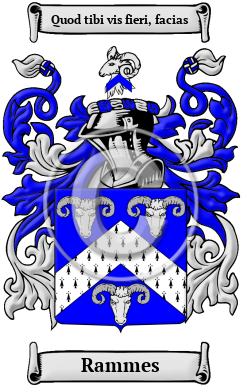
Motto: Quod tibi vis fieri, facias
Motto Translation: What you wish done, do yourself.
- The Norman People and Their Existing Descendants in the British Dominions and the United States Of America. Baltimore: Genealogical Publishing, 1975. Print. (ISBN 0-8063-0636-X)
- Filby, P. William, Meyer, Mary K., Passenger and immigration lists index : a guide to published arrival records of about 500,000 passengers who came to the United States and Canada in the seventeenth, eighteenth, and nineteenth centuries. 1982-1985 Cumulated Supplements in Four Volumes Detroit, Mich. : Gale Research Co., 1985, Print (ISBN 0-8103-1795-8)
 |